
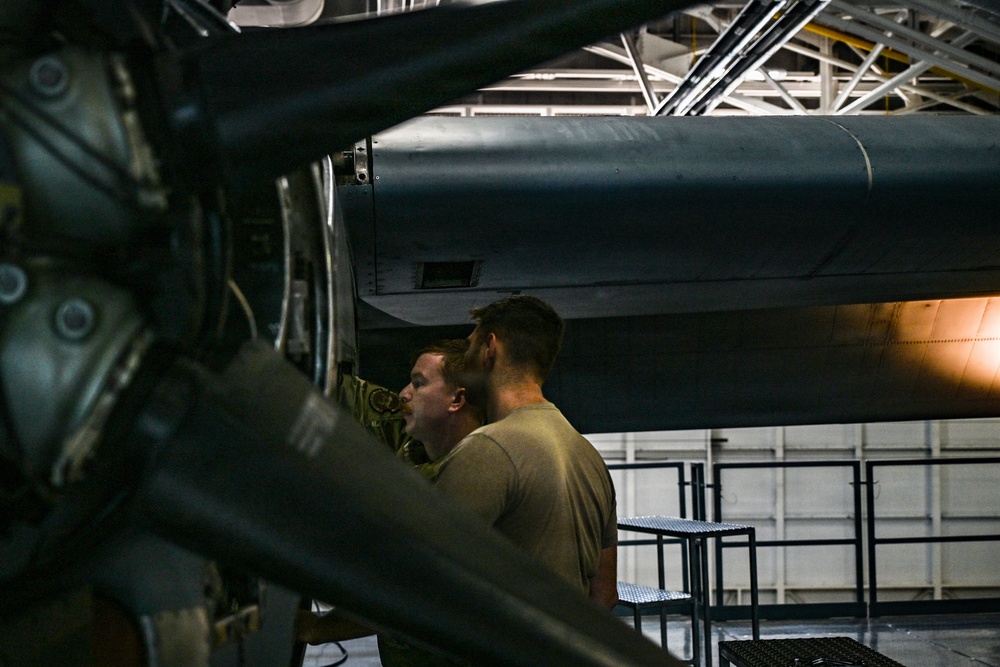
Photo By Capt. Jennifer Kaprielian | U.S. Master Sgt. Dan Doyle and Tech Sgt. Alex Morin, propulsion technicians with the...... read more read more
 Subscribe
This year marked a major milestone for the Connecticut Air National Guard’s C-130 Hercules fleet as the 103rd Airlift Wing completed both a T-56 Series 3.5 engine upgrade and an NP2000 propeller conversion. The sleek new propeller design has already drawn attention, and as 2025 wraps up, the effort stands out as a significant achievement across the wing.
The engine and propeller modifications required months of coordination and placed increased demands on both maintenance and flight operations. Compounding the challenge, the unit was tasked with a deployment that would utilize at least half of the wing’s fleet. With the deployment timeline in place, completing the modifications took on a new level of urgency — and our airmen rose to meet the challenge.
To understand the impact of the upgrades, it helps to look at what they bring to the workhorse of the Connecticut Air National Guard, the C-130H. Visually, the NP2000 propeller is immediately noticeable, featuring eight sleek black blades instead of four silver ones. Internally, the 3.5 engine upgrade delivers increased power across a wider range of operating conditions. The results have already been measurable: propeller repair time has been nearly cut in half, fuel efficiency has improved, and the aircraft now produce approximately 10 percent more thrust, reducing takeoff distances. Lower fuel consumption combined with improved performance allows the aircraft to carry more cargo, benefiting both domestic and deployed missions.
Propeller upgrades across the Air Force initially began as a safety initiative, but the NP2000 quickly proved to offer broader benefits for operators and maintainers alike.
“The validated data showed about 30 percent less on-wing maintenance time and 22 percent less time spent repairing the propellers,” said Lt. Col. Doug Ferro, commander of the 103rd Aircraft Maintenance Squadron. “It also produces more thrust, averaging between 10 and 17 percent shorter takeoff distances.”
While the modifications significantly improved capability, they also placed increased demands on 103d scheduling and flight operations. Converting aircraft to the NP2000 propeller required off-station support for installation and airworthiness testing. Aircrews flew each aircraft to a contractor site in Stennis, Mississippi, and conducted functional check flights (FCFs) at each stage of the upgrade to ensure safety and readiness.
The 103rd Operations Group relied on a small team of FCF-qualified pilots and flight engineers to clear each aircraft for return to airworthy status. With only a limited number of aircrew holding this specialized qualification, those members absorbed a substantial increase in flying demands in addition to their normal home-station requirements.
The scheduling challenges within the maintenance hangar were equally complex. The modification timeline shifted frequently, requiring constant coordination across multiple sections. Master Sgt. Lee Morrison, a production superintendent with the 103rd Maintenance Group, played a key role in managing the evolving schedule, according to coworkers. Chief Master Sgt. Dennis Goggin, maintenance operations flight superintendent for the 103rd Maintenance Group, was also instrumental in managing scheduling requirements while simultaneously serving as a unit deployment manager in the lead-up to the deployment.
When asked about the project, Goggin highlighted the support received from the National Guard Bureau after the wing submitted a plan in October 2024.
“We outlined our goal for our 2025 Mission Generation Force Element deployment — to have six aircraft fully modified with 3.5 engines and NP2000 propellers to support a four-ship deployment,” said Goggin. “At the time, we had zero aircraft fully modified.”
Over the next eight months, the wing worked closely with Capt. David Robitaille, a C-130 weapons system manager, and Master Sgt. Steven Sevigny, the propulsion career field functional manager, to make that goal a reality.
“We are extremely grateful for the support we received from A4,” Goggin said. “Capt. Robitaille and Master Sgt. Sevigny supported our goal early and prioritized our fleet at every opportunity. They moved mountains at times to ensure the success of our deployment.”
Numerous Flying Yankees contributed to the success of the conversion effort. While the NP2000 propeller modifications were completed off-site, the 3.5 engine upgrades were performed at home station and relied heavily on 103rd resources and oversight. The 103rd Quality Assurance Office and propulsion maintainers played a critical role, certifying 570 “Red Line” work requirements across 24 engine installations to prepare six aircraft for functional check flights.
“As the primary quality assurance representative, I served as the intermediary between the government contract office and the contractor,” said Master Sgt. Paul Martin, quality assurance chief inspector for the 103rd Maintenance Group. “We ensured all work was conducted and certified to Air Force standards.”
Martin noted that each aircraft was returned within approximately a 10-day window. He credited Tech. Sgt. Kyle Murkowicz and Tech. Sgt. Keaton Cooper for leading hundreds of Red Line inspections, and praised Master Sgt. Jeff McClenning and Master Sgt. Joshua Marvill for resolving foreign object debris issues, completing panel checks, and ensuring tooling accountability. Two aircraft were converted ahead of schedule.
“I think we did an outstanding job utilizing the full capabilities of our maintenance group,” Martin said. “At the time, it felt like we were simply doing our jobs, but looking back at how much we contributed to upgrading our C-130s to maximum performance capability gives all of us a strong sense of pride.”
Goggin emphasized the broader impact of the effort on the wing. “We got four fully modified C-130s downrange,” he said. “Our Airmen executed the mission at the highest level and represented the Flying Yankees extremely well.”
As we enter the new year, keep an eye on the New England skies for one or more of the 103rd Airlift Wing’s newly modernized C-130 aircraft.
| Date Taken: | 12.23.2025 |
| Date Posted: | 12.23.2025 15:42 |
| Story ID: | 555245 |
| Location: | EAST GRANBY, CONNECTICUT, US |
| Web Views: | 684 |
| Downloads: | 0 |

This work, 103rd Airlift Wing Completes Major C-130 Fleet Modernization, by Capt. Jennifer Kaprielian, identified by DVIDS, must comply with the restrictions shown on https://www.dvidshub.net/about/copyright.


No keywords found.




