
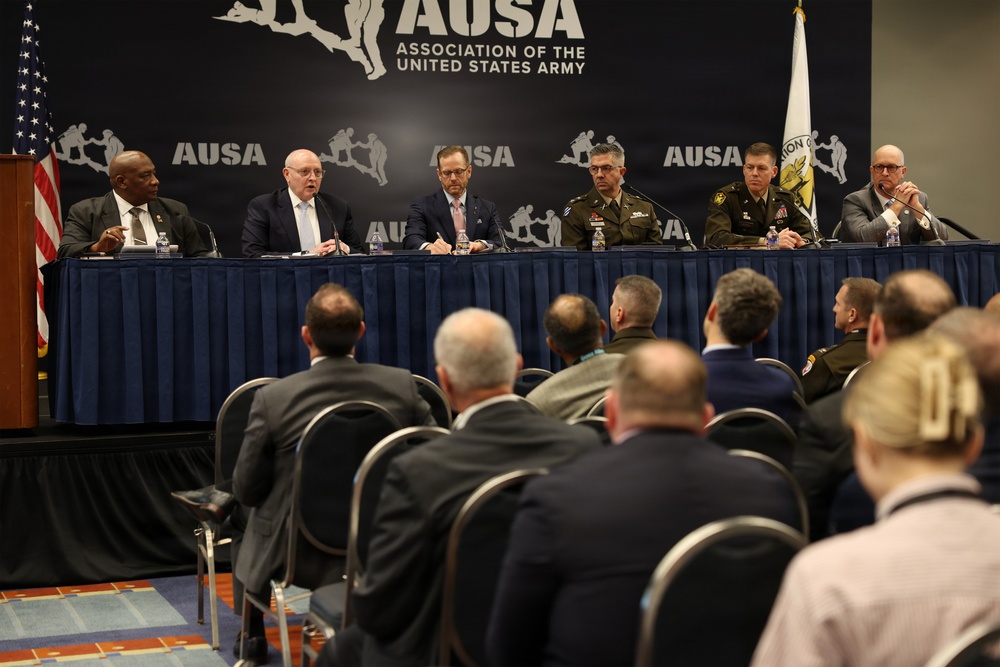
Photo By Ribka Gemilangsari | DASADEC Mr. Patrick Mason joined the panel on Agile Partnerships: Co-Production and...... read more read more
Washington D.C. – The Association of the U.S. Army’s 2025 Annual Meeting and Exposition was a resounding success, with record numbers from international allies and partners. Throughout the conference, the message was clear — the U.S. Army is committed to innovating and winning at the pace of change.
This year’s theme, “Agile, Adaptive, Lethal — Winning at the Pace of Change,” resonated with attendees as the convention showcased the latest technologies, modernization efforts, and direction for advanced development. Innovation is at the core of our agile partnerships with industry and our allies.
Mr. Patrick Mason, Deputy Assistant Secretary of the Army for Defense Exports & Cooperation, joined his peers from across industry, government, and acquisition to discuss how we are streamlining processes to transform capability deliver. He highlighted the importance and impact of agile partnerships to our collective strength, and emphasized how co-production, co-development, and co-assembly are at the center of Army transformation.
“When they [the U.S. Army and international partners] come to these types of events, they get to see the tremendous technology capability of manufacturing that not only is in the United States, but globally as well,” Mason said. “This really facilitates great discussion between nations on how we work together on our collective defense industrial bases to meet the security needs that we see globally.”
The Security Cooperation panel underscored the importance of agile partnerships as critical components of collective security and advancing innovative technology. Discussion amongst the panelists highlighted how vital these partnerships are for the health of the U.S. defense industrial base.
“Demand is at an all-time high for partnership with the United States – demand for our goods and services, defense articles or training,” said Mike Miller, Director, Defense Security Cooperation Agency (DSCA). “Execution against that demand has also been at unprecedented levels.”
AUSA showcased a wide range of innovation across the convention center’s exhibit halls. This year’s event was particularly notable for the prominence of unmanned and counter- unmanned systems, with demonstrations spanning ground, air, and cross-domain applications.
“When you walk around AUSA and you look at all of the displays and you talk to all of the people that are here, the first thing that stands out is the absolute American innovation that is occurring right now,” Dak Hardwick, Vice President of International Affairs, Aerospace Industries Association, acknowledged. “The world is operating at an incredible speed, and what we see with the innovative products that you see on the floor here is the opportunity for the American aerospace and defense industry to be part of the innovation sector for the future.”
Brigadier General Allen Pepper, Commanding General of the U.S. Army Security Assistance Command (USASAC), highlighted the crucial “need to deliver the capability at the time of need, and that's something we are absolutely hearing clearly and getting after together.”
The panelists connected on a common theme — shared responsibility and accelerated delivery of critical capabilities, quickly and effectively — improving the Foreign Military Sales (FMS) process and reforming acquisition to allow manufacturers to deliver capabilities faster. Mr. Mason noted that he had been working to look at how the Army handles acquisition and how "acquisition and FMS and security assistance are absolutely linked and tied together." They acknowledged just how quickly the threat and technology are evolving, and how vital partnering with allies is to develop, field, and sustain modern equipment to maintain a competitive edge.
“While we have some wonderful ideas here in the United States and we're strengthening our defense industrial base, let's face it, our allies and partners have some good ideas as well,” said LTG (Ret.) Charles Hooper, who was the former director of DSCA. “By partnering with them to facilitate co-production and co-development, we get to take advantage of them. We get to increase our value, value proposition, and we get to take advantage of the synergy that comes from a collective effort to address a challenging issue.”
The Deputy Assistant Secretary of the Army for Defense Exports & Cooperation (DASA DEC) leads the U.S. Army Security Assistance Enterprise (ASAE), serving as the Army’s partner- focused leader for strategic security cooperation. DASA DEC’s mission is to manage the Army's Security Assistance and Armaments Cooperation programs, which are designed to engage allies and partners across the full spectrum of Army acquisition to achieve readiness, modernization and interoperability goals.
| Date Taken: | 12.22.2025 |
| Date Posted: | 12.23.2025 11:28 |
| Story ID: | 555219 |
| Location: | DISTRICT OF COLUMBIA, US |
| Web Views: | 176 |
| Downloads: | 0 |

This work, AUSA 2025: Developing an Agile, Adaptive, and Lethal Future Force, by Steven Lusher, identified by DVIDS, must comply with the restrictions shown on https://www.dvidshub.net/about/copyright.


No keywords found.





