
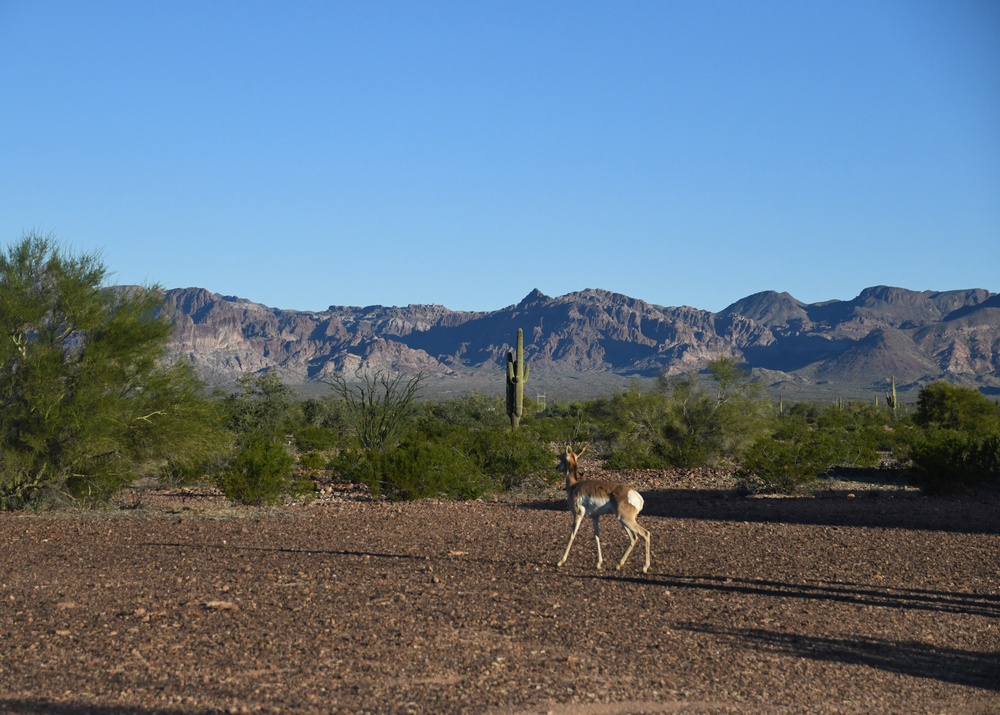
Photo By Ana Henderson | At one time the Sonoran pronghorn population was on the brink of extinction with about...... read more read more
 Subscribe
At one time the Sonoran pronghorn population was on the brink of extinction. The dry summer of 2002 wiped out 75% of the pronghorn population leaving only about 25. With no measurable rainfall for 13 months the –populations could not survive.
Since then, the efforts to revive the pronghorn population on the Kofa National Wildlife Refuge (NWR) and Cabeza Prieta NWR are bringing them back to their historic range.
Today, about 247 pronghorns live on the Cabeza Prieta NWR and nearby lands. At least 232 pronghorn live on the Kofa NWR and Yuma Proving Ground (YPG). This keeps the population at the recovery goal of 150 pronghorns for the Kofa NWR/YPG area.
“We are supposed to maintain that number five to seven years and show a trend of stable and increasing populations,” explains Daniel Steward, YPG wildlife biologist.
Many federal agencies in southwest Arizona have played a role in bringing back the species yet Steward credits The Arizona Game and Fish Department and U.S. Fish and Wildlife Service for being the technical experts and the leaders.
Several agencies manage semi-captive breeding pens on Kofa and Cabeza Prieta NWRs. These pens are approximately 300 acres in size and allow pronghorns to live in their natural environment with supplemental food water and predator exclusion to maximize fawn survival. The agencies then capture animals from the pen annually for release into the wild. The recent capture released four males into another breeding pen on KWR to promote breeding.
Members from the agencies and volunteers camped on-site to start the day early for the recent capture in mid-December. YPG’s Veterinary Clinic provided staff as did the Environmental Sciences Division and a few other hands from YPG were there to help. Marine Corps Air Station Yuma Commander Col. Jared Stone and his son also lent a hand during the capture.
Leading up to the capture, a multi-chambered boma, was constructed inside the massive breeding pens. The pronghorns were conditioned over a period of weeks to enter a boma for food and water.
The boma has three circular pins so the pronghorn can gently be herded between chambers leaving only two or three in the capture chamber at a time.
Pronghorns are known as the fastest land animal in North America so the capture crew must run in with a net to slow them down and the “muggers” grab and subdue them.
“The muggers have a special skill set because safety is paramount for both the crew and the animals,” explained Steward.
During this capture the does and fawns were released from the boma and back into the pen and the bucks were taken by stretcher to the veterinarian tents. Veterinarians administer vitamins, antibiotics and oxygen to the pronghorn, to reduce stress and check for injuries before transportation to another pen also on Kofa NWR.
At release, the bucks stuck together and ran around their new home, at least for the next few weeks. Only time will tell if the effort produces fawns.
Steward explains that the ultimate the goal of this effort is to build a strong and self-sustaining pronghorn population.
“It’s not just about putting more pronghorn out there…the trick is to promote the habitat and reduce the threats. To let pronghorn survive without our intervention,” adding, “Our role as a federal agency under the Endangered Species Act is to promote ecosystems where endangered animals can recover and thrive.”
| Date Taken: | 12.22.2025 |
| Date Posted: | 12.22.2025 14:40 |
| Story ID: | 555135 |
| Location: | YUMA PROVING GROUND, ARIZONA, US |
| Web Views: | 1,148 |
| Downloads: | 0 |

This work, Pronghorn capture on Kofa National Wildlife Refuge aims to continue species recovery, by Ana Henderson, identified by DVIDS, must comply with the restrictions shown on https://www.dvidshub.net/about/copyright.

No keywords found.




