
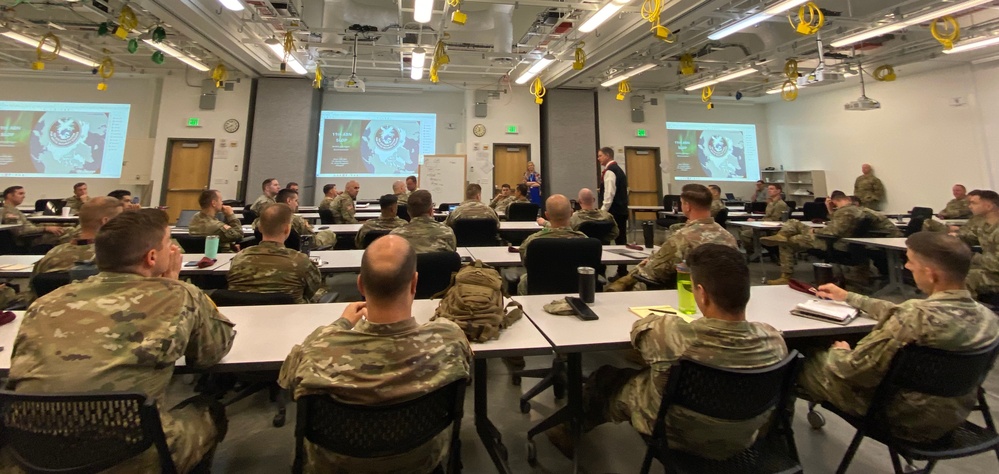
Photo By Amber Kurka | The School for Arctic Security Studies provides and Arctic primer for Soldiers from...... read more read more
The School for Arctic Security Studies is preparing to launch its most ambitious slate of educational programs yet, expanding its curriculum in 2026 to meet rising demand for Arctic-focused learning among U.S. forces and allied partners operating in the region.
With new asynchronous courses, redesigned executive programs, and increasing requests for tailored Arctic primers, the school’s footprint is growing rapidly, a trajectory SASS leaders say aligns with evolving strategic guidance and the needs of warfighters operating in and around the Arctic.
“This is just-in-time education at just the right moment,” said Matthew Bell, dean of the School for Arctic Security Studies. “The fact that we were already going down this path before the Department of War’s latest guidance was published demonstrates the unique value we bring to the defense enterprise.”
New asynchronous courses lead 2026 expansion
SASS introduced two new asynchronous courses this month: the Arctic Foundations Course and the Arctic Warfare History Course. Both offer flexible, self-paced options for building Arctic literacy, a capability Bell and his team see as essential as the school’s audience continues to expand.
The Arctic Foundations Course provides an introductory exploration of Arctic governance, strategic dynamics, infrastructure, and the region’s complex operating environment. The Arctic Warfare History Course blends World War II case studies with modern strategic challenges, incorporating a mix of asynchronous content and live sessions.
According to Dr. Brian K. Houghton, deputy dean of SASS, these additions directly strengthen the school’s larger curriculum.
“The addition of the Arctic Foundations Course allows people to quickly and on their own time become Arctic-security literate,” Houghton said. “It allows us to strengthen our baseline course ARSOC (Arctic Regional Security Orientation Course) to take it just a little bit deeper.”
Bell said the asynchronous model will continue to expand as demand grows. “These productions are just the tip of the iceberg,” he said. “Any one of these could be an asynchronous course, a standard virtual course, or even an in-person course down the road. What matters is meeting the need with the right tool at the right moment.”
Flagship courses continue with modernized content
Alongside its new offerings, SASS is modernizing several of its flagship programs to keep pace with changes across the strategic environment. ARSOC remains the entry point for warfighters and security practitioners seeking foundational Arctic knowledge, while the Arctic Multidomain Legal Course is shifting to a hybrid format that blends live instruction with asynchronous content.
The Arctic Operational Risk Course is incorporating lessons emerging from recent joint exercises and operational planning, and the Understanding the Arctic Operating Environment Course continues to prepare practitioners for the realities of competition in one of the world’s harshest regions. The multinational NATO in the North course will also return, equipping mid- and senior-level leaders with a deeper understanding of deterrence and defense along the Alliance’s northern flank.
“We’re looking to update our baseline courses to ensure they are the most relevant, the most connected for Arctic practitioners,” Bell said.
Four new courses planned for late 2026
SASS is also preparing to launch four additional courses in late 2026 — two newly developed offerings and two redesigned programs. One of the most significant changes is the transformation of the center’s former crisis logistics course.
“We are making changes to the Arctic Crisis Logistics Course, and we’re changing it to Arctic Contested Logistics Course,” Houghton said. “It’s more than just a name change. It’s a fundamental reworking of the course.”
The Arctic Contested Logistics Course will focus on supply chain vulnerabilities, operational sustainment, and adversary pressures across both the Arctic and Arctic-Pacific theaters, areas Bell said are increasingly central to homeland defense and strategic competition.
He also confirmed the development of a second new course, the Arctic Strategic Competition and Dynamics Course, which will explore the Arctic-Pacific region and the behavior of strategic competitors.
To meet broader demand from DoW components, interagency organizations, and allied militaries, the school is developing additional asynchronous offerings, including courses on Arctic energy and Arctic infrastructure.
On-demand primers and exercise support continue to grow
Beyond scheduled courses, SASS is responding to a rising number of requests from operational units for short, targeted primers, a trend Bell and Houghton expect to intensify in 2026.
“We want to make sure we provide to the warfighters the immediate knowledge that would benefit them,” Houghton said. “These shorter primer opportunities enhance Arctic security, often in just a couple of hours.”
Requests have come from units such as the 11th Airborne Division, the Cold Weather Training Center, and multiple professional military education institutions. Bell said these engagements, often arranged with limited lead time, are becoming a routine part of the school’s mission.
“We get these requests all the time,” he said. “Any one of these can be anywhere from an hour up to a half day, depending on what they're asking for.”
SASS is also expanding its support to exercises and tabletop events sponsored by U.S. Northern Command and other Arctic-focused organizations.
“We think there’s a niche for us, especially in helping pull lessons learned and communicating them across Arctic practitioners,” Bell explained.
Alumni engagement will expand alongside course growth
SASS will continue its quarterly alumni engagements in 2026, creating opportunities for graduates to stay connected with faculty, global experts, and peers across the Arctic security community.
“These events provide a unique opportunity to get back to them and talk about what’s interesting them most,” Bell said. “They help us pull subject-matter experts through our network and keep our offerings responsive.”
Delivering the right education at the right time
Despite the challenges of the past year, Bell said the school’s rapid expansion reflects both the dedication of its faculty and the growing importance of Arctic-focused education across the DoW. “We’re delivering just-in-time education that makes Arctic practitioners better at doing their job and executing their mission,” he said.
He added that the expansion of courses and adoption of new learning formats represent a deliberate effort to strengthen Arctic readiness for the joint force and allied and partner militaries. With more offerings, greater flexibility, and deeper practitioner engagement than ever before, SASS is positioned to provide timely, relevant education during a period of strategic competition and rising operational demand.
For more information or to register for upcoming 2026 offerings visit: https://tedstevensarcticcenter.org/courses-seminars/
| Date Taken: | 12.17.2025 |
| Date Posted: | 12.18.2025 19:29 |
| Story ID: | 554896 |
| Location: | JOINT BASE ELMENDORF-RICHARDSON, ALASKA, US |
| Web Views: | 92 |
| Downloads: | 0 |

This work, School for Arctic Security Studies expands 2026 offerings with new courses, asynchronous learning, and growing demand from warfighters, by Amber Kurka, identified by DVIDS, must comply with the restrictions shown on https://www.dvidshub.net/about/copyright.

No keywords found.





