
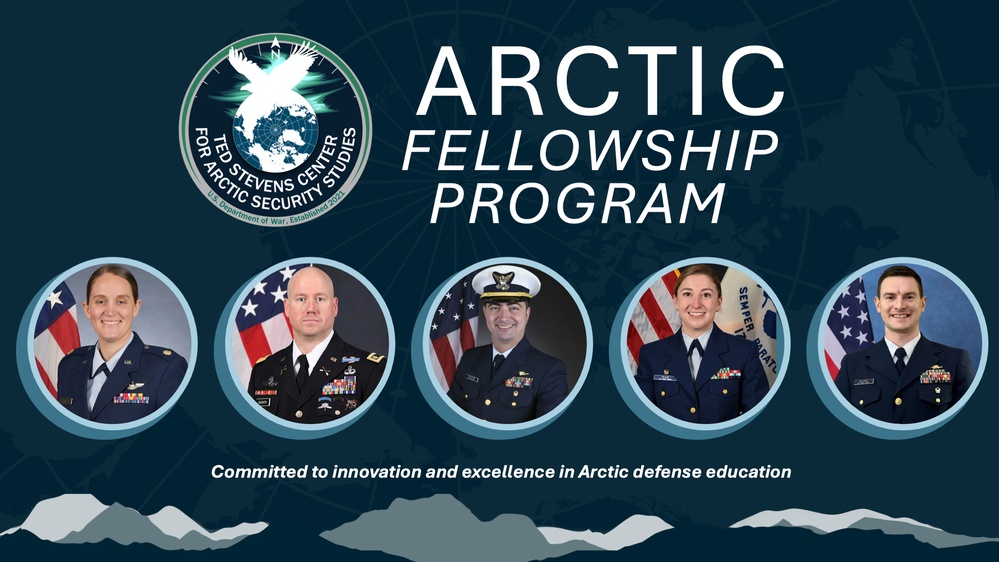
Photo By Amber Kurka | The Ted Stevens Center for Arctic Security Studies' Arctic Fellowship Program is...... read more read more
Experience in one theater does not automatically translate to success in another. In the Arctic, that reality carries strategic consequences. The Ted Stevens Center for Arctic Security Studies’ Arctic Fellowship Program was built to confront that challenge by developing warfighters who understand the North on its own terms.
Rather than focusing solely on cold-weather skills, the fellowship is designed to build Arctic literacy — the ability to think, plan and operate in a region shaped by distance, limited infrastructure, complex governance and unique security dynamics. Fellows pursue advanced education, conduct applied research and engage directly with Arctic practitioners to better understand how those factors influence military operations and homeland defense.
“This is an opportunity for service members to come and enhance their Arctic security understanding to become experts in the Arctic,” said Dr. Brian K. Houghton, deputy dean of the School for Arctic Security Studies at the TSC. “It is more than just an educational opportunity of going to graduate school.”
For Maj. Stephen Gagnon, a U.S. Army Special Forces officer and the program’s first Army Arctic Fellow, that distinction matters. His work during the fellowship focuses on how military organizations, local communities and national partners can operate together more effectively in the Arctic.
“I want to strengthen my understanding of Arctic security and better understand how local communities, military organizations and national partners can work together to improve safety and resilience in the region,” Gagnon said.
That integration across military, civil and policy domains is central to the fellowship’s design. Participants are immersed in academic study while also examining how real-world Arctic conditions affect planning and decision-making across services and agencies.
“The skills and knowledge and abilities of fighting in the Middle East or the South Pacific don’t transfer to the Arctic,” Houghton said. “That’s the clincher.”
The Arctic Fellowship is deliberately structured to meet the professional development needs of different service components. Army and Air Force officers participate in a one-year program, while the U.S. Coast Guard Arctic Fellowship spans two years to align with Coast Guard postgraduate education requirements, reflecting the service’s enduring operational role in the region.
Maj. Chelsea A. Bailey, a Department of the Air Force F-22 fighter pilot, said the fellowship provides perspective that operational assignments alone cannot.
“The fellowship provides a valuable foundation of knowledge in several different Arctic security sectors,” Bailey said.
Three U.S. Coast Guard officers are participating in this year’s program, including returning fellow Lt. Cmdr. Samuel A. Krakower and first-year fellows Lt. Taylor Peace and Lt. Cmdr. Christopher Salerno, each bringing operational experience relevant to Arctic missions.
Salerno said his fellowship research focuses on strengthening coordination across the agencies responsible for Arctic operations.
“I want to develop a framework for an interagency unified command to enhance planning and coordination of Arctic operations,” Salerno said.
Houghton said learning alongside peers from other services is one of the program’s most important outcomes, particularly as the Department of War prepares leaders for increasingly complex operating environments.
“One of the great things it does is it establishes networks within and across services,” he said. “That network will last throughout their careers.”
As an Arctic nation, the United States faces unique challenges in defending its northern approaches. Houghton said developing leaders with deep regional understanding is essential to deterrence and preparedness.
“We are creating experts in Arctic security so that we have the capacity to succeed in planning, preparing for, and dealing with future security issues or conflict in the Arctic,” he said.
That expertise, he added, directly supports homeland defense.
“It helps us have a stronger, more robust ability to protect and defend our country,” Houghton said.
With interest in the fellowship continuing to grow, the TSC plans to expand participation across additional service components, including the U.S. Navy, Marine Corps and Space Force, and to eventually include senior enlisted leaders.
For Houghton, the reason for the program’s existence remains straightforward.
“The United States is an Arctic country,” he said. “We need to have warfighters with Arctic security understanding.”
| Date Taken: | 12.17.2025 |
| Date Posted: | 12.18.2025 19:27 |
| Story ID: | 554838 |
| Location: | JOINT BASE ELMENDORF-RICHARDSON, ALASKA, US |
| Web Views: | 80 |
| Downloads: | 0 |

This work, Arctic Fellowship Program develops warfighters with the expertise the North demands, by Amber Kurka, identified by DVIDS, must comply with the restrictions shown on https://www.dvidshub.net/about/copyright.

No keywords found.





