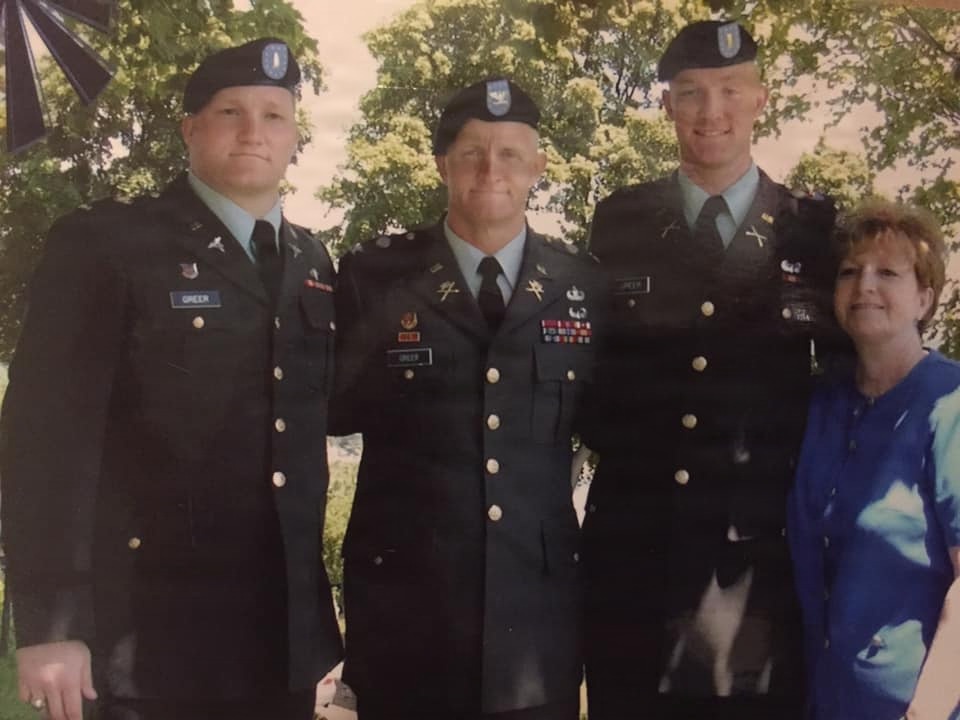
Photo By Pfc. Wilfred Salters | William Greer poses for a photo with is family—his wife, Karen Greer, and two sons, Lester and Robert Greer at the United States Military Academy Graduation in West Point, New York, 2004. see less
| View Image Page
The Error That Launched the Career of a Field Artillery Hall of Famer
FORT LEAVENWORTH, Kan. — The trajectory of a life, and a distinguished military career, sometimes hinges on the smallest of chances, or in the case of William Greer, a single mistake while signing up for the U.S. Air Force. By accidentally punching the wrong section on his punch card, Greer unknowingly switched his Reserve Officers’ Training Corps path from Air Force to Army, launching a journey that would see him command the "Red Knights" in the 101st Airborne and earn him a place in the U.S. Field Artillery Hall of Fame.
Growing up in rural Southeast Kansas, the call to service was inevitable due to the military legacy in the Greer household. His father, a World War II veteran, was with the 28th Infantry Division, the organization that formed the “Louisiana Maneuvers” preparation process. His career Air Force brother-in-law also provided the initial inspiration. When it came time to choose a military occupational specialty, his father, having served as an infantryman, gave him some practical and wise advice: “Don’t be an infantryman; be a field artilleryman—they were always somewhere back there.”
Greer took that advice to heart, and with that, he made a choice that would be the beginning of his new life, finding his passion in the blend of strategy and science. “I liked field artillery because of the science of delivery of fires and the art of integrating them with maneuver,” he explained. “Life is about choices and then making the best of them.”
From rising to the command position at his first assignment with the 3-18th FA, 212th FA Brigade in Fort Sill, Oklahoma, to serving as a Fire Support Officer and Executive Officer with the 10th Mountain Division at Fort Drum, Greer absorbed critical lessons on leadership, often from the non-commissioned officers around him. He credits his first senior enlisted advisor with instilling the importance of "standards and discipline" and the value of being a dedicated follower.
“Early on I learned the importance of standards and discipline, and self-discipline in driving organizational excellence. My first command sergeant major, when I was a lieutenant, was Homer Williams in 3-18th FA. He was the perfect example of an NCO. He was fit, knowledgeable, articulate, and always supporting his battalion commander's guidance and intent,” said Greer. “Being a good follower is, perhaps, the most important role each of us ever performs in the U.S. Army.”
Later, he learned the power of persistence from a talented staff, lessons he carried through every assignment, from Germany as a Pershing II Platoon Leader to teaching ROTC at Iowa State University.
“Staff Sgt. Craig Morgan Greer, now Warrant Officer Craig Greer in the United States Army Reserves as their band leader, taught me the power of persistence—anything I needed done as the Brigade Fire Support Observer/Controller at the Joint Readiness Training Center I assigned to Craig,” he stated. “Even amongst a wonderfully talented team he stood out. Probably the most important lesson I learned from many talented leaders, teammates, and subordinates is to provide them an opportunity to flourish, and they will almost never let you down.”
Greer’s path included significant operational roles, but a highlight of his career was commanding the 3rd Battalion, 320th Field Artillery Regiment. He led the "Red Knights" through intense training rotations and deployments, instilling a philosophy of leadership he still champions today.
When asked what advice he would give to young officers and enlisted soldiers in the field artillery branch today, Greer said, “Be an expert at your craft, at whatever level you are currently serving. Listen more than you talk; be physically, mentally, and spiritually tough. There are tough days in the Army but make sure to be the type of person that you want to be around.”
In 2001, Greer took command of the 101st Airborne Division Artillery. The 9/11 attacks immediately reshaped his command’s mission, shifting focus from training to homeland security and preparing for a new kind of war. He deployed to Iraq in 2003 for Operation Iraqi Freedom, a defining moment in his later career.
After high-level planning roles in South Korea, Greer returned to Fort Sill as Chief of Staff, helping transition the post to the modern "Fires Center of Excellence" before retiring from active duty in 2008.
Reflecting on his hall of fame induction, he is grateful and deeply honored.
“I’m thankful to the United States Field Artillery Association for honoring my service as part of their program… from my foxhole, there are many that are more deserving than me,” said Greer.
He measures his success not just by titles held but by the legacy he hopes to leave behind. "I hope when my bosses, teammates, and subordinates reflect on me, they will say, 'He was a good man,' 'He did his best,' 'I'm glad I served with him.” He expressed that his most significant contribution from his military service was watching his subordinates grow up to be leaders in their own right, but his greatest accomplishment remains his family—his wife, Karen, and two sons, Lester and Robert, who both followed him into Army service.