Eagle Nesting Season Returns to Aberdeen Proving Ground
ABERDEEN PROVING GROUND, Md. — Each winter, bald eagles begin one of the most critical phases of their life cycle on Aberdeen Proving Ground (APG): nesting and raising young. From December through early summer, the installation becomes an important sanctuary for the nation’s emblem, supported by a comprehensive conservation program led by the APG Department of Public Works (DPW), Environmental Division – Natural Resources Team.
Bald eagles are protected under the Bald and Golden Eagle Protection Act and the Migratory Bird Treaty Act, and APG’s management practices align with guidance from the U.S. Fish and Wildlife Service (USFWS) to ensure the species continues to thrive while military missions continue uninterrupted.
During nesting season, which typically begins Dec. 15 and lasts until around mid-June, APG establishes 200-meter protective buffer zones around known eagle nest trees. According to Lynda Hartzell, Natural Resources manager with DPW’s Environmental Division, these buffers are essential to reducing disturbance.
“The buffers serve to protect the nest tree and associated habitat and minimize visual and auditory impacts associated with human activity near the nest site,” Hartzell said.
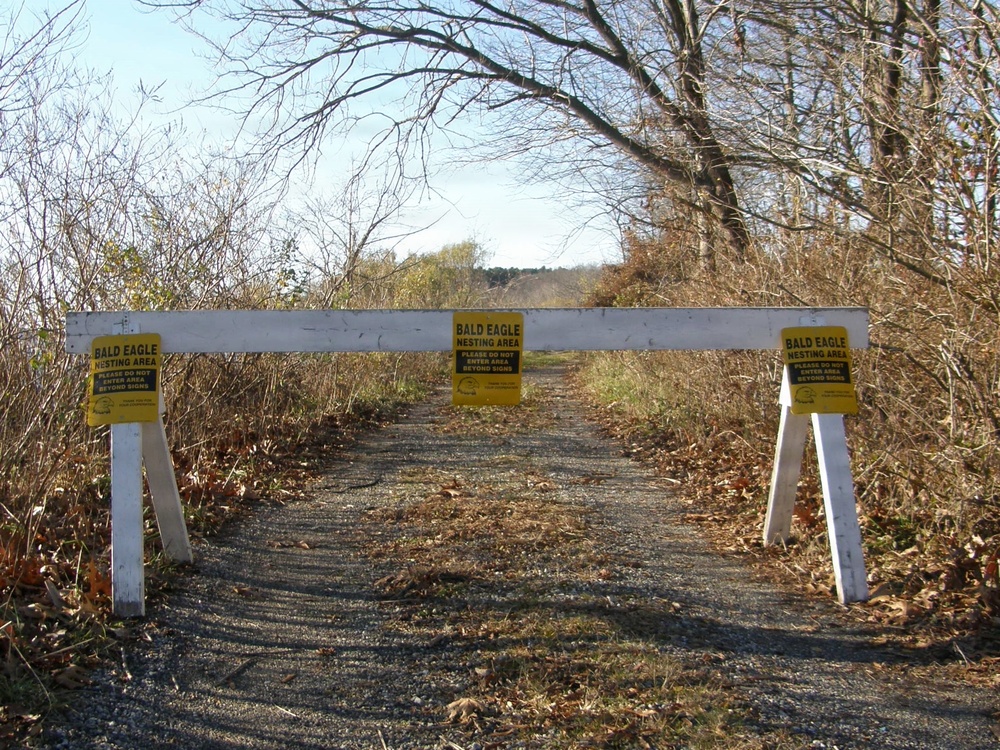
Within these areas, human activities are restricted during nesting season. Routine vehicular and pedestrian pass-through traffic on main roads is allowed, but smaller access roads may be temporarily closed with barricades or marked with signage. Many nests are in restricted range areas, where access is already limited.
In addition to seasonal protections, APG implements year-round conservation measures, including installing highly visible markers on overhead power lines to reduce eagle collisions, promptly removing road-killed animals to minimize vehicle strikes, and conserving forested shorelines that provide critical habitat.
Monitoring eagle nests is a key part of APG’s stewardship program. The Natural Resources Team conducts four to five aerial surveys each nesting season to track nest activity and productivity.
“We look for indications of nest activity including fresh sticks and grass lining in the nest, eagles perched in the nest tree, and eagles standing or sitting in the nest,” Hartzell explained. “Later in the nesting season, we count the number of nestlings in each nest.”
These surveys are conducted in partnership with the Aberdeen Test Center (ATC) Aviation Operations Division, using in-house pilots and aircraft. The collaboration provides significant cost savings and ensures flights are conducted safely and efficiently.
“ATC’s pilots provide an immense level of expertise in navigating to every nest on the installation at the appropriate speed, altitude, and route to avoid disturbing the nests,” Hartzell said.
Flights are scheduled early in the morning before testing ranges become active, with constant coordination with Range Control. As trees leaf out in late spring and nests become harder to see from the air, the team transitions to ground surveys to confirm when young eagles have successfully fledged.
APG personnel, residents, and visitors are encouraged to enjoy observing bald eagles — from a distance.
“An eagle will let you know you are too close by stopping and not resuming its normal activity, by flying off, and/or by vocalizing,” Hartzell said.
Anyone who finds an injured or deceased eagle should not touch the bird, note its location, and immediately contact APG Police Dispatch at 410-306-0550. Other questions or concerns may be directed to Hartzell at 520-691-8227 or [lynda.a.hartzell.civ@army.mil](mailto:lynda.a.hartzell.civ@army.mil).
Human activities are restricted to within 200 meters of nests during nesting season, though exceptions are made for routine traffic and ongoing mission operations. For hunters and outdoor recreation users, eagle nest buffers are clearly identified on [APG’s iSportsman website,](https://aberdeen.isportsman.net/) the installation’s online portal for recreational access.
These measures help balance wildlife protection with APG’s testing, training, and recreational missions.
Education is another cornerstone of APG’s eagle conservation efforts. Each year, the Natural Resources Team convenes meetings with mission partners to review and update the Integrated Natural Resources Management Plan (INRMP), which outlines how APG manages wildlife and habitat while sustaining military readiness. The INRMP is available for public review on [APG’s website](https://home.army.mil/apg/about/Garrison/directorate-public-works).
The team also supports community outreach, including annual Arbor Day and Earth Day events, featuring hands-on demonstrations and educational displays about APG’s natural resources programs.
Through careful planning, monitoring, and community cooperation, Aberdeen Proving Ground continues to serve as both a critical military installation and a haven for bald eagles — ensuring that future generations can witness these iconic birds nesting along the Chesapeake Bay watershed.