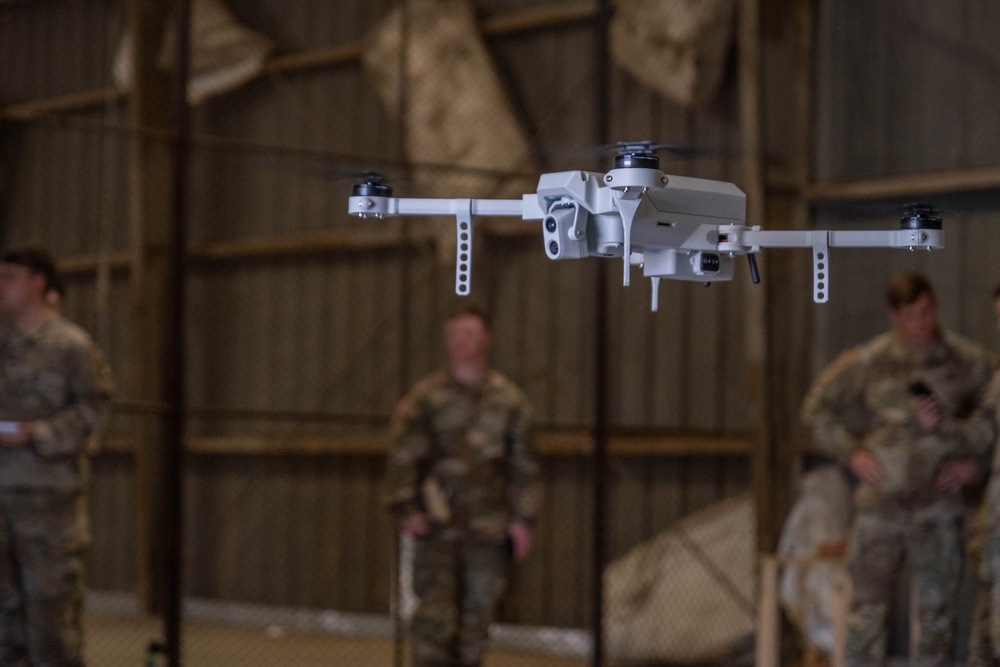
Photo By Staff Sgt. Kaden Pitt | The small-unmanned aircraft system, developed by the 101st Airborne Division (Air Assault), takes its initial flight on Oct. 10, 2024, at Fort Campbell, Ky. The drone is set to be tested during Operation Lethal Eagle in the spring of 2025. (U.S. Army photo by Staff Sgt. Kaden D. Pitt) see less
| View Image Page
AMC delivers innovation for ready combat formations in 2025
REDSTONE ARSENAL, Ala. – Army Materiel Command enhanced the Soldier experience, delivered ready combat formations and reimagined the Organic Industrial Base in 2025.
This year marked the start of several initiatives aimed at modernizing the way the Army feeds Soldiers. The Army Nonappropriated Fund Contracting Office at Installation Management Command, G-9, on behalf of AMC, awarded Compass Group USA, Inc. a concession contract Aug. 28, to create a unique campus-style dining venue at Forts Hood, Bragg, Stewart, Carson and Drum. The campus-style dining venue, or CSDV, pilot will leverage the experience of industry experts to operate dining locations on installations that provide Soldiers more options with better service, ambiance and hours. Pilot locations are expected to open by the end of June 2026.
“The Army is focused on creating a positive seismic shift in food service operations,” said Lt. Gen. Chris Mohan, Army Materiel Command commanding general. “It’s all about taking care of the warfighter by increasing healthier, more easily accessible food options that are convenient to them.”
In tandem, from Aug. 11-25, the Army conducted a limited user assessment test for the Flexible Eating and Expanded Dining, or FEED, initiative, Fort Hood. This pilot, which is expected to expand in 2026, allowed Soldiers to use their meal entitlements outside of traditional Army-operated dining facilities for the first time. During the test, almost 80% of the Soldiers who participated chose healthier options. In addition, Soldiers took advantage of the expanded flexibility and versatility, using more than 160 lunch entitlements and 30 breakfast entitlements after 3 p.m.
AMC also enhanced the Soldier experience by improving how the Army inventories its equipment. Central Issue Facilities across the continental U.S. transitioned from a warehouse to a streamlined storefront that carries smaller inventory more optimized for the units stationed at each installation.
To ensure every Soldier is equipped with the right gear, at the right time, for the right mission, AMC spearheaded the Rapid Removal and Modernization of Organizational Clothing and Individual Equipment. The command conducted proof of principle windows at several installations validating a scalable method to divest legacy equipment and directly boost readiness.
AMC also enhanced the Soldier experience while delivering ready combat formations. This year, Fort Bliss cut the ribbon on the military’s first 3D-printed barracks. The barrack, which can house up to 56 Soldiers per building, are made out of a unique concrete-based material that can be tailored to local environmental conditions, like humidity and temperature, to optimize performance.
That was not AMC’s only ribbon cutting, the Fort Hunter Liggett Multipurpose Range Complex modernization project finished after two years of extensive upgrades and new constructions to provide cutting edge facilities for Warrior Readiness. The $5.6 Million comprehensive project included range upgrades, a secure staging area for vehicles and a new bivouac site.
The Organic Industrial Base also saw upgrades as the Army continues its 15-year modernization efforts. Army leaders broke ground on a 6.8 mm ammunition production facility in support of the Next Generation Squad Weapon Program at the Lake City Army Ammunition Plant. McAlester Army Ammunition Plant formally unveiled a modernized facility designed to support the U.S. military’s air defense capabilities: the Theater Readiness Monitoring Facility. Tobyhanna Army Depot opened its Microelectronics Manufacturing Facility, where a team of talented engineers and technicians develop repair, manufacturing and testing capabilities for circuit cards required by complex military weapons systems.
Rock Island Arsenal-Joint Manufacturing and Technology continued to embrace additive manufacturing, creating temporary replacement parts for critical manufacturing equipment, significantly reducing downtime and extending the lifespan of aging machinery. The factory also installed an advanced, fully automated paint line featuring rotary atomizer technology. This new development offers unparalleled precision, reduces material waste and minimizes environmental impact, ensuring the OIB remains a strategic asset capable of meeting current, surge and future requirements.
“We are 3D printing titanium in AMC every single day,” said Mohan. “So we use advanced manufacturing techniques to improve our current manufacturing capabilities, and we see great value in that.”
RIA-JMTC also prepared to build the capacity for large-scale production of 3D-printed drones, working in close collaboration with other key OIB facilities, like Tobyhanna Army Depot. This year, the depot saw its first delivery of first-person view small uncrewed aircraft systems, marking a significant milestone in advancing its mission to enhance readiness for America’s warfighters.
“It’s not just the work done at the sites, because what a lot of people don’t know is our OIB capabilities are absolutely expeditionary,” said Mohan. “At any given time, we have between 600-1,000 teammates who are working somewhere other than where they live. They are overseas and in unit motor pools bringing their technical expertise to increase the Army readiness and train others to do the same.”
Across the globe, AMC delivered ready combat formations and trained with allies and partners. The 402nd Army Field Support Brigade reinforced its role as the Indo-Pacific’s Theater Army Field Support Brigade by projecting enterprise sustainment capabilities across multiple countries during Talisman Sabre 25 – a multinational, large-scale exercise led by the Australian Defence Force and supported by U.S. Indo-Pacific Command.
U.S. and Philippine service members participating in Exercise Salaknib 25 successfully demonstrated the critical capability of combined joint logistics over-the-shore operations in Dingalan, Aurora, Philippines. These waterborne operations enable military personnel to transport vehicles and equipment ashore in austere environments or when traditional port facilities are degraded or unusable.
This year, the AMC enterprise found new ways to do business. Army Medical Logistics Command’s Integrated Logistics Support Center catalogued hundreds of repair parts and linking them to dozens of medical equipment systems, reforming sustainment practices throughout the operational force.
AMC also prioritized leveraging advanced analytics and artificial intelligence, or A3I, to improve its operations at echelon. AMC employees have been building their own apps and tools using data in Vantage – helping them improve processes, streamline workflows, make better decisions and be more efficient. The command applied this concept with tools like Weapons System 360, which gives leaders a complete look at the Army’s supply chain, and ParaLine, an app that significantly reduces inventory processing time and improves property accountability for Soldiers.
Communication-Electronics Command Integrated Logistics Support Center and Software Engineering Center collaborated to develop an Artificial Intelligence-Assisted Maintenance tool, providing Soldiers with 24/7 access to expert-level troubleshooting, reducing diagnostic time and accelerating equipment return to service.
Aviation and Missile Command used tools like LAP360 to identify potential maintenance needs and supply availability challenges. Tank-automotive and Armaments used data analytics to predict vehicle failures and optimize maintenance schedules. Army Contracting Command leveraged data and implemented AI tools to identify trends and streamline the contracting process.
“By aggressively leveraging existing data, streamlining processes, and empowering Soldiers with intuitive tools, we ensure our ability to sustain our troops in a contested global environment at the speed of war,” Mohan said.

 Subscribe






