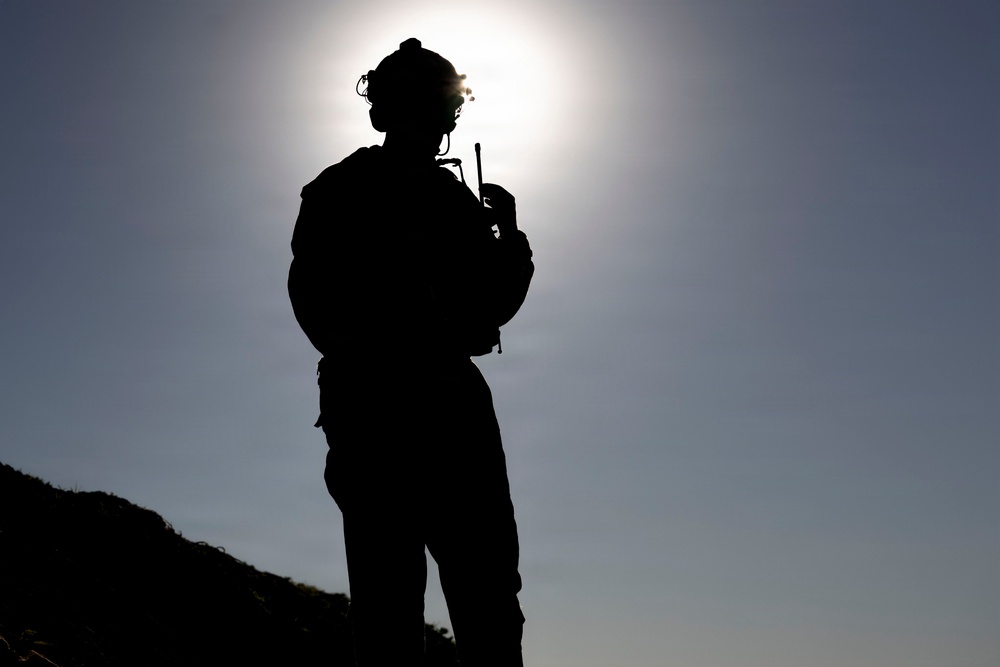
Photo By Lance Cpl. Mia Ocampo | U.S. Marine Corps Staff Sgt. Zackery O’Neal, a joint terminal attack controller evaluator with Fire Support Battalion, 11th Marine Regiment, 1st Marine Division, calls in close air support during Exercise Steel Knight 25 at Marine Corps Base Camp Pendleton, California, Dec. 9, 2025. The integration demonstrates how JTAC operators and H-1 helicopter crews synchronize fires and maneuver, enabling accurate and timely CAS for Marines on the ground. Steel Knight is an annual exercise that strengthens the Navy-Marine Corps team's ability to respond forward, integrate across domains, and sustain Marine Air-Ground Task Force readiness. O’Neal is a native of California. (U.S. Marine Corps photo by Lance Cpl. Mia Ocampo) see less
| View Image Page
MARINE CORPS BASE CAMP PENDLETON, CALIFORNIA, UNITED STATES
Precision in the Fight: JTAC Training Advances Under Staff Sgt. O'Neal at Steel Knight 25
MARINE CORPS BASE CAMP PENDLETON, Calif. — In the complex battlespace of the modern fight, where aviation, artillery, and maneuver forces converge, Staff Sgt. Zackery O'Neal stands as one of the Marine Corps’ integrators of firepower. As a Joint Fires and Effects Integrator and a billeted Joint Terminal Air Controller Evaluator with Fire Support Battalion, 11th Marine Regiment, 1st Marine Division, O'Neal plays a central role in ensuring Marine aviators receive timely, accurate, and decisive fires in support of ground operations.
A Joint Terminal Attack Controller (JTAC) is responsible for conducting terminal attack control and integrating air-to-surface and surface-to-surface fires in direct support of the commander’s scheme of maneuver. For O'Neal, that responsibility defines the profession.
“A JTAC integrates fires across domains,” O'Neal said. “We conduct terminal attack control, deconflict the battlespace, and make sure effects are delivered exactly where they’re needed to support the infantry’s movement and the overall objective.”
As a JTAC Evaluator, O'Neal oversees and assesses the proficiency of Marine Corps JTACs preparing to deploy or attach to supported units. His role ensures that controllers under his charge are trained, certified, and capable of safely employing aviation fires in high-tempo, complex environments.
“Our job is to evaluate JTACs as they conduct close air support in support of a ground scheme of maneuver,” O'Neal said. “We make sure they are trained, proficient, and ready before they go forward.”
During recent training at Marine Corps Base Camp Pendleton, O'Neal led events designed to strengthen the proficiency and lethality of JTACs across the regiment. The focus: sharpening integration between aircrew, fire support teams, and maneuver elements.
“The purpose of today’s training was to enhance the proficiency, the training, and the lethality of our Joint Terminal Attack Controllers,” O'Neal said. “We prepare them to support infantry companies and battalions during deployments, global force management missions, and day-to-day exercises.”
Steel Knight 25 provided an opportunity to reinforce those core competencies. O'Neal led events designed to strengthen the proficiency and lethality of JTACs as they executed integration alongside maneuver elements, fire support teams, and supporting aviation platform. During this exercise, aircrews employed a variety of munitions in simulated and live-fire scenarios using 155mm artillery.
“Our fire support Marines serve as the liaison between the ground scheme of maneuver and the aviation combat element,” O'Neal said. “Every mission requires detailed integration to achieve the common objective.”
For O'Neal, the most rewarding moments in his career have come during major exercises and deployments where aviation and ground forces truly synchronize effects. Among them: integrating AC-130 gunships and H-1 aircraft during Exercise Garnett Rattler 25 in New Mexico; conducting close air support with A-10s, F/A-18s, H-1s, and F-35Bs aboard Marine Corps Air-Ground Combat Center Twentynine Palms; and mentoring Marines as their confidence and efficiency in fires integration matured.
“Watching Marines grow in confidence and execution during close air support is something special,” O'Neal said.
O'Neal’s operational experience includes Exercise Talisman Sabre with partner nations during his time with V2/1, a Unit Deployment Program rotation with V3/3 as a company fire supporter, and Exercise Garnett Rattler 25 working with joint aviation platforms in realistic close air support scenarios.
To him, the MOS is more than a billet — it is a continuing commitment to readiness.
“This job means striving for lethality every day and every time we go to the field,” O'Neal said. “Our skills are perishable. As fire supporters, we have to maintain the knowledge and capability to operate at the level expected of us.”
Over his career, O'Neal has been recognized with three Navy and Marine Corps Achievement Medals for his service and impact across both 3rd Marine Division and 1st Marine Division.
Despite the complexity of the job, O'Neal’s passion for the profession remains clear.
“It’s the best MOS,” he said. “You’re integrating air and surface fires in support of your infantry brothers’ scheme of maneuver. There’s nothing better than shaping the battlefield and creating controlled chaos to support the mission.”
As the Marine Corps continues to refine fires integration across domains, leaders like Staff Sgt. Zackery O'Neal ensure the next generation of controllers remains ready, lethal and precise, fully synchronized with the maneuver force.

 Subscribe






