
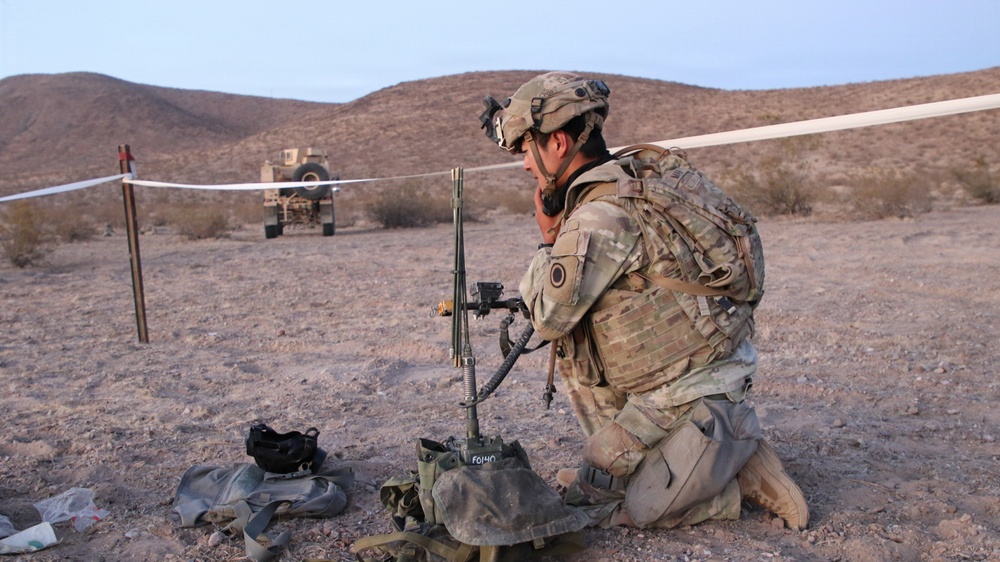
Photo By 1st Lt. SILPI BISTA | Soldiers of the 13th Combat Sustainment Support Battalion, 593d Corps Sustainment...... read more read more
Fort Irwin, California, where the National Training Center transforms into a crucible of modern warfare, the 2nd Stryker Brigade Combat Team “Lancer Brigade,” 7th Infantry Division, faced the full spectrum of tactical and logistical challenges during rotation 25-11. While maneuver elements executed simulated combat operations against a near-peer adversary, the unsung engine behind their success was the 13th Combat Sustainment Support Battalion Headquarters, brought in as a force multiplier to fill a critical gap in sustainment command and control.
Unlike divisions equipped with a Division Sustainment Brigade, the 7th Infantry Division lacks this organic capability. This absence creates a unique challenge during large-scale training events like NTC, where the complexity and scale of operations demand centralized logistics oversight. To bridge this gap, the 13th CSSB “Pioneers” deployed to provide the operational-level sustainment expertise necessary to keep the Lancer Brigade in the fight.
Lt. Col. Eric Baca, commander of 13th CSSB, emphasized, “NTC 25-11 was a true test of our ability to provide sustainment support in a combat environment with the ever-changing landscape of multi-domain conflicts. We adapted, synchronized, and delivered, because when maneuver units are pushing the edge, sustainment must be right there with them.”
The NTC environment is designed to replicate the chaos and unpredictability of large-scale combat operations. Units must contend with extended lines of communication, rapid consumption of fuel and ammunition, frequent equipment failures, and the constant need to adapt distribution plans in real time. In such conditions, logistics is not merely a support function, it is the lifeblood of operational success. Without a robust and agile sustainment framework, even the most tactically proficient units risk grinding to a halt.
The 13th CSSB brought with it a modular, multifunctional capability tailored to meet the demands of the Lancer Brigade. From coordinating bulk fuel and water resupply to managing repair parts, maintenance, and transportation assets, the battalion provided a unified sustainment structure that enabled the brigade to maintain tempo and readiness throughout the rotation. Their ability to synchronize distribution management across the battlespace ensured that every element from forward-deployed platoons to rear support nodes received the resources needed to execute their mission.
The Pioneer team proved to be a strategic enabler. Their presence allowed the Lancer Brigade to focus on maneuver and mission execution without being bogged down by fragmented sustainment efforts. The battalion’s integration into the rotation demonstrated the Army’s evolving approach to expeditionary logistics, where modular sustainment units can be deployed to reinforce and extend the operational reach of maneuver forces.
| Date Taken: | 09.10.2025 |
| Date Posted: | 12.12.2025 16:26 |
| Story ID: | 554082 |
| Location: | FORT IRWIN, CALIFORNIA, US |
| Web Views: | 129 |
| Downloads: | 0 |

This work, Sustaining the Fight: 13th CSSB Powers Lancer Brigade during NTC 25-11, must comply with the restrictions shown on https://www.dvidshub.net/about/copyright.


No keywords found.





