
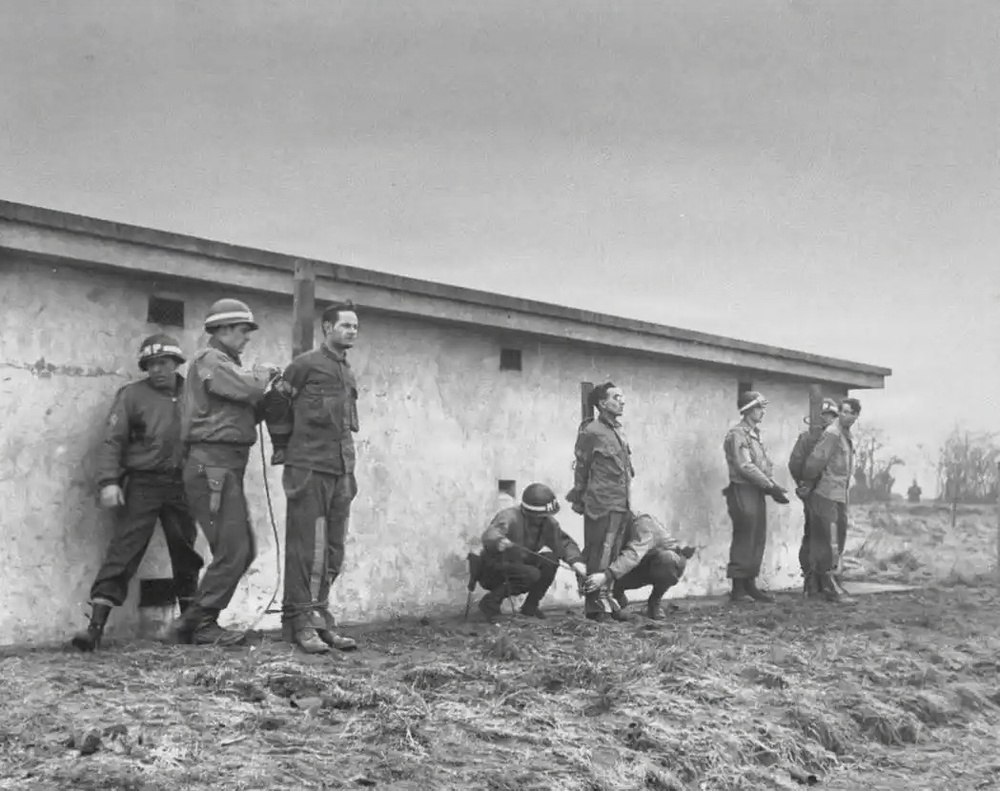
Photo By Erin Thompson | Some men of the Einheit Stielau being prepared for execution by firing squad after...... read more read more
 Subscribe
On Dec. 19, 1944, U.S. Army Counter Intelligence Corps (CIC) agents learned of a German plot to assassinate General Dwight D. Eisenhower at Supreme Headquarters Allied Expeditionary Forces (SHAEF) in Paris as part of their Ardennes offensive. Heightened security measures along the front and in Paris were enacted to prevent the rumored plan’s success.
When the Germans launched their offensive in the Ardennes Forest on Dec. 16, one of the units committed to the effort was a new Panzerbrigade 150, commanded by SS Lt. Col. Otto Skorzeny. The unit was comprised primarily of English-speaking German soldiers who dressed in American uniforms and possessed American equipment, weapons, and vehicles, as well as German vehicles disguised as American. As part of Operation Greif [Griffin], the brigade would infiltrate Allied lines and commandeer Allied control posts, clearing the way for follow-on combat forces. The brigade included a small reconnaissance element known as Einheit Stielau (for the lieutenant who commanded the unit). Its mission was to sabotage vital bridges, disrupt communications lines, and sow confusion in the American units ahead of the German advance.
A memorandum detailing Operation Greif had been captured on the first day of the offensive. In response, counterintelligence units along the Allied front strengthened a control line to check identity documents of individuals approaching bridges and roadblocks and reinforced security at vital installations. In addition to screening refugees and displaced persons, CIC agents interrogated all men in American uniforms who could not provide the proper security responses or identification.
On Dec. 18, military police (MPs) captured three Einheit Stielau members in an American jeep for failing to give the proper password. During CIC interrogations, the prisoners revealed rumors of a plot to assassinate General Eisenhower and other high ranking Allied officials in Paris. This revelation was corroborated late the following evening, when MPs and CIC agents stopped another American jeep at a control point near Liège in Belgium. Although the occupants of the jeep gave the proper password, the American soldiers investigated the jeep further. Its American markings had been freshly and poorly applied, and explosives and German weapons were discovered inside. Under interrogation, the leader of the group, Lt. Gunther Schulz, spilled the German plans for the following day and his orders to seize several bridges in the area.
Schulz also provided additional details of the plot to kill Eisenhower. The mission was to be carried out by Skorzeny, himself, with about fifty support personnel, some posing as German prisoners and others as their American captors. With further affirmation of the earlier reports, the information was quickly passed to SHAEF, where an “irritated” Eisenhower was put under a heavy protective detail and forced to move his quarters closer to headquarters. Reportedly, forty-three roadblocks were erected to obstruct traffic in and around Paris, and the rumored meeting places of the assassins were placed under constant surveillance. This heightened security continued until Dec. 29. In his memoir, Crusade in Europe, Eisenhower wrote,
"By that time the security people were beginning to believe that their fear of the murder scheme had been exaggerated. While they continued to surround me with greater security measures than they had employed before the beginning of the offensive, I could at least now depart from my headquarters without a whole platoon of MPs riding in accompanying jeeps and scout cars."
Einheit Stielau activity continued throughout the Ardennes offensive, although few disguised Germans were caught within Allied lines. Most of those caught in American uniforms were executed as spies. Meanwhile, Skorzeny had been wounded in Belgium and returned to Germany for treatment. Perhaps this prevented him from carrying out his mission to assassinate Eisenhower or perhaps the plot had always been more rumor than actual intent. Postwar, Skorzeny, tried and acquitted of being a war criminal, denied in interviews and his memoirs that such a plot ever existed, while the New York Times in May 1945 described it as a “great hoax to spur morale.”
Article by Lori S. Stewart, USAICoE Command Historian. New issues of This Week in MI History are published each week. To report story errors, ask questions, request previous articles, or be added to our distribution list, please contact: TR-ICoE-Command-Historian@army.mil.
| Date Taken: | 12.12.2025 |
| Date Posted: | 12.15.2025 11:35 |
| Story ID: | 554071 |
| Location: | US |
| Web Views: | 191 |
| Downloads: | 0 |

This work, Interrogation Uncovers Rumored Assassination Plot (19 DEC 1944), must comply with the restrictions shown on https://www.dvidshub.net/about/copyright.

No keywords found.




