
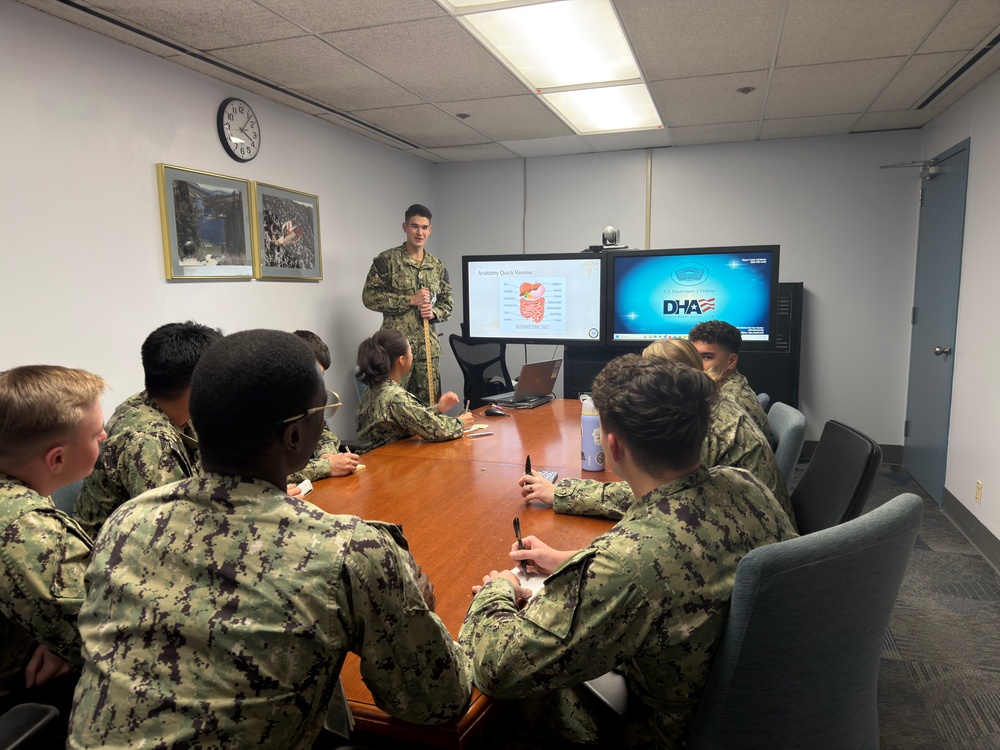
Courtesy Photo | Hospital Corpsmen from NMRTU China Lake participate in a hands-on medical training...... read more read more
CHINA LAKE, Calif. — Over the past couple months, Lt. j.g. Christian Woodie, a physician assistant assigned to Navy Medicine Readiness and Training Unit (NMRTU) China Lake, led twice‑weekly medical readiness training sessions designed to strengthen clinical reasoning and reinforce core medical skills among junior hospital corpsmen.
Each session brought together 8–10 corpsmen for focused instruction on foundational competencies — including patient history‑taking, effective hand‑offs and accurate medical documentation — skills that are essential in both clinic and operational settings. From there, Woodie introduced case‑based scenarios highlighting common conditions seen in primary care and readiness environments. The group practiced evaluating back pain, recognizing red flags, and differentiating among primary and secondary headaches. They also learned to conduct detailed cranial nerve examinations and completed hands‑on basic suturing practice.
Woodie, from Bel Air, Maryland, said his approach centered on helping corpsmen grow more comfortable and confident applying their medical knowledge in real‑world settings. “A lot of our corpsmen are fresh out of Corps School… an initial goal was to help them feel more comfortable in a medical environment,” he said.
He structured the curriculum around common clinic presentations and topics the corpsmen expressed interest in exploring further. “Back pain was a complaint that kept bringing patients into the clinic,” Woodie said. “I also encouraged the corpsmen to bring me topics they felt they could learn more about. I was asked to cover headaches and most recently the GI system.”
Hands‑on learning was a cornerstone of the sessions. “I figured it would be useful to describe a clinical scenario including a history and physical exam… rather than simply giving them the information without context,” he said. Corpsmen practiced cranial nerve exams and abdominal special tests such as Murphy’s and Rovsing’s signs on one another. Suturing training reinforced skills valuable across both routine care and expeditionary medical missions.
The training also covered preventative care and current cancer screening guidelines, as well as reviews of common medication classes like analgesics, cold and allergy medications, and antihypertensives — knowledge directly tied to day‑to‑day medical readiness.
Hospital Apprentice Larie Belle Urbano, from Fort Stockton, Texas, said the training helped her bridge the gap between classroom knowledge and clinical application. Before attending, she said she was still developing her confidence with patient intake. “I would be unable to get the right questions or information to ask to better help the provider,” she said.
Urbano described the case‑study format as especially helpful. “Based on some of the knowledge we learned from Corps School, he helped me understand so much on how everything in the body works together… identifying what might be going on with the patient by having us do realistic scenarios,” she said.
Her communication skills have improved noticeably. “I was always on edge having to rely on assuring patients that the provider will answer their questions,” she said. “But now I can ask them more questions if needed — even do a physical exam.”
Urbano has begun applying HEENT and neurological exam techniques on duty and said learning to recognize red flags has strengthened her ability to support patient care. She hopes to continue her medical career after service. “This training will be beneficial for both my career after my service and the Navy,” she said. “As someone who is brand new to medicine, it is a good first step.”
Woodie noted that engagement and enthusiasm from the corpsmen have been strong, with several already applying new skills in clinic. After a cranial nerve session, two corpsmen separately described performing the exam on patients, with one identifying an abnormal finding of vertical nystagmus. “They enjoyed how they were able to apply what they had learned into a real clinical setting,” he said.
For Urbano, the program has reinforced her sense of direction and purpose. “It has not impacted my job satisfaction — what has increased is my confidence when it comes to performing my duties as a Hospital Corpsman,” she said. She encourages others to take advantage of similar opportunities. “Every opportunity is a privilege, and we should not let that time go waste.”
Woodie emphasized that the training was designed to build a strong medical foundation that supports long‑term professional growth — from independent duty corpsman roles to careers as nurses or physician assistants. “The training is focused on improving their clinical skills and medical decision making,” he said. “If they show improvement in these areas, leadership will take notice.”
As the training continues, Woodie plans a comprehensive review to reinforce the material covered. Ultimately, he said, the goal is simple: develop confident, capable corpsmen who strengthen the command’s medical readiness and stand ready to support the warfighter.
| Date Taken: | 12.31.1969 |
| Date Posted: | 12.12.2025 13:37 |
| Story ID: | 554052 |
| Location: | CHINA LAKE, CALIFORNIA, US |
| Hometown: | BEL AIR, MARYLAND, US |
| Hometown: | FORT STOCKTON, TEXAS, US |
| Web Views: | 156 |
| Downloads: | 0 |

This work, China Lake Corpsmen Strengthen Skills Through Case-Based Medical Training, by Christopher Jones, identified by DVIDS, must comply with the restrictions shown on https://www.dvidshub.net/about/copyright.


No keywords found.





