
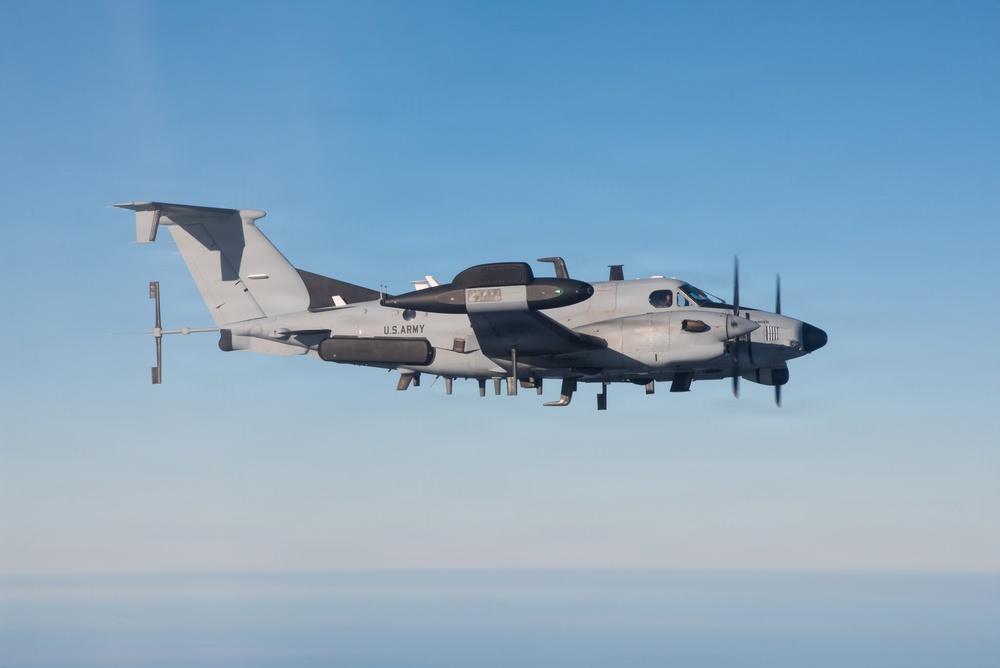
Photo By Daniel Baldwin | First deployed in 1971 in Germany to monitor Soviet Bloc troop movements in East...... read more read more
 Subscribe
For more than five decades, the Army has used its aerial intelligence, surveillance, and reconnaissance (A-ISR) turboprop fleet to provide critical A-ISR to maintain battlespace awareness and superiority. In July, the Airborne Reconnaissance Low-Multifunction (ARL-M) and Guardrail both flew their closing flight missions in Korea. The Army provided 54 years of A-ISR turboprop support on the peninsula. In September, the last aircraft from the legacy fleet, the Enhanced Medium Altitude Reconnaissance and Surveillance System-Multiple Intelligence (EMARSS-M), conducted its final mission, bringing the fleet’s historical journey to an end.
Beginning in 1971, the Army deployed the first Guardrail aircraft to the 1st Military Intelligence (MI) Battalion in Germany to monitor Soviet Bloc troop movements in East Germany and Czechoslovakia, maintaining this role for nearly three decades. Following the Cold War, three Guardrail system configurations were deployed to the 224th MI Battalion and 15th MI Battalion used during Operation Desert Shield/Desert Storm, where they played a crucial role in identifying the locations of the Iraqi Republican Guard and providing oversight of other Iraqi troop movements for coalition forces. Guardrail directly supported the Marine Corps’ advance along the coast into Kuwait City.
In addition to their service in Operation Iraqi Freedom/New Dawn and Operation Enduring Freedom, Guardrail aircraft from the 3rd MI Battalion continued to operate in Korea, a presence they have maintained since the mid-1970s, where they assisted in monitoring the demilitarized zone.
In 1996, ARL-M joined Guardrail in the skies in response to a U.S. Forces Korea and U.S. Pacific Command requirement to replace the retiring OV-1D Mohawk aircraft. For the first time ever, the ARL-M provided a crucial moving target indicator/synthetic aperture radar (MTI/SAR) subsystem, which allowed the user to obtain surveillance, imagery reconnaissance, target identification, and communications intercepts. These advanced systems provided a more efficient and effective means of gathering intelligence that the aging OV-1D Mohawk could not achieve.
The final aircraft to join the Army’s A-ISR turboprop fleet was the EMARSS. Developed on the Beechcraft King Air 350ER platform, the first prototype flew in 2013 and was operational by 2016, with deployments to regions including Africa, Latin America, Iraq, and Afghanistan.
The EMARSS program used common architecture with five different variants allowing EMARSS aircraft to respond to diverse operational demands of military missions and technological advancements, resulting in EMARSS remaining at the technological edge of ISR collection.
In 2006, Project Director Sensors-Aerial Intelligence (PD SAI) led the Guardrail Modernization Program, upgrading the Army’s RC-12 fleet to the RC-12X, commonly known as the Guardrail Common Sensor (GRCS). This vital initiative not only replaced aging sensors but also introduced innovative and modern payloads that extended the life of the fleet by nearly 20 years.
The enhancements significantly increased the frequency range and types of signals collected, enabling the system to capture and characterize signals within a fraction of a second while simultaneously processing different emitters and signal types. By integrating state-of-the-art sensors, including improved electronic support measures and SIGINT capabilities, the Guardrail Modernization Program ensured that the GRCS system remained relevant and effective for ISR operations.
Divesting the turboprop fleet
“In 2022, the Army made a deliberate funding decision to prioritize aerial modernization to focus on deep sensing capabilities, aligning with future Army strategies,” said Julie Isaac, PD SAI.
Deep sensing requires two things: the ability to use more capable sensors and to fly higher.
The Army A-ISR strategy emphasized the need for the rapid development of modernized sensors and enhanced platform capabilities to provide commanders with globally responsive and highly capable aerial sensing solutions. The higher the platforms fly, the further they can collect intelligence for many sensors.
The legacy turboprop fleet has limited speed, range, altitude, power, and payload carrying capacity for deep sensing. The legacy fleet could not meet requirements for near-peer competition.
The divesture of all three systems – ARL-M, Guardrail, and EMARSS – began in fiscal year 2023 (FY23). PD SAI divested all mission equipment packages (MEP) from the legacy aircraft and the Fixed Wing Project Office (FWPO), which oversees the life cycle management of the aircraft, completed the strategic divestment of the legacy turboprop fleet in FY25. To ensure Soldiers would still be supported through the divestment process, PD SAI, in conjunction with FWPO and HQDA G2, developed and executed a strategy to stagger the divestment process. The staggered schedule allowed several enduring systems to be divested, while some were maintained in the current configuration for operational use.
“As the Army shifts its focus from the past 24 years of counterinsurgency operations to align with the Multi-Domain Operations [MDO] fight, legacy systems like the ARL-M, EMARSS, and [GRCS] had to be divested to re-align taxpayer funding to modernized aircraft systems,” Isaac said. “While maintaining similar capabilities of these legacy systems, the Army is pivoting to the MDO fight and a modernized Army 2030 focus. A smaller fleet of aircraft that can cover much larger footprints for longer periods of time is now the way forward.”
The modernized fleet will allow greater altitude to enable deep sensing of adversary forces and greater range to reach an increasingly diverse set of problems in an increasingly connected global threat landscape. The keystone of this modernization strategy is the High Accuracy Detection and Exploitation System (HADES), which is in prototyping now.
Bridging the gap to HADES
The Army began shaping the HADES program in 2020 to replace the legacy turboprop aircraft fleet, with the goal to replace all the Guardrail, EMARSS, and ARL aircraft.
In preparation for HADES, PD SAI partnered with FWPO to demonstrate and operationally deploy jet-based ISR sensing on contractor-owned and contractor-operated Airborne Reconnaissance Targeting Exploitation Mission Intelligence System (ARTEMIS) and Aerial Reconnaissance and Electronic Warfare System (ARES) systems.
“By collaborating with FWPO, PD SAI can evaluate the ISR sensors on the demonstrator platforms to help inform HADES program requirements,” said Eric Hughes, Product Manager for Multi-Domain Sensing System. “PD SAI will collect and analyze feedback about how the sensors operate on the demonstrator jets at the altitudes, speed, and ranges that HADES is expected to perform.”
Additionally, the Army is pursuing the Army Theater-level High Altitude Expeditionary Next Aerial ISR Radar/SIGINT (ATHENA-R/S) jet platforms as a bridging strategy to meet operational requirements until HADES is fielded.
“ARTEMIS, ARES, and ATHENA will serve to demonstrate the value of new and existing sensor technologies in HADES-like packages and provide current near-peer sensing capabilities within the U.S. European and Pacific Commands areas of responsibility,” Hughes said. “These aerial ISR bridge systems allow the Army to rapidly innovate and accomplish interim objectives including continuing to meet operational requirements, transforming formations, and intelligence infrastructure to exploit HADES capability, and establishing initial quantities of trained aircrews for the transition to HADES.”
As HADES program-of-record capabilities are fielded, these bridging systems will be retired.
HADES
HADES is the first program coming out of the Multi-Domain Sensing System family of systems and has successfully gone through the required Army acquisition shaping panel.
HADES will provide transformational increases in speed, range, payload, and endurance for Army aerial ISR collection capabilities supporting the Joint force to strengthen deterrence and win in the MDO. The system will be incorporated into a government-owned, government-operated modern business jet aircraft.
The first Bombardier Global 6500 aircraft that will be used for HADES was delivered to FWPO last year and a second aircraft was delivered in July. The first fully developed HADES prototype system is expected to be delivered in FY26 followed by a second prototype in FY27.
The retirement of the Army’s legacy turboprop fleet marks a significant transition in aerial ISR capabilities. The phased divestiture of systems reflects the Army’s commitment to modernization, aligning its resources with the evolving demands of MDO. The strategic shift to HADES not only honors the legacy of the turboprop fleet but also sets the stage for a more agile and capable A-ISR force, ensuring that the Army can effectively address the complexities of modern warfare and maintain its competitive edge in a rapidly changing global threat landscape.
| Date Taken: | 12.11.2025 |
| Date Posted: | 12.12.2025 09:09 |
| Story ID: | 553987 |
| Location: | US |
| Web Views: | 632 |
| Downloads: | 0 |

This work, Army completes A-ISR turboprop fleet divestment, by Daniel Baldwin, identified by DVIDS, must comply with the restrictions shown on https://www.dvidshub.net/about/copyright.


No keywords found.




