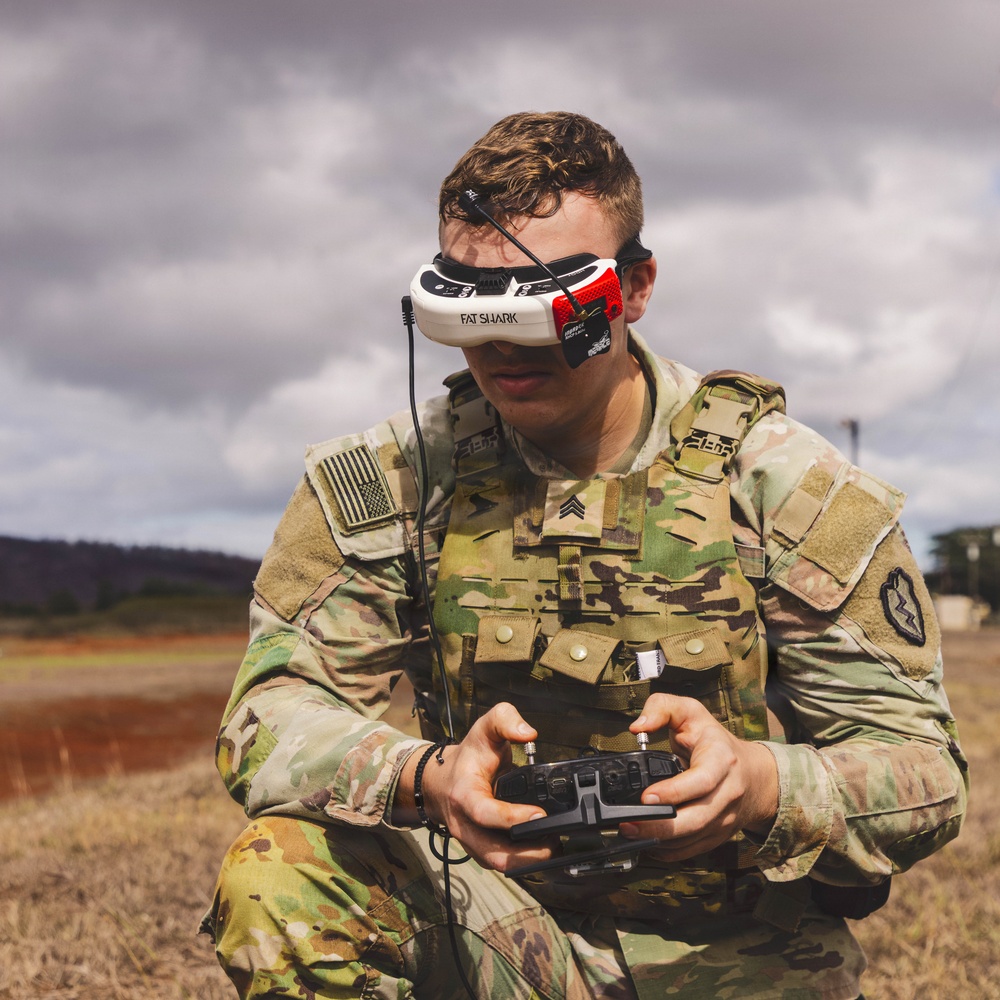
Photo By Sgt. Taylor Gray | Sgt. Thomas Anderson, assigned to Multi-Functional Reconnaissance Company, 1st Battalion, 27th Infantry Regiment, 25th Infantry Division, participate in Tropic Lightning Week 2025 and face off on the field of strife at Area X-Ray, Dec. 9th, 2025. The week celebrates the Soldiers and families of 25th ID, builds unit pride, and strengthens esprit de corps across the division. see less
| View Image Page
SCHOFIELD BARRACKS, Hawaii — As the U.S. Army adapts to rapidly changing operational demands in the Indo-Pacific, unmanned aerial systems are becoming central to how Soldiers gather information, maneuver and increase survivability in complex terrain. This year’s Tropic Lightning Drone Competition, hosted by the 25th Infantry Division, highlighted that evolution by showcasing new UAS capabilities and strengthening partnerships between Soldiers and industry innovators.
The competition employed only three drone types: medium-range C100 systems, short-range Teal or Skydio drones, and first-person-view platforms. These were used exclusively throughout the event’s tactical scenarios, which were designed to replicate challenges found in jungle and urban terrain. The demonstrations showed how small unmanned systems can enhance reconnaissance, shorten decision timelines and reduce risks for Soldiers operating across dispersed formations.
U.S. Army 2nd Lt. Gisele Girones, UAS platoon leader, 21st Infantry Regiment, 2nd Battalion, 3rd Brigade Combat Team, said FPV drones are often misunderstood as recreational systems rather than operational tools. She said the competition created an opportunity to highlight their tactical relevance in realistic field conditions.
“FPVs can be utilized in a tactical scenario, not just through obstacle courses or sort of videos that you see online, but can be used real time on the battlefield by U.S. Soldiers,” Girones said.
Demonstrating FPVs alongside the C100 and short-range systems, she said, underscored the pace of UAS development and the growing importance of these tools for reconnaissance and maneuver elements in the division.
“It showcases truly the forefront of the future. We are flying relatively complex technologies in a tactical environment, so we are perfectly tying in Soldier skills with tactical employment, showcasing that you can employ complex technologies under stress and employ them well in a tactical environment,” Girones said.
That modernization effort is visible across the Army. The service has begun fielding the Stalker vertical takeoff and landing aircraft at Fort Rucker, Alabama, only months after deciding to procure the system, according to reporting by Ryan Finnerty of FlightGlobal. The rapid fielding reflects the urgency behind replacing aging platforms with aircraft suited to dispersed and mobile operations.
Girones’ platoon is undergoing a similar transformation. Over the past six months, the unit expanded from 18 to 49 Soldiers, fielded seven airframes and began reclassifying operators into the Army’s 15X unmanned systems specialty, underscoring the increasing importance of small UAS capabilities across brigade formations.
The Army is also incorporating FPV systems into formal training pipelines under its Transformation in Contact initiative. FPV drones give Soldiers vital exposure to advanced reconnaissance tools and enable units to rehearse precision strike and targeting techniques in realistic, simulated environments.
The event also highlighted the role of industry in advancing UAS technology. MC3 Technologies, a Hawaii-based company, partners with the 25th Infantry Division’s Lightning Labs innovation cell to build, refine and test emerging unmanned systems.
“We support Lightning Labs by helping procure materials, building drones and 3D-printing components Soldiers need for testing,” said Kyla Lee of MC3 Technologies.
Lee said MC3’s mission extends beyond innovation. The company aims to strengthen Hawaii’s workforce by exposing local youth to robotics, cyber and drone design. MC3 has also experimented with Raspberry Pi-based tactical tools, including spoofed networks and low-profile ground sensors intended to extend situational awareness without putting Soldiers at risk.
“We want to spark curiosity,” Lee said. “If young people see they can build and design these systems themselves, they can help meet the technology needs the Army faces today.”
As the Army shifts toward multidomain operations, leaders say UAS platforms like the C100, Teal, Skydio and FPV drones will play increasingly important roles in improving mobility, survivability and decision-making across contested environments. Events such as the Tropic Lightning Drone Competition give Soldiers opportunities to test emerging systems, refine tactics and collaborate with civilian innovators in real time.
More than a display of technical skill, this year’s competition demonstrated how quickly unmanned systems are reshaping the operational landscape. For units across the 25th Infantry Division, the event reinforced a clear message: the future fight will demand speed, adaptability and mastery of technologies that keep Soldiers informed, protected and ready for complex missions.

 Subscribe






