
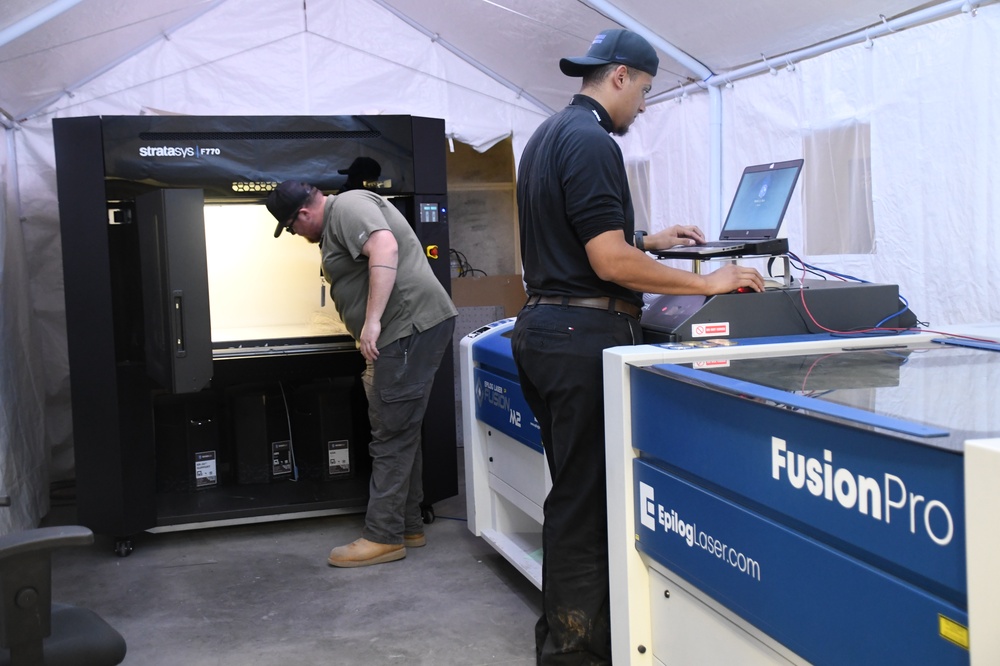
Photo By Ana Henderson | Yuma Test Center’s Metrology and Simulation Division recently purchased two...... read more read more
 Subscribe
Three-Dimensional (3D) printers have opened the opportunity for individuals and organizations to go from concept creation to tangible items in a matter of hours.
Yuma Test Center (YTC) sees value in this capability and over the years has acquired polymer (plastic) and metal printers to support its mission.
Recently, YTC’s Metrology and Simulation Division bought two 3D printers that provide a larger printing capacity and eight different materials, including carbon fiber.
“Carbon fiber is a stronger material that will help improve the longevity of a part that a mission might require while testing,” explained Metrology Branch Chief Savanna Silva.
These printers provide an expediated solution to keep the mission going when a part is needed quickly.
“We can use it to make tooling and other parts that don’t have a complex geometry,” explained Silva. Yet she stressed that the printed 3D parts are not used for anything that’s safety related.
“Anytime a part is 3D printed regardless of material, whether it be polymer or metal, there will always be inherent gaps within its printed structure. So, when we are identifying parts to print, we focus on items that aren’t mission-critical, safety related, particularly those that can be easily replaced without affecting the overall mission and the personnel involved.”
Another way 3D printers are making an impact is in prototyping for developmental engineering at YTC.
“We have a machine shop, and in collaboration with the engineers in the Metrology and Simulation Division, we work together to take a project from understanding the customer requirements to creating a prototype and ultimately delivering a full-scale final solution. This could result in either a 3D printed or machined part, one that would be produced by our machine shop,” said Silva.
During this developmental process the printers can quickly produce a part to test its fit before having it manufactured by the machine shop.
Silva said, “One of the great things about working with test customers is that they come to us with an idea. Our developmental engineers take that concept and turn it into a computer-aided design using SolidWorks. Then, they 3D print a prototype and conduct a fit test on the intended system to ensure it is going to work. If it doesn’t, we make adjustments and reprint it. We’ve found that 3D printing is much more cost-effective compared to traditional machining, where hours of precision work would be needed to produce a part out of bar stock.”
Silva shared another example of YTC successfully using a rapid-printed prototype.
“We’ve also used 3D printing to better understand firing mechanisms in the mortar systems. A printed part may only last for maybe one or two rounds before it’s no longer serviceable, but it gives us a good sense of the fit. From there, we can machine a permanent solution from bar stock.”
Dillion Mann, an engineer with Metrology and Simulation Division, does design and analysis work for small to large components. He described some of the novel items he’s been able to create to enhance the mission using 3D printers.
“We have created GPS helmet units that go on to the Soldiers so they can track the Soldiers during jumps,” said Mann.
For the Ground Combat Directorate, Mann said they designed and printed mounting plates for apparatus and gears for various items. They also print replacement parts for legacy systems such as some of YTC’s radars, where replacement parts are no longer manufactured. Overall, Silva said, YTC is using 3D printing as another tool towards modernizing Yuma Proving Ground’s capabilities and enhancing the lethality of the U.S. Army.
“It helps us to maintain the agility we need in today’s world.”
| Date Taken: | 12.11.2025 |
| Date Posted: | 12.11.2025 12:48 |
| Story ID: | 553893 |
| Location: | ARIZONA, US |
| Web Views: | 138 |
| Downloads: | 0 |

This work, Yuma Test Center uses 3D printers to streamline design projects and keep the mission going, by Ana Henderson, identified by DVIDS, must comply with the restrictions shown on https://www.dvidshub.net/about/copyright.


No keywords found.




