
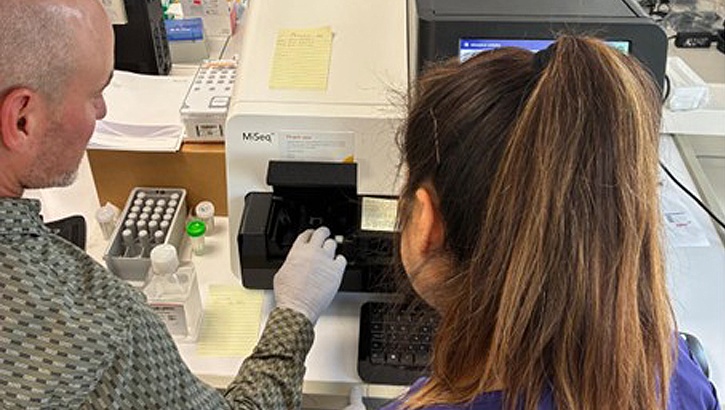
Photo By Douglas Holl | William Gruner, a molecular biologist with the U.S. Air Force School of Aerospace...... read more read more
 Subscribe
By Armed Forces Health Surveillance Division
A biodefense initiative spearheaded by teams from the Armed Forces Health Surveillance Division, Global Emerging Infections Surveillance Branch, and the Department of War Global Respiratory Pathogen Surveillance Program at Defense Center for Public Health–Dayton, has established a flexible model for rapid pathogen characterization within the DOW.
“This is a significant stride toward enhancing biodefense and military readiness,” said Air Force Maj. Manuel Moncada, GEIS lead of surveillance and lab field operations. “Landstuhl Regional Medical Center recently leveraged this genomic sequencing capability for influenza while using this innovative remote bioinformatics ‘reach-back’ support system.”
The Military Health System Digital Biobank is a cloud-based environment hosted on the MHS information platform built to facilitate real-time, analytical support of large data files for DOW laboratories that may have limited bioinformatics capabilities.
“Quickly sequencing and analyzing pathogen genomes is paramount to offering crucial insights into disease transmission, evolution, and drug resistance,” said Lindsay Morton, senior molecular epidemiologist for GEIS.
However, maintaining cutting-edge genomic capabilities at overseas locations like LRMC is challenging due to competing clinical priorities, resource limitations, and personnel turnover. The specialized teams traveled to LRMC in June 21–27, 2025, to facilitate influenza genomic sequencing and associated bioinformatics training.
The comprehensive training covered:
This collaborative project demonstrated the MHS Digital Biobank’s capability for rapid, near real-time genomic data sharing and remote analysis. Influenza virus data generated by LRMC in Germany were uploaded and almost immediately accessed by a network of expert bioinformaticians in the United States. This network included teams at the U.S. Army Medical Research Institute of Infectious Diseases Center for Genome Sciences, the Naval Medical Research Command Biological Defense Research Directorate, the Walter Reed Army Institute of Research Viral Disease Program, and DCPH-Dayton.
Leveraging their advanced bioinformatics tools, these stateside-based laboratories produced analysis reports within 24 hours and fully assembled viral genomes within 48 hours. This stands in contrast to the typical turnaround time for analyzing genomic data, which could take weeks to months depending on how much time it takes to get the data into the hands of bioinformaticists.
"This training not only empowered our local team at LRMC to generate high-quality sequencing data but also seamlessly integrated them into a broader, highly responsive genomic analysis network," said Army Lt. Col. Brett Swierczewski, GEIS branch chief. "The MHS Digital Biobank proved to be a game-changer, ensuring that critical genomic insights can be delivered rapidly, regardless of geographical distance."
The successful execution of this remote support model underscores an immense utility for DOW genomic health surveillance, said Swierczewski. It also demonstrated capacity for:
As a direct result of this training, the LRMC laboratory is now well-positioned to support regional requests for characterizing viral pathogens, with collaborative partners ready to act in the United States, said Swierczewski. This advancement will contribute to broader DOW biosurveillance initiatives, solidifying the DOW's ability to monitor, understand, and respond to infectious disease threats across the globe, ultimately safeguarding the health of service members and their families.
Key takeaways:
The Defense Health Agency supports our Nation by improving health and building readiness—making extraordinary experiences ordinary and exceptional outcomes routine.
NOTE: The mention of any non-federal entity and/or its products is for informational purposes only, and is not to be construed or interpreted, in any manner, as federal endorsement of that non-federal entity or its products.
| Date Taken: | 12.10.2025 |
| Date Posted: | 12.11.2025 16:08 |
| Story ID: | 553771 |
| Location: | DE |
| Web Views: | 203 |
| Downloads: | 1 |

This work, Bridging data across continents Landstuhl Regional Medical Center, Department of War laboratories pioneer remote bioinformatics support for genomic influenza surveillance, must comply with the restrictions shown on https://www.dvidshub.net/about/copyright.

No keywords found.




