Transforming infrastructure and training Palau’s workforce
Courtesy Photo |
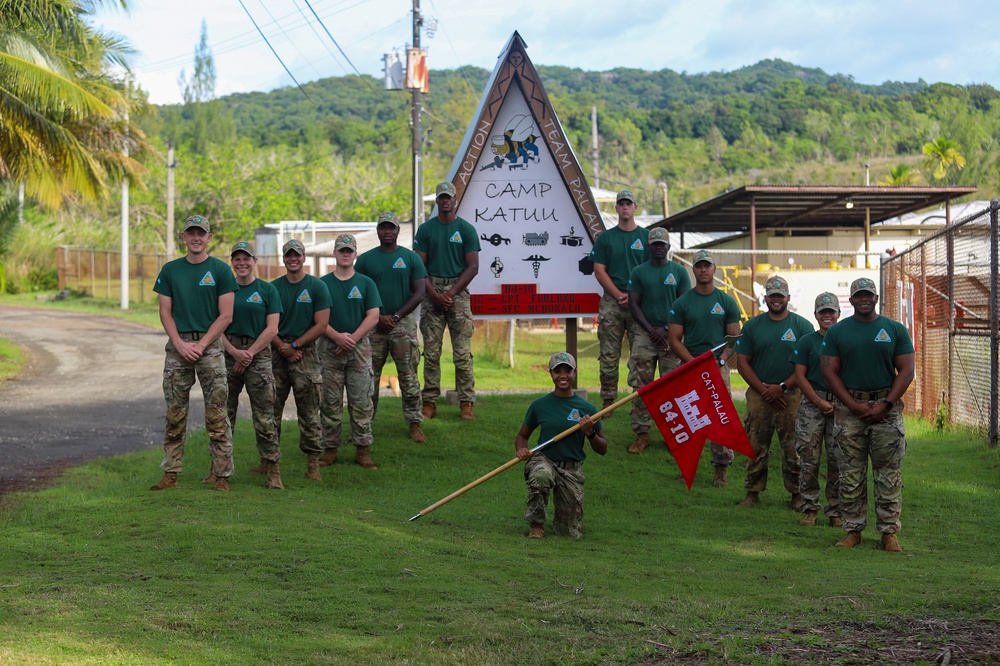
U.S. Army Civic Action Team 84-10 pose in front of the welcome sign in Camp Katuu,......read moreread more
Courtesy Photo | U.S. Army Civic Action Team 84-10 pose in front of the welcome sign in Camp Katuu, Palau, 2025. The team maintains the site and ensures it remains open to the public throughout their six-month rotation. (Courtesy Photo) see less
| View Image Page
Transforming infrastructure and training Palau’s workforce
CAMP KATUU, Palau — The Civic Action Team Palau 84-10 is once again at work in the Republic of Palau. These U.S. Army servicemembers are not just completing construction projects, they are investing in the future of an entire community.
CAT Palau operates under the U.S. military’s civic action program, deploying construction teams throughout the Pacific to complete infrastructure projects while training local workers. The current rotation runs from late July to February 2026, continuing a tradition of service that dates back to 1969.
A Mission Built on Partnership
The 13-member CAT Palau team has been tackling critical infrastructure projects across the island nation while simultaneously training 10 local apprentices in construction trades. The mission represents immediate impact paired with lasting legacy.
"The relationship here in Palau is impactful," said Spc. Trinity Little, who serves as both a heavy equipment operator and the public affairs officer for the team. "The program that we go through to teach them is very important because they do get certified, and this is the only program they have where they can get that training, and they get paid for it."
The apprentices don't just observe; they earn stipends while working toward National Center for Construction Education and Research credentials in their chosen trades. It's hands-on education that transforms lives and builds capacity in a community where such opportunities are scarce.
"This is the only program that they can go through and be an intern and learn and actually get certified," Little emphasizes. "They get paid for this. They get NCCER credentials."
From Classroom to Construction Site
The rotation follows a carefully structured approach. During the first month and a half, all apprentices complete NCCER Core curriculum—intensive classroom instruction covering construction fundamentals, safety protocols, and industry standards. Then comes the real work: applying those lessons on actual job sites under the guidance of certified instructors.
For Spc. Melik Fletcher, an electrician returning for his second year with CAT Palau, the teaching role has evolved significantly. Last year, after completing a week-long instructor training course in Guam led by Bert Johnston, education director at the Guam Contractors Association Trades Academy, Fletcher arrived in Palau with just one apprentice and considerable anxiety about public speaking.
"The one thing that stood out that I wasn't comfortable with was public speaking," Fletcher admits. "When I came out to Palau last year, I wasn't too comfortable speaking and teaching."
This year tells a different story. Fletcher now mentors three apprentices, and his confidence has soared.
"Having more apprentices was actually a little bit better," he said. "I was able to identify the apprentices that were a little bit stronger within the trade and then allow them to also teach the other apprentices."
His public speaking anxiety? "It's a lot better," he says with a smile.
Teaching How to Teach
The transformation Fletcher experienced traces directly back to that intensive week in Guam, where Johnston’s instructor training program prepares servicemembers for their educational mission. The course focuses not on construction trades themselves, but on the art and science of teaching.
Little arrived at the training with zero teaching experience and modest expectations. "I had never taught anyone anything that was important," she recalls. "I didn't have any experience in teaching anybody."
The program changed that through immersive practice. “Every day we presented at least two to three times in front of people where we just took small topics and then taught the class," Little explains. "It was a teach-the-teacher program."
Projects That Matter
The team's work spans the full spectrum of construction trades, addressing real community needs with measurable impact.
The Access Road Project: a half-mile, two-lane access road to the recycling center. The team inherited the project from the Navy, transforming an overgrown field into functional infrastructure. After clearing vegetation and grading terrain, they're now laying rock and approaching completion.
Solving the Bat Problem: required creative thinking and electrical expertise. At a school in Aimeliek, Palau, bats had invaded the building, leaving their droppings in hallways and creating health concerns. The solution? Fletcher and his team installed 12 solar-powered lights around the campus. Bats now avoid the illuminated areas, keeping them away from the school building.
Fire Department Support: involved critical plumbing work, including toilet installation and a water tank system to supply it. The project ensures the fire department has functional facilities—basic infrastructure that makes a difference in daily operations.
Security Enhancement: came through installing security cameras at the civic center near Koror, improving safety and monitoring capabilities for the community facility.
For Sammy Kailang, a 21-year-old Palau native, the program opened doors he never knew existed. Over 18 months, he's rotated through heavy equipment operation, welding, and electrical work, experiencing the full range of construction trades.
His favorite? Operating a bulldozer on the access road project.
The learning curve was steep. Beyond operating the massive machine, Kailang absorbed critical lessons about safety, situational awareness, and precision work. He emphasizes safety that prevents accidents and saves lives.
His welding work included repairing a damaged gate at the base, while his electrical training culminated in installing solar panels at the school. Each trade builds his confidence and expands his career possibilities.
Kobe Sablan, 24, took a different path. Born in Guam and raised in Palau, he focused intensively on heavy equipment operation, particularly dump truck work on the access road project.
Though he'd driven trucks before, the current program taught him new techniques—especially regarding safety protocols and operational efficiency.
Once a week, Sablan loads his dump truck with cleared vegetation and debris, then hauls it to the landfill, a simple task that's essential to the project's success. He's already certified in heavy equipment and welding from previous CAT rotations and building a credential portfolio that will serve him throughout his career.
For Little, this deployment represents her longest sustained period operating heavy equipment. "We went on a rotation in Indonesia for a project in 2024, but that was only for about 30 days," she explains. "This is the longest I've been able to actually operate. Anytime we're in Hawaii, the only time we actually operate is if there's training coming up."
Fletcher's return for a second rotation speaks volumes about the program's impact. After his first deployment, he immediately requested to come back.
"Last year, I absolutely fell in love with Palau and teaching the youth," he says. "I was part of a book reading program, going to elementary schools and reading to kids." By March, months before the next rotation, he'd secured his spot on the returning team.
A Legacy Beyond Construction
CAT Palau doesn't just complete projects, it multiplies capability. Every apprentice who earns certification becomes a resource for their community, capable of maintaining infrastructure, training others, and contributing to Palau's development.
CAT Palau’s mission is simple but powerful: 13 servicemembers investing six months to train 10 local workers who will contribute to the community for decades.

 Subscribe






