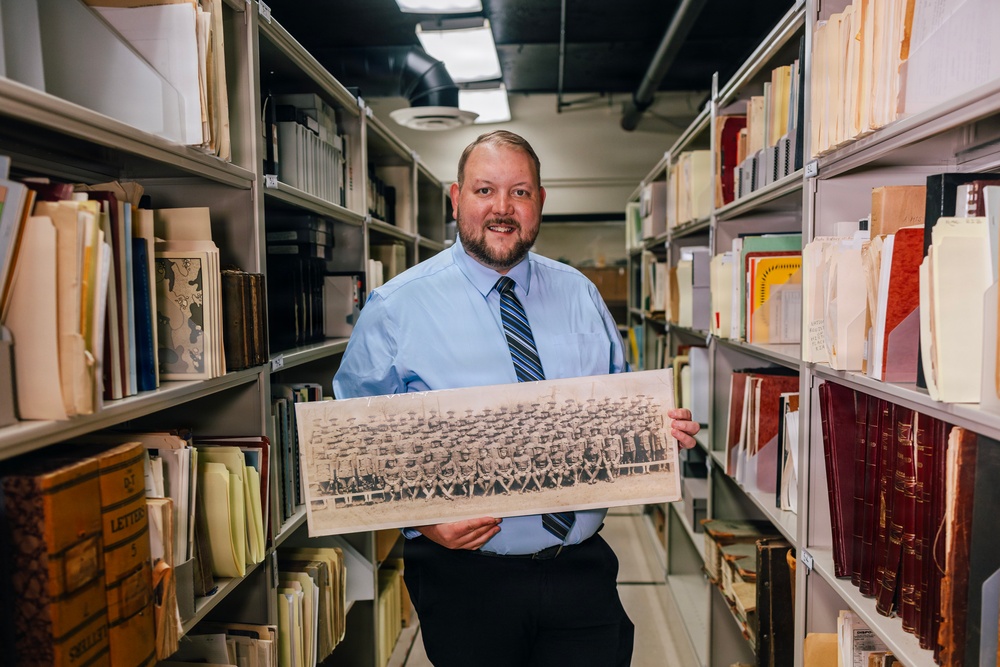
ROCK ISLAND ARSENAL, Ill. – From forgotten manuals to battlefield lessons, the U.S. Army Sustainment Command’s history team turns old records into frontline support for today’s warfighters.
Kaleb Bemis, ASC’s archivist, is a part of that history team. He manages more than 2.3 million historical documents for ASC and Rock Island Arsenal. Those archives, along with the expertise of the history team, help ASC make better informed decisions that support Soldiers and strengthen the Army’s global sustainment mission.
Archivists are a timekeeper of history. They preserve, organize and manage historical records and documents. While archivists and historians work closely, archivists build the foundation by preserving the raw materials of history.
ASC, headquartered at Rock Island Arsenal, Illinois, oversees logistics and sustainment for Army units worldwide. Its mission is to ensure Soldiers have the equipment, supplies and support they need when and where they need it.
The ASC history team, part of the Public and Congressional Affairs office, supports that mission by providing historical data, technical manuals, and lessons learned that shape today’s operations and tomorrow’s strategies.
For example, when Ukrainian forces received M109A2 Paladin howitzers, ASC was asked to locate technical manuals for the long-retired variant. Bemis had them archived, scanned and sent for translation, helping maintain combat readiness abroad.
In another case, ASC explored retrofitting older artillery systems like the M65 “Atomic Annie.” This was an artillery piece built by the U.S. and capable of firing a nuclear device. It was developed in the early 1950s, at the beginning of the Cold War.
Bemis and his team located original test data, saving the Army potentially millions in research and development. The team’s ability to retrieve legacy documentation prevents costly reinvention.
“For Army historians, archivists are crucial in research efforts to apply lessons learned to ongoing efforts,” said Kevin Braafladt, ASC’s command historian. “They are the subject matter experts that streamline research and are able to apply their knowledge to expand or focus research. They also ensure that as documents are collected from ongoing efforts that they will be preserved and ready to be accessed again.”
“Kaleb has an intimate knowledge of where materials are located in the archive to be used as resources for larger history publications, briefings, and lectures,” said Mark Struve, ASC’s assistant historian. “He also is able to field requests for the public, sourcing materials to provide a larger scope of knowledge about Rock Island Arsenal and the Army.”
Bemis offers more than just technical data from equipment. He also provides documentation for past situations and decisions and uses his expertise to explain how it applies to modern-day.
An example of this is the influenza pandemic of 1918. During the start of the COVID-19 pandemic, Bemis researched the archives and located information on how the Army handled a pandemic more than a century before. This information helped today’s leadership determine what worked – and didn’t – in the past concerning logistics and supplies that could be applied to the current decision making.
“I think the biggest misconception that people have about the history office is that we just document and can’t help with future decision making,” Bemis said. “Anytime you’re going through and looking to make a decision, you want all the past actions to see what went well, what didn’t go well, and lessons learned. Even if it’s not necessarily the complete answer you’re looking for, you can see how they made that decision 20 or 30 years ago or more. We can take those lessons learned and impact the Soldiers of tomorrow.”
Braafladt used the example of Bemis’s role in phasing in new equipment.
“With the ever changing and complex mission of ASC Kaleb was able to apply lessons learned on phasing new equipment into established theaters that the Army operates in,” Braafladt said. “The historical example that he was able find and apply to an introduction of a new piece of equipment to EUCOM was when the Army introduced the M1A1 Abrams and replacing the M1 Abrams. The lessons Kaleb found were able to show vulnerabilities and resulted in a cost and time savings to the Army’s introduction to this new equipment. We will never know the true cost savings that Kaleb and other dedicated Army archivists have been able to assist with, but every dollar we save is a dollar that can be directly applied to the warfighter mission.
”Struve agrees. “History is as interesting as you can make it, and constantly relevant. It takes a historian to compose the scores of materials and resources into a coherent narrative that fills the annals of libraries and archives everywhere. Historians provide input to make informed decisions, are resources to reduce wasted time and money, and, in many cases, can save lives by highlighting important lessons learned.”
Bemis and his team – a total of three – lead battlefield staff rides, which are immersive tours that connect historical events to modern military roles. These experiences are customized for each unit. As examples, intelligence teams study information networks and weather patterns and legal sections examine wartime ethics through Civil War prisoner-of-war camps.
One reoccurring ride local to RIA centers around the Battle of the Rock Island Rapids. The two battles of Campbell’s and Credit Islands explores logistics failures and leadership decisions during the War of 1812. The islands flank RIA with Campbell’s Island to the east and Credit Island to the west.
“Even though it’s a long time ago, there’s some valuable lessons out of that,” Bemis explained. “Doing the right thing versus not doing the right thing as an officer, and the consequences, logistics lessons, relations within the Army, intel, and artillery - we kind of hit all of the bases. All the Soldiers, they’re going to perk their ears at some point and it’s going to hit their MOS (military occupational specialty).”
ASC’s history office also supports the broader RIA community. Bemis assists with documenting not just military milestones, but the lives of those who built them. He recalls a fifth-generation employee whose ancestor helped construct the clock tower at RIA in 1867. Bemis even located a photo of the man’s great-great-great-grandfather in the archives.
That connection extends to infrastructure projects. When RIA’s golf course reopened, Bemis provided original blueprints and historic trophies. When a bridge component failed in 2016, his team had the original drawings ready to assist engineers.
His work also extends beyond those in the Army. He regularly fields public requests.
“Just today, I had a woman from France,” Bemis shared. “Her grandfather worked in the factory during World War II. We don’t have the personnel records, but we have all of the World War II magazines, so I searched through, and I found a picture of her grandfather. He made the honor roll for production in 1945, so I found a photo and a couple of mentions of him. That’s the kind of thing I can give the public.”
Bemis explained that the system has all the RIA records scanned in high quality, which allows for thorough searches when the history team gets requests. Consequently, when someone asks for a decades-old briefing, Bemis knows where to begin. If the document was received, it’s likely retrievable. If not, his team works to track it down another way.
However, as the Army adapts to an ever-increasing digital world, Bemis is navigating a new archival frontier. He pointed out that handwritten notes on printed briefings once revealed the thought process behind decisions, which is something harder to capture in today’s digital formats. He urges retiring personnel to share their materials, even if they seem trivial. A 2004 briefing might hold insights that become vital years later.
The transition to digital archiving also presents technical challenges. ASC’s legacy system allowed for rich metadata that made retrieval easy. As that system sunsets, Bemis is working to preserve searchability and structure.
To fill gaps left by digital records, the history office conducts oral histories with personnel at all levels. Whether it’s Operation Allies Welcome or telemaintenance missions, these interviews help ASC learn and evolve.
It’s not just senior leaders who matter, said Bemis. Stories from Soldiers and Civilians on the ground offer critical insights into how operations unfold and how they can improve. He also encourages Soldiers and Civilians to utilize the history team, whether that’s for staff rides or finding things in the archive to assist with the decision-making process.
| Date Taken: |
12.09.2025 |
| Date Posted: |
12.09.2025 09:33 |
| Story ID: |
553495 |
| Location: |
ROCK ISLAND ARSENAL, ILLINOIS, US |
| Web Views: |
87 |
| Downloads: |
0 |
PUBLIC DOMAIN

This work, From archives to action: ASC’s hidden asset, by Kelly Haertjens, identified by DVIDS, must comply with the restrictions shown on https://www.dvidshub.net/about/copyright.