
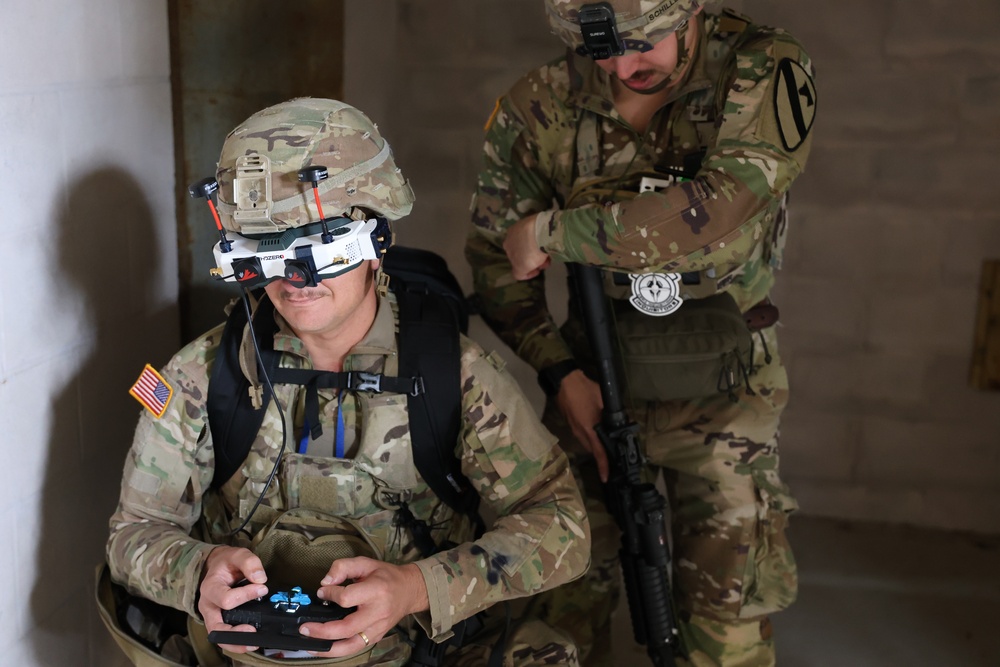
Photo By Leslie Herlick | Sgt. 1st Class Corey Ringsmuth, an unmanned aircraft systems instructor-writer from...... read more read more
FORT RUCKER, Ala. – The Army Drone Team competed in the National Drone Association’s Drone Crucible Competition Dec. 4-6, joining some of the military’s top drone operators and industry experts in a series of combat-focused challenges.
The event, held at Camp Blanding, brought together teams with their own unmanned aircraft systems to test and refine squad-level drone capabilities. Scenarios included close-quarter breaching and room clearing, strikes against moving enemy convoys and aerial targets, long-range engagements on critical assets, and integrated missions against multiple targets and counter-drone systems.
Capt. Jacob Bickus, officer in charge of the Army Drone Team stationed with the 1-145th Aviation Regiment, US Army Aviation Center of Excellence, said the competition was only the third event for the newly formed unit since its launch in September. Over the three-day event, the team, comprised of top drone operators and specialists from across the Army, showed they belong among the military’s leading drone experts in both technical and tactical drone employment.
Chief Warrant Officer 2 Scott Carpenter, an unmanned aircraft system operations technician from the 20th Special Forces Group said the Drone Crucible Competition offered a rare chance to bring together some of the Army’s best minds in unmanned systems.
“I think it’s a great way to bring all those different viewpoints and experiences and really generate the best tactics, techniques and procedures,” Carpenter said. “It’s powerful as far as how UAS is employed.”
Carpenter noted that success often hinges on having the right tool for the mission, whether infrared cameras for night operations or quadcopters with prop guards for close‑quarters training. He said developing subspecialties within units could strengthen capabilities across the force.
The event also gave Carpenter, a National Guard Soldier and Dual Status Military Technician, the opportunity to see how active‑duty units are employing drones. “It’s a very good opportunity to get outside of your normal sphere and see what the conventional Army is doing across the nation,” he said. “Even down to the finer details, like what kind of antenna they’re using. It absolutely translates.”
The Army Drone Team’s participation in the Drone Crucible competition is aimed at more than testing equipment though. Capt. Nathan Rosenberger, a military intelligence officer and artificial intelligence technician assigned to the Army's Artificial Intelligence Integration Center in Pittsburgh, said the event highlights the value of working across branches.
“Inter-service collaboration is extremely important,” Rosenberger said. “One of the main takeaways from a competition like this is having all of the services come together, work together, and take some lessons to work from.”
Sgt. Ernesto Viveros, an unmanned aircraft systems operator in the 1st Armored Brigade Combat Team, 1st Cavalry Division at Fort Hood, Texas, said his path to the team began after the Army retired the Shadow system, forcing soldiers to adapt to new platforms. “I’ve been flying drones since August of last year,” Viveros said. “Our chief put us on a path to figure it all out, because he saw what was going on and wanted us to be prepared.”
Viveros said that the rapid pace of innovation has pushed the Army to keep up. “Shadow was an old system, and they just kept it around,” Viveros said. “Now you’ve got conferences, the USNDA, everyone’s trying to learn and buy new systems. From last year it’s just been fast-paced, and we’re jumping on.”
Bickus reflected on the competitive nature of the exercise and the opportunity to train alongside elite units. “Anytime you can train with someone as elite as the Navy SEALs, it’s a good day,” Bickus stated. He also compared commercial drones with systems developed in‑house, noting that Soldiers are still building trust in different platforms. “The more we use them, the more we’ll get comfortable and kind of build trust with certain systems,” he said.
Finally, Bickus addressed the broader learning environment, pointing to the importance of adapting established tactics while observing global drone employment. He remarked that the competition allowed Soldiers to refine their skills in close‑quarters battle scenarios and nighttime operations, while also learning from allied and partner practices.
The Army Drone Team came out on top in many of its matches, underscoring the unit’s rapid growth and potential. The competition, however, was less about winning individual events and more about building trust in emerging systems, refining tactics and strengthening ties across the force. As the Army continues to adapt to the fast pace of drone innovation, the team’s performance at Camp Blanding marked another step toward shaping how Soldiers employ unmanned systems in future conflicts.
| Date Taken: | 12.07.2025 |
| Date Posted: | 12.08.2025 15:30 |
| Story ID: | 553415 |
| Location: | FORT RUCKER, ALABAMA, US |
| Web Views: | 87 |
| Downloads: | 0 |

This work, Army Drone Team advances tactics at Drone Crucible competition, by Leslie Herlick, identified by DVIDS, must comply with the restrictions shown on https://www.dvidshub.net/about/copyright.


No keywords found.





