
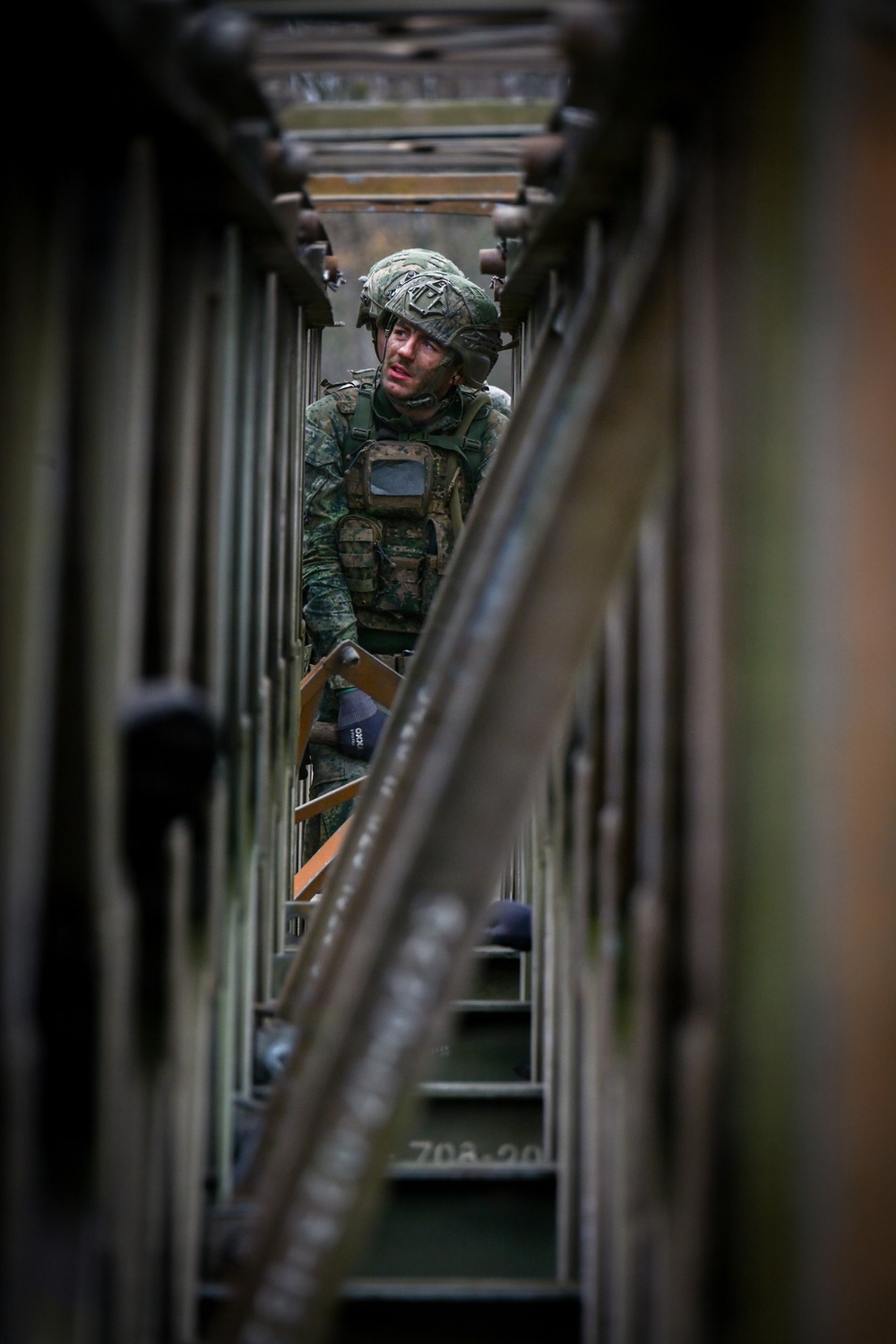
Photo By Aryan Zarinkhesht | U.S. Army Garrison Benelux and the Dutch Officer Engineer School collaborated at...... read more read more
BRUNSSUM, Netherlands - A unique U.S.–Dutch partnership delivered a win-win for both militaries this week, as the Dutch Ministry of Defense (DMOD) Officer’s and Combat Engineering School and U.S. Army Garrison (USAG) Benelux joined forces on Dec. 3 to construct a new Bailey bridge on the Brunssum installation.
Approximately 25 Dutch Soldiers constructed the bridge over the existing superstructure - which could no longer support large vehicles - connecting Brunssum central to Brunssum East (BRN-E). The new structure enables safe access for large fire, emergency response and military vehicles by boosting the load-bearing capacity from 20 to 55 tons.
The existing bridge at the site had deteriorated to the point where fire trucks and heavy military equipment could not cross safely. That gap in access presented both a safety risk and a mission-readiness limitation.
As they became aware of the safety concern in the summer of 2025, members of the USAG Benelux Directorate of Public Works (DPW) at Brunssum got their problem-solving skills in motion. “We came up with an idea to build a bridge on the bridge,” said Martinus “Mike” Janssen, a construction engineer at Brunssum.
The garrison team at Brunssum is very familiar with the Bailey bridge concept because the design is a quite usual sight in the Dutch landscape. The modular structure was developed during World War II, and the country has a long and well-established history with such crossings. During and after World War II, Dutch Army engineers became recognized for their ability to rapidly deploy Bailey structures across rivers, canals, and damaged infrastructure — a capability that supported national rebuilding and NATO missions alike. Dutch military engineers still train extensively on modular bridging systems, maintaining a reputation for precision and efficiency. Reaching out to the military school quickly appeared to be the solution. The team contacted Warrant Officer Ben Hoving, head of the Dutch School for Bridging and Sailing course near Eindhoven. Constructive discussions resulted in creative proposals that could meet both the garrison need and the Dutch military training requirement - a Bailey bridge that is modular, fast to assemble and ideal for engineer-training environments. With aligned timelines and available materials, the collaboration moved forward quickly and seamlessly. “We heard about the problem for the fire truck. So, yeah, we had to do something.” We came up with a plan to build a Bailey Bridge and our colonel also agreed to do the project here,” Hoving said. “Normally we build a bridge, and after that you have to take it down and clean it. Now they know the bridge will remain here, and it's for a very, very, very good purpose. For the mindset, it's very good for them and it's good training.” During the execution phase, the trainee engineers found themselves immersed in a real-world situation. Upon arriving at the installation, they learned their assignment for the day and proceeded to carry out every stage of Bailey bridge construction: site preparation, assembly, alignment, anchoring, and load testing – practical skills that form the core of the school’s training mandate. A win for all, the construction met all expectations - live, hands-on training for Dutch military engineers and a fully restored, 55-ton capacity crossing for the garrison. Since the school utilized excess bridging materials already on hand, the project came at no cost to the U.S. government. ““The collaboration between USAG Benelux and the Dutch Military Officer’s Engineering School has proven to be highly beneficial—providing students with graduation credits while enabling USAG Benelux to gain full access to BRN-E,” said Col. Patrick J. Hofmann, USAG Benelux commander. Dutch leaders from the Military Engineering School and from the DMOD had the opportunity to join their U.S. partners during an award ceremony upon construction completion. “I recognize the Dutch Military Officer’s School for their vital role in advancing critical infrastructure here at Brunssum,” Hofmann said, highlighting a “significant step forward in strengthening our partnership with our NATO Allies.”
| Date Taken: | 12.02.2025 |
| Date Posted: | 12.08.2025 11:31 |
| Story ID: | 553368 |
| Location: | BRUNSSUM, NL |
| Web Views: | 110 |
| Downloads: | 0 |

This work, Bailey bridge construction enhances Benelux readiness at Brunssum, by Marie-Lise Baneton, identified by DVIDS, must comply with the restrictions shown on https://www.dvidshub.net/about/copyright.


No keywords found.





