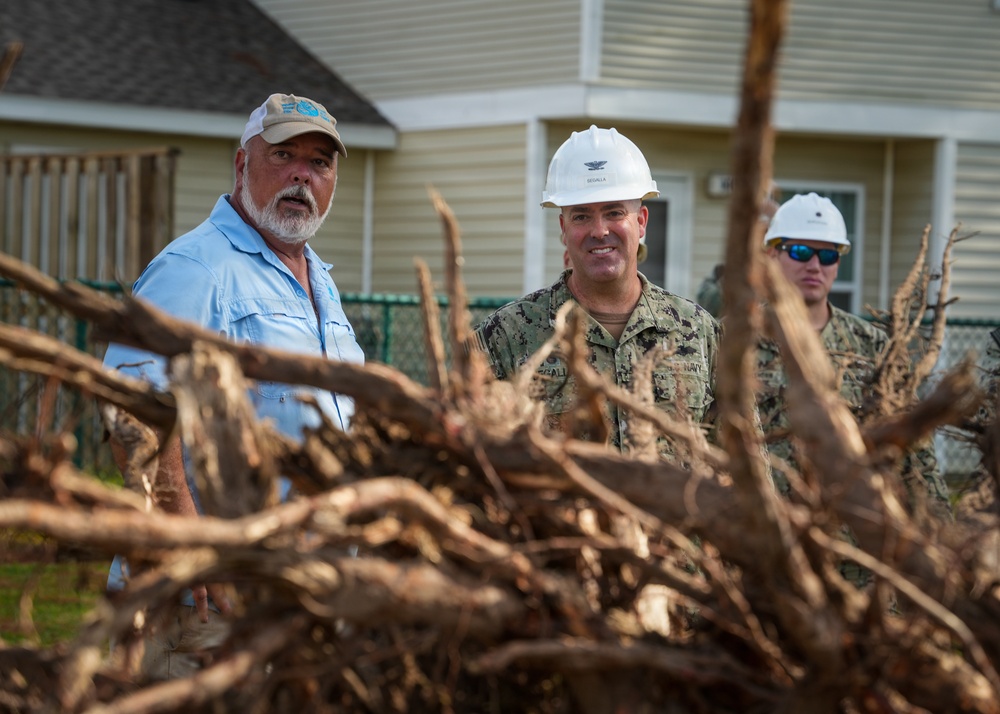
GULFPORT, Miss. (Sept. 30, 2025) In the humid late-summer heat of the Gulf Coast, the buzz of chainsaws marked a first of its kind training, as a certified master arborist trained U.S. Navy Seabees apart of Naval Mobile Construction Battalion (NMCB) 11 in advanced tree-removal and vegetation management techniques. Skills that often mark the first step in expeditionary construction and disaster response missions.
For Seabees, the ability to clear terrain efficiently and safely can be the difference between a delayed response and timely mission success. The two-day hands-on training brought real-world arboricultural science into a field environment, sharpening skills essential for expeditionary operations around the globe.
The training began with demonstration and instruction on tree health, structure, and risk assessment, then moved into the hands-on phase, where Seabees donned personal protective equipment and applied lessons in directional felling, limbing, bucking, and storm-damage removal.
“This is a cool experience for me as an SW,” said Steelworker Constructionman Fredrick Baehre. “I am getting to learn things outside of my general rating, that I will be able to apply out on a job site pretty regularly, and I am getting to learn it from the professionals.”
Master arborist guidance emphasized not just cutting techniques, but understanding how trees react under tension, compression, and environmental stress, knowledge that can prevent accidents and speed up operations in crisis scenarios.
“The techniques we learned this week will be critical for disaster response,” said Steelworker 2nd Class Samuel Sanford, a project leader on the Construct Gulfport Protective Wall Project with NMCB 11, the site the training was being held at. “Knowing how to size up a downed tree, where to make a safe cut, and how to use our tools effectively means we can clear roads or construction sites faster without risking injury.”
Civilian arborists bring decades of specialized experience that complements military field engineering. For Seabees, whose operations often begin by shaping the natural environment, that expertise is a force multiplier.
“This kind of partnership is invaluable,” said Lt. Thomas Lariviere, a battalion Company Commander, whose company oversees the protective wall project. “Seabees thrive on adaptability and ingenuity, but expert training like this gives them an edge. It keeps our Sailors safer and helps them stay mission-ready no matter the conditions.”
In humanitarian assistance and disaster relief operations, Seabees are often among the first responders, called on to reopen roads, clear debris, and establish forward operating bases. The ability to understand the terrain, respect environmental risks, and work efficiently in challenging conditions is vital.
“When a hurricane or typhoon hits, time is everything,” added Steelworker 1st Class Emily Bollin, the Battalion Safety Lead Petty Officer. “We’re often working in unstable environments. Learning the arborist’s approach to hazard trees gives us a level of confidence that we can get the job done and keep each other safe.”
For more than 80 years, Seabees have built and rebuilt critical infrastructure in some of the world’s toughest environments, from Pacific Island jungles during World War II to disaster-stricken regions today. Terrain preparation has always been at the heart of operations.
Bringing in a master arborist underscores the Navy’s ongoing commitment to improving that capability and passing on skills that will be vital for future missions.
“Seabees have always been known for making the impossible possible,” said Lt. Lariviere. “When we acquire shared knowledge, we’re investing in the safety and success of the entire battalion.”
NMCB 11, assigned to Naval Construction Group (NCG) 2, is homeported in Gulfport, Miss. as part of the Naval Construction Force.
The mission of NCG 2 is to organize, man, train, maintain, and equip Naval Construction Regiments (NCRs), NMCBs, the Construction Battalion Maintenance Unit (CBMU), and the Underwater Construction Team (UCT) to provide supported commanders with expeditionary engineering forces capable of general engineering and construction, and limited combat engineering across the full range of military operations.
| Date Taken: |
09.30.2025 |
| Date Posted: |
12.07.2025 21:14 |
| Story ID: |
553335 |
| Location: |
GULFPORT, MISSISSIPPI, US |
| Web Views: |
145 |
| Downloads: |
0 |
PUBLIC DOMAIN

This work, Digging In and Branching Out: Master Arborist Brings Critical Skills to Seabees, by PO2 Alexa Trafton, identified by DVIDS, must comply with the restrictions shown on https://www.dvidshub.net/about/copyright.