Leaders of WWII Namesake Submarines Carry Legacy Forward
Courtesy Photo |
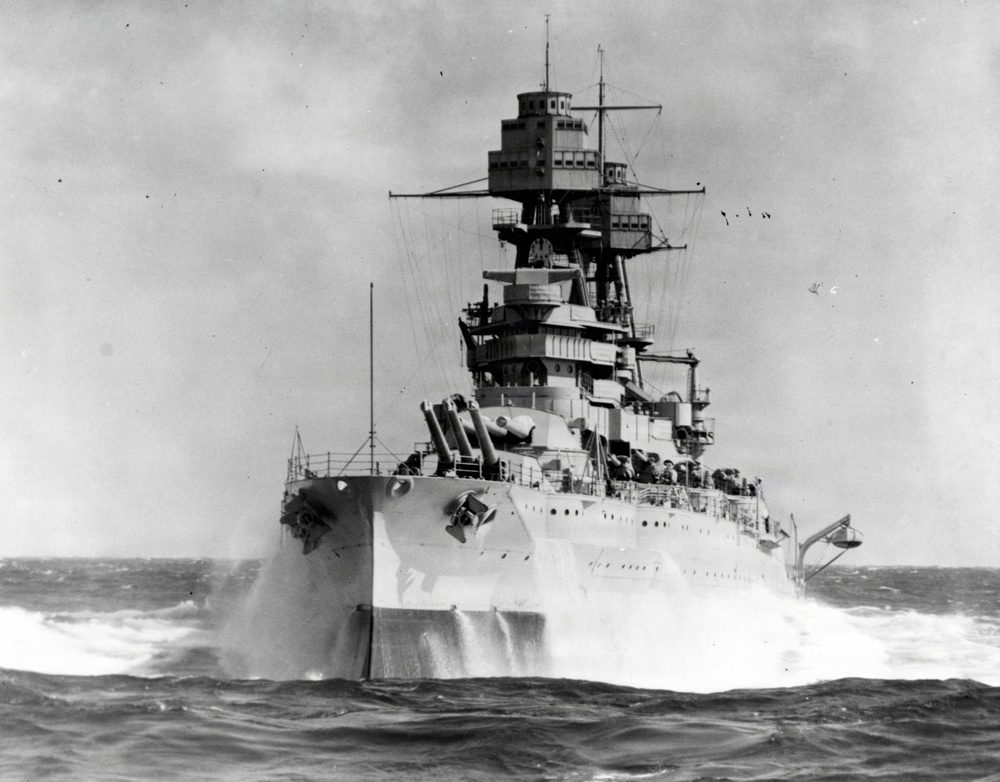
USS Arizona (BB 39) is shown pitching in heavy seas during the 1930s. (Source: Naval......read moreread more
Courtesy Photo | USS Arizona (BB 39) is shown pitching in heavy seas during the 1930s. (Source: Naval History and Heritage Command) see less
| View Image Page
JOINT BASE PEARL HARBOR-HICKAM, HAWAII, UNITED STATES
Leaders of WWII Namesake Submarines Carry Legacy Forward
This year’s Pearl Harbor Day observance marks the 84th anniversary of the surprise attack on the U.S. Pacific Fleet by Japanese forces. The commemoration honors and remembers the more than 2,400 service members and civilians who died on Dec. 7, 1941, and plunged the U.S. into World War II.
On that fateful day, 21 ships were damaged or sunk including the USS Arizona (BB-39), USS Utah (AG 16) and USS Oklahoma (BB-37). All three ships sustained significant damage and loss of life and remain in Pearl Harbor. Their legacy lives on in three Virginia class fast-attack submarines that will bear their names.
Leaders from the USS Utah (SSN 801) and the USS Arizona (SSN 803) recently reflected on what it means to share the names of the sunken battleships and to continue their legacies. The nuclear-powered submarines are currently under construction at the General Dynamic Electric Boat Shipyard in Groton, Connecticut. Builders expect to complete the USS Utah in the fall of 2026 and the USS Arizona in the fall of 2028.
“We are stewards of that legacy. We have the honor of carrying on and establishing that name to the active roster. We are humbled by it,” said Cmdr. Christopher Hornung, commanding officer of Pre-Commissioned Unit (PCU) Utah.
Chief of the Boat Electronics Technician, Submarine, Navigation Master Chief Dave Jackson for Pre-Commissioning Unit (PCU) Arizona explained that his crew is undergoing rigorous training to become battle ready, which ultimately promotes peace.
“We have a very capable warship, and our job is to build a very capable crew to operate that warship,” said Jackson. “A capable crew with all the right tools can foster peace throughout the world because people do not want to find out what the business end of our submarine looks like.”
History of World War II-Era Ships
USS Utah was a 21,825-ton Florida class battleship that served in World War I. In 1931, the ship was recommissioned, modernized, and fitted with anti-aircraft guns, so naval aviators could complete gunnery training. On Dec. 7, Utah was struck by two Japanese torpedoes that caused it to capsize. Fifty-eight Sailors perished. The site has become a protected war grave on Ford Island.
USS Arizona was a 31,400-ton Pennsylvania class battleship that served in European, Caribbean, and Atlantic waters. In 1939, the ship was modernized and later transported President Herbert Hoover. It performed operations with the Battle Fleet for a decade before being stationed in Pearl Harbor. During the attack, Arizona was hit by multiple bombs one of which detonated the ammunition magazines in her forecastle. An enormous explosion followed, destroying the ship’s forward hull and causing her to sink, taking the lives of 1,177 crewman who died aboard. Arizona suffered half of all the Dec. 7 casualties. In the 1960s, the USS Arizona Memorial was built above the remains of the sunken battleship and honors the crewman who perished.
USS Oklahoma was a 27,500-ton Nevada-class battleship that operated in Atlantic and protected convoys in European waters. In 1919, she escorted President Woodrow Wilson and served with the Battle Fleet for about a decade. From 1927 to 1929, Oklahoma was modernized, making her more battle ready. During the Spanish American War, she helped evacuate U.S. citizens and others. In 1940, Oklahoma was transferred to Pearl Harbor. During the Dec. 7 attack, several Japanese aerial torpedoes struck ship, tearing open her port side and causing her to roll over and quickly sink to the harbor bottom. Navy Sailors and Navy Yard employees recovered several men trapped in the overturned hull, but 400 crew members perished.
Future Submarine Fleet: Carrying Legacy Forward
Jackson explained that building a high-tech, world-class submarine takes approximately a decade and the crew starts to work and prepare for its eventual launch in the last three to four years of that timeline.
The final submarine crew will consist of approximately 135 to 145 submariners. Right now, the Arizona crew has 48 submariners on site; the crew is added incrementally as the submarine achieves building milestones.
“Those sailors are getting ready for what we call initial fill,” Jackson explained. “Which is when we start to actually use the engine room. That's the part of the submarine that we had first. We start to test the systems, ensure that there’s no leaking in the piping, and that they’re all working as designed, and that the systems and components are functioning properly.”
Cmdr. Christian Olsen, commanding officer of the Arizona, said the sub has added lethal capabilities that increase his crew’s ability to “achieve peace through strength.”
Arizona is the first of the Virginia-class submarines to have a Virginia Payload Module, meaning it has a hull that is about 90 feet longer and can launch approximately 40 missiles instead of 12 like other Virginia-class submarines.
In 2024, Olsen participated in Exercise Rim of the Pacific (RIMPAC), the world’s largest maritime exercise that takes place every two years in and around the Hawaiian Islands. More than 30 navies from around the world take part in the five week-exercise. Olsen said RIMPAC reminded him of how the Navy has formed partnerships with numerous countries since 1941.
“It’s a reminder of where we were, but also how far we’ve come since then,” he explained.
Hornung said his crew plans to honor the legacy of the Utah by maintaining high standards each day and charting their own path.
“We have a responsibility to honor it to make sure that we’re living up to it in our daily lives and daily operations and in the history that’s going to be (SSN 801) in the future,” he said.