
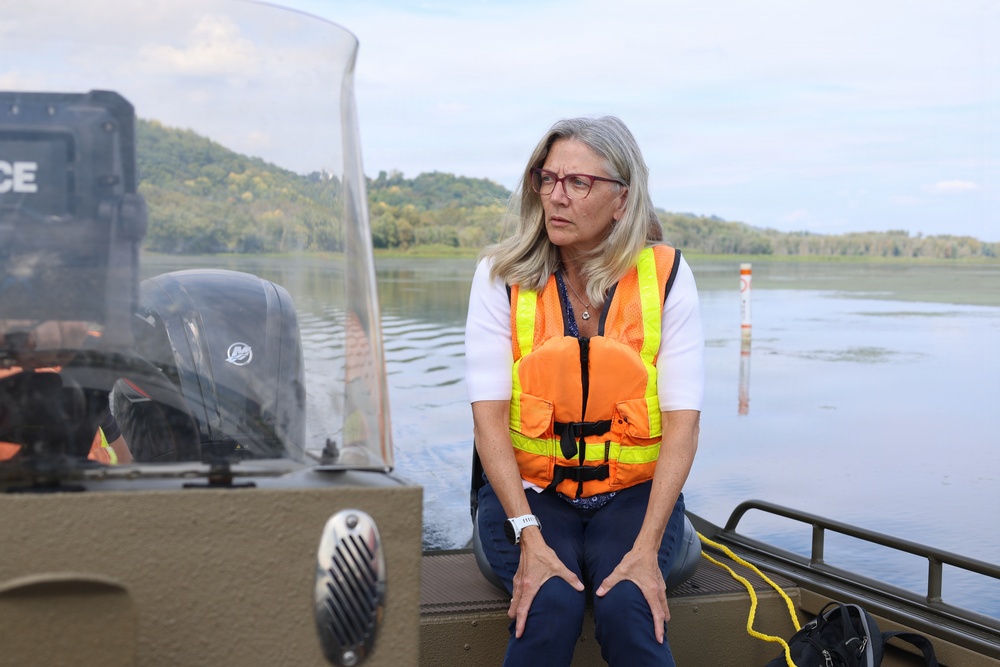
Photo By Melanie Peterson | Raylene Hylland, project engineer, rides in a boat to visit the Lower Pool 10 habitat...... read more read more
The U.S. Army Corps of Engineers, St. Paul District, is building islands upstream of Lock and Dam 10 in Guttenberg, Iowa, as part of the Lower Pool 10 Habitat Rehabilitation and Enhancement project. The overall project purpose is island restoration and preservation by placing sand, riprap (or rock) and topsoil on the islands to rebuild or save them from high water events and erosion along the river.
“This project is important because without this work, we’re seeing erosion of the islands and loss of trees and habitat for eagles and other birds,” said Raylene Hylland, project engineer and contracting officer representative.
There are multiple benefits including deepening overwintering habitat for fish, habitat for migratory and native birds, and island preservation from erosion. “The overall benefit is for the health of the river,” she said.
Beneficial use of river sand
The sand material used to create the islands is mostly taken from nearby McMillan Island in Pool 10, a river sand placement site. The river sand is regularly placed there when it is dredged from the Upper Mississippi River navigation channel.
In 2024, this maintenance of the channel made way for 10.9 million tons of commodities to be moved through Lock and Dam 10 by the shipping industry. When material from McMillan Island is depleted, the material for the island-building will be taken directly from the channel. In this way, the St. Paul District is beneficially using material that had to be removed anyway and giving it a new purpose.
Additionally, the topsoil will be taken out of nearby Bussey Lake. The topsoil is used to promote tree and vegetation growth on the islands. The deeper water in the Bussey Lake backwaters will provide an overwintering habitat to help fish survive cold winters.
Staged project
The overall project is split into three stages. Stage 1, which focuses on South Ferry Slough, was awarded in November 2024 and began construction in August 2025. With a budget of $11 million, stage 1 is projected to be completed by 2027.
This season, the contractor, Legacy Corporation of East Moline, Illinois, will finalize the construction of the largest island within the project.
“What I think is interesting, is that this first island has over a third of the sand for stage 1 and is a little over half a mile long and 120 feet wide. If the sand was placed on a football field, it would be 30 feet high,” Hylland said. “The project has 65,000 tons of rock, which would be more than 3,000 dump trucks full of rock. The topsoil is half of the quantity of the sand. The project is built with sand, rock and topsoil in that order. Then we seed it and plant trees, and we have a year for that to establish and it’s considered finished.”
Pending funding, the goal is for all three stages to be completed by 2030 and to target North Ferry Slough and the McMillan Island complexes in additional construction contracts.
Challenges and coordination
A project of this magnitude presents its own challenges, Hylland explained. The contractor must follow various special use permits, which includes the Eagle Exclusion Zone. This states that you cannot work within 660 feet of an active eagle’s nest from Jan. 15 until the young eaglets fledge, which is typically mid-June but can be later. There are several active eagle’s nests within the construction zone.
The contractor must also avoid mussel beds containing federally listed Higgins’ eye pearly mussels, abide by northern long-eared bat restrictions, and stop work by Oct. 15 for the migratory bird restrictions in the area. “Planning and staging for the contractor is critical,” Hylland said.
The project was planned in coordination with the U.S. Fish and Wildlife Service, the Iowa and Wisconsin departments of natural resources, and input from the local community.
This project is part of the Upper Mississippi River Restoration program. The program ensures the coordinated development and enhancement of the Upper Mississippi River system with a primary emphasis on habitat restoration projects and resource monitoring. In the 39-year history of the program, more than 60 habitat projects benefiting approximately 100,000 acres from Minneapolis to St. Louis, have been completed.
-30-
| Date Taken: | 12.05.2025 |
| Date Posted: | 12.05.2025 16:16 |
| Story ID: | 553195 |
| Location: | GUTTENBERG, IOWA, US |
| Web Views: | 157 |
| Downloads: | 0 |

This work, An island state of mind: Island building project provides multiple benefits, by Melanie Peterson, identified by DVIDS, must comply with the restrictions shown on https://www.dvidshub.net/about/copyright.


No keywords found.





