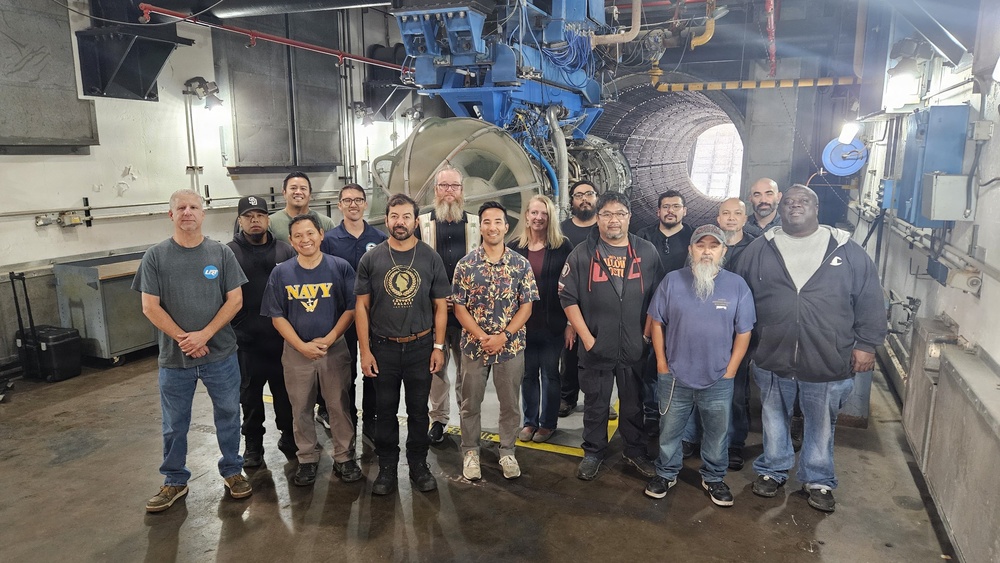
Fleet Readiness Center Southwest’s (FRCSW) LM2500 engine program achieved remarkable success in FY25, surpassing production goals despite facing significant challenges. The team’s dedication, expertise, and innovative approach have made this program a standout example of excellence in military aviation and ship maintenance. From personnel shortages to facility constraints, the team rose to every challenge, delivering results that exceeded expectations.
The LM2500 engine is the backbone of naval ship power. It is used primarily on destroyers and rapid response ships and is a critical component of the U.S. Navy’s fleet. This engine, known for its durability and reliability, powers some of the most advanced warships in the world but as with all mechanical devices it requires maintenance and that is where FRCSW comes into play.
The FRCSW LM2500 team is led by Deputy Program Manager, Mr. Christopher Sturm and Production Manager Jack Jackson. The team’s success didn’t come easily. Throughout FY25, they were faced with numerous obstacles, from significant personnel losses to aging facilities and supply shortages. The program lost 22% of its workforce through the Deferred Resignation Program (DRP), reducing their team to just 55% of the staff they had previously been allotted. Additionally, only one of the two test cells remained operational, and the team had to work without a key test cell operator for much of the year. Nevertheless, they continued to meet mission demands, producing more engines than ever before. Facility challenges, such as the outdated Mark III grinder, were another hurdle, but despite these challenges, the team remained determined and adaptive, responding to every challenge with resilience. FRCSW's engineers and leadership worked quickly to address the issues. The supply team worked in collaboration with NAVSEA and NAVSUP to ensure parts were pre-processed and available when needed and the addition of new equipment and processes, [including a brand new grinder](https://www.dvidshub.net/news/546167/fleet-readiness-center-southwest-revolutionizes-engine-repair), helped increase efficiency and overall production.
In FY25, the LM2500 program reached new heights in throughput. At the start of the year, the team set an ambitious goal to complete 18 engine overhauls. However, that target was quickly increased to 24 engines, 15% more than the command has ever produced previously. The program was able to meet this goal, going well beyond the initial target of 18 engines thanks mainly to exceptional collaboration between the engineering team, leadership, and artisans. Their dedication was evident as the program completed not only full engine rebuilds but also check and test engines, which required quick turnaround times to meet fleet demands. The LM2500 team’s commitment ensured that these check and test engines were returned to the fleet in just 60 days, allowing ships to deploy on time and support critical Navy and Marine Corps operations.
The team consistently went above and beyond, working tirelessly to ensure the men and women of the Navy and Marine Corps have the tools they need to deliver lethality to all American foes. One standout example came when NAVSEA urgently requested an engine for a ship set to deploy in just 10 days. The team responded with incredible speed, testing, assembling, and shipping the engine to Everett, WA, in time for the deployment. This dedication allowed the ship to deploy on time, avoiding costly delays and further demonstrated the exceptional capabilities of the command.
At the same time the team also made significant strides in improving production quality. The first-pass yield, a critical metric for engine overhaul success, skyrocketed to an impressive 100%, an astounding improvement from previous years, when it hovered around 30-35%. This achievement was made possible by the leadership team’s focus on training, process improvement, and collaboration with artisans. Decisions were pushed down to the deck plate, enabling real-time problem-solving and allowing artisans to take full ownership of their work. The team streamlined every aspect of the process, ensuring every minute counted without compromising safety or quality.
The success of the LM2500 program is a direct reflection of the outstanding leadership and collaboration at FRCSW. Leaders like Grover Collins, one of the program’s stars, exemplify the dedication and skill that drive the program’s success. Grover’s willingness to work any shift and perform any task, combined with his deep expertise, has been instrumental in meeting and exceeding production targets. Engineering leaders Maverick Hall and Eliott Kadota have played a crucial role in providing the support needed to ensure the artisans’ success. Their innovative solutions and proactive approach to addressing challenges, whether through new equipment or process improvements, have been essential in maintaining high standards of performance.
As the program continues to expand, FRCSW is looking to the future with a strong commitment to supporting the Navy’s gas turbine engine needs. The program continues to grow, with future expansion into the MT7, MT30, and LM2500+ engine capabilities to support the demand of NAVSEA on LHDs (Landing Helicopter Docks), LCAC (Landing Craft Air Cushion), and other ships as well as the T-408 engine for the H-53K aircraft at PMA-261. Additionally, FRCSW is adding to the commands position as the premier location for all gas turbine engine repairs in the U.S. with a planned MILCON (Military Construction) effort underway to replace the old test cells with new, state-of-the-art facilities.
The team’s success in FY25 has laid the foundation for future growth, with a target of 20 engines in FY26. The LM2500 leadership team is confident that they can surpass this goal, continuing to flex and meet the Navy’s needs no matter the demand and provide the tools necessary for the military to fight and win in any battle.
The FRCSW LM2500 program is the only government repair facility in the U.S. capable of supporting all Navy gas turbine ships, making its work crucial to national defense. With the unwavering dedication of the artisans, engineers, and leadership, the team continues to be one of the most talented and capable groups within FRCSW, providing the Navy and Marine Corps with the engines they need to deliver lethality and readiness on a daily basis. Through creativity, innovation, and teamwork, the LM2500 program has set new benchmarks for production, quality, and service. This success story stands as a testament to the incredible capabilities of the team, whose hard work ensures that the Navy’s mission continues uninterrupted no matter the challenges faced. FRCSW Employees are the Backbone of Military Readiness!
| Date Taken: |
10.31.2025 |
| Date Posted: |
12.05.2025 14:52 |
| Story ID: |
553180 |
| Location: |
SAN DIEGO, CALIFORNIA, US |
| Web Views: |
433 |
| Downloads: |
1 |
PUBLIC DOMAIN

This work, FRCSW LM2500 Program: A Year of Success Amidst Challenges, by Michael A Furlano, identified by DVIDS, must comply with the restrictions shown on https://www.dvidshub.net/about/copyright.