
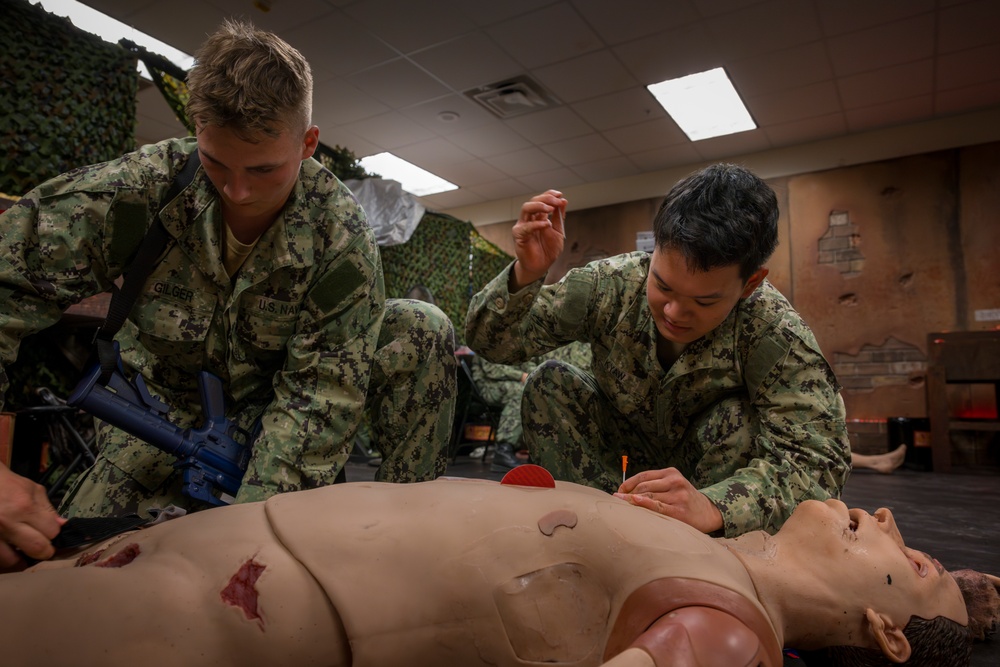
Photo By Malcolm McClendon | Hospitalman Nicole Acostacabrera, left, a Hospital Corpsman Basic student at the Navy...... read more read more
 Subscribe
JOINT BASE SAN ANTONIO-FORT SAM HOUSTON, Texas (Oct. 27, 2025) — Two classes of the Hospital Corpsman Basic (HCB) program at the Medical Education and Training Campus (METC) completed an updated pilot curriculum integrating Tactical Combat Casualty Care (TCCC) principles into entry-level training, marking a shift in how Navy Medicine prepares corpsmen for the modern battlespace.
HCB classes 170 and 190 graduated Sept. 10 and Oct. 7, 2025, respectively, with full TCCC Tier 3 Combat Medic and Corpsman certifications from the Defense Health Agency’s Joint Trauma System, an unprecedented milestone for new accession hospital corpsmen.
Tier 3 Combat Medic and Corpsman TCCC training traditionally occurs prior to deployment or in fleet-training pipelines. Integrating it into the HCB program curriculum means every newly trained corpsman will report to the fleet ready to perform battlefield-relevant lifesaving interventions from day one.
Naval Medical Forces Development Command (NMFDC) collaborated with Navy Medicine Training Support Command, and METC, the tri-service campus that trains Navy, Army, and Air Force enlisted medical personnel, to revise instructional design, align learning objectives, update skills stations, and create scenario-based training modeled after real-world combat casualty situations. Before full implementation, METC must complete validation processes to identify final training gaps and confirm curriculum effectiveness.
“The normal pass rate of HCB, historically, has been about 70 to 80 percent,” said Cmdr. Thomas Sather, the U.S. Navy’s TCCC program director. “For this integration, we had two validation classes. For the first one, we graduated 80 out of 86 students that started the program. The second class that went through validation did even better with 83 out of the 86 students graduating with full certification. So, we're already seeing a graduation rate change from the 70s to around 95 percent. That's huge for us and members of our sea services.”
Sather also said TCCC is a joint services requirement and became the baseline lifesaving standard across the Department of War after policy shifts directed all services to train personnel in combat-relevant casualty response. The Navy Surgeon General identified TCCC as a top priority and directed Navy Medicine to build a scalable program to certify all corpsmen, providers, and eventually the entire Navy force.
“Our job is to support a more lethal, more survivable force,” said Sather. “If we can stop bleeding, secure an airway, and get a patient to the next level of care, we can save lives on the battlefield. And our battlefield isn’t just on land—it’s in the littorals, at sea, anywhere the Navy finds itself. It’s truly a team effort.”
To meet Navy-wide requirements, Sather’s team trained nearly 7,000 personnel in fiscal year 2025, exceeding initial goals by more than 40 percent.
“We increased our instructor cadre across the Navy and Marine Corps by over 330 certified instructors over the past year,” said Sather. “These instructors can train everyone from providers to entry-level Sailors. “The goal is to build a self-sustaining system across the Navy.”
New corpsmen will receive training on various skills ranging from bleeding control interventions, airway and respiratory management techniques to prevention and treatment of shock, burns, eye injuries, and splints. Additionally, students will learn various drags and carry skills, communication and documentation of casualty information needed for evacuation.
“Every corpsman graduating from HCB will already be certified at the Tier 3 level,” he said. “That means they’re deployable, and they’re immediately capable of providing lifesaving care in a hostile environment.”
Scenario-based training replicates austere environments found aboard ships, in the littorals, or while attached to Marine Corps air or land units. Students learn to apply tourniquets under stress, manage airways while simulating incoming fire, and conduct rapid trauma assessments in field conditions, training that previously occurred at much later times in a corpsman’s pipeline.
For corpsmen already serving in the fleet, NMFDC is developing a bridge program to bring all Sailors to the full TCCC Tier 3 standard. The bridge course aims to condense the traditionally eight-to-ten-day curriculum into a fleet-friendly format while still meeting certification requirements.
Formalizing TCCC at accession-level training not only enhances Navy Medicine’s ability to build readiness but ensures Sailors enter the fleet prepared for the complex realities of maritime and joint combat operations.
“Integrating TCCC Tier 3 at the accession level strengthens our warfighting foundation,” said Master Chief Hospital Corpsman Charles Padilla, senior enlisted leader for NMFDC’s education and training department. “It ensures every new corpsman joining the Naval force is ready to protect the health and survivability of our Sailors and Marines—an investment in readiness that reflects our commitment to lethality, accountability, and force-wide preparedness.”
NMFDC is the headquarters element designated within the Bureau of Medicine and Surgery as a direct subordinate to the Surgeon General of the Navy, charged with leading and managing all medical training, education, professional development, and instruction to produce highly trained and ready medical personnel.
| Date Taken: | 10.27.2025 |
| Date Posted: | 12.05.2025 15:26 |
| Story ID: | 552972 |
| Location: | FORT SAM HOUSTON, TEXAS, US |
| Web Views: | 250 |
| Downloads: | 2 |

This work, NMFDC Leads TCCC Integration into Entry-Level Corpsman Training at METC, by PO1 Shayla Hamilton, identified by DVIDS, must comply with the restrictions shown on https://www.dvidshub.net/about/copyright.


No keywords found.




