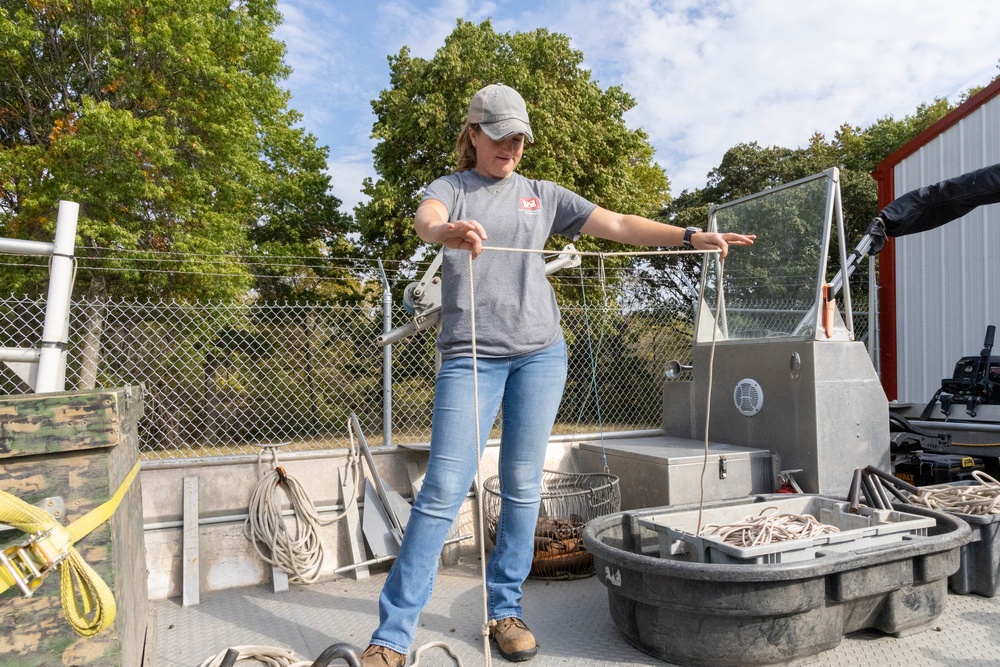
Photo By Christine Reinhardt | Ashlee Korte, fish biologist with the Kansas City District, U.S. Army Corps of Engineers, sets up a trot line, which will be used to try and catch pallid sturgeon for monitoring on the lower Missouri River as part of the district’s fish and wildlife management practices. see less
| View Image Page
Trot lines, and trammel nets and trawls, oh my! Trying to catch the elusive age-one pallid sturgeon
It’s said beauty is in the eye of the beholder. To some, a long-snouted, murky white, boneless bottom feeder native to the Missouri and Mississippi rivers – known as the pallid sturgeon – might not sound very beautiful. To others, the endangered fish is an essential part of the river ecosystem – making it a beautiful creature worth saving.
According to the Missouri Department of Conservation, pallid sturgeon can live up to 40 years and weigh upwards of 100 pounds. Once harvested commercially, the pallid sturgeon is now listed as endangered, in part due to alterations to the Missouri and Mississippi rivers. However, efforts aimed at restoring the population like captive breeding, juvenile stocking and habitat restoration, have made meaningful progress over the past few decades. Still, much remains to be learned, and continued research is essential to fully recover this ancient species.
A balancing act
Ashlee Korte, fish biologist with the Kansas City District, U.S. Army Corps of Engineers, always dreamt of becoming a marine biologist. Originally from southern Illinois, she attended California State University, Long Beach hoping to study and work in the ocean with sharks and other sea creatures. However, a summer internship with the Missouri Department of Conservation in St. Louis drastically changed her career trajectory.
“The summer of 2022 I was working on the Missouri and Mississippi [rivers], and I completely fell in love with it,” said Korte. “I was like, ‘this is the best thing ever.’”
After graduating the same year, Korte was hired by the Kansas City District in the science and monitoring section of the district’s planning branch. As a USACE fish biologist, she is part of a team that monitors pallid sturgeon on the lower 250 miles of the Missouri River. Monitoring includes marking and recapture techniques, genetic sampling and other tracking efforts to determine if pallid sturgeon are successfully reproducing in the wild.
“If we can determine what the recruitment rate is, we can make a better estimation of the overall population,” said Korte. “Then we can make informed management decisions to support population growth.”
Easier said than done considering USACE balances eight different congressionally authorized purposes on the Missouri River. From flood control and water supply to recreation and navigation, there are many competing missions on the nation’s longest river. Korte and her fellow biologists’ work focuses on meeting requirements under the Endangered Species Act so USACE can continue to fulfil its mission on the river.
“If we know how many fish are recruiting to the population each year … we can determine if the population is recovering or not,” said Korte. “We’re also working to better understand the habitat these fish are using.”
Each year, the U.S. Fish and Wildlife Service, along with other agencies, stock pallid sturgeon in the Missouri River. Reproductively mature adults are brought to a hatchery in Yankton, South Dakota, where they spawn. Their offspring are then released into the river as either newly hatched fish or age-one fish with the hope that they will survive, recruit to the population and eventually reproduce on their own.
Biologists like Korte work throughout the year to monitor and track the pallid sturgeon to determine whether spawning is occurring naturally. But there’s a catch – effectively tracking and monitoring pallid sturgeon after they’ve been released from the hatchery at age-one has proven to be extremely challenging.
“We need to [monitor] the age-one life stage because once fish make it from baby to age-one, their chances of survival increase and they can ultimately recruit to the population,” said Korte. “But we haven’t been able to consistently catch fish at that age.”
Male pallid sturgeon take eight to 10 years to mature and females take 15 to 20 years to mature. If biologists can’t track and monitor the fish from age-one to juvenile, they can’t determine the best management practices to help the pallid sturgeon recover.
“We catch the babies – we know how to do that really well,” said Korte. “We know how to catch the adults, but we still have no idea how to reliably catch age-one fish.”
Nevertheless, she persists
The challenge of catching age-one pallid sturgeon was the topic of conversation at an annual Pallid Sturgeon Science meeting in early 2024. According to Korte, the group – made up of federal and state fish and wildlife agencies – meets once a year to discuss management actions, objectives and ongoing challenges. The big question to come out of last year’s meeting: how to effectively catch and monitor age-one pallid sturgeon?
Following the meeting, Korte’s supervisor approached her with the idea for a graduate research project focused on that exact question. Now pursuing a master’s degree in natural resources and ecology management, Korte is focused on determining the most effective methods to capture age-one pallid sturgeon in the lower Missouri River.
“That is really the question I am trying to answer – how to catch age-one pallid sturgeon on the lower Missouri River,” said Korte. “Once we can catch them, then we can start making hypotheses as to which habitats they do well in and start making inferences on what’s happening with the population.”
So far, Korte has attempted three different methods for catching age-one pallid sturgeon. Trot lines, trammel nets and trawl nets. According to Korte, there are two types of gear in the fisheries world – passive and active. Trot lines are passive because they are set in the water and rely on the fish to encounter and be captured by the gear. Whereas trammel and trawl nets are active because a boat moves the nets through the water to intentionally encounter and capture the fish. Unfortunately, Korte has not had much success with any method over the past few months.
“Of the 500 fish that I stocked, we have caught 26,” she said.
Despite the frustration of not effectively catching age-one pallid sturgeon, Korte is not discouraged. Approaching the second year of her graduate project, she will continue her focus on determining the best method for catching age-one pallid sturgeon. Perhaps a different type of net or gear will work more reliably. Whatever happens, the stakes of Korte’s work remains at the forefront.
“All species have a role in the ecosystem,” said Korte. “Endangered species are especially important and pallid sturgeon are at risk for a reason. We need to do what we can to help recover the population.”