P-834 Service Pier Extension Strengthens Naval Base Kitsap-Bangor’s Role in Indo-Pacific Security
Photo By Sarah Lincoln |
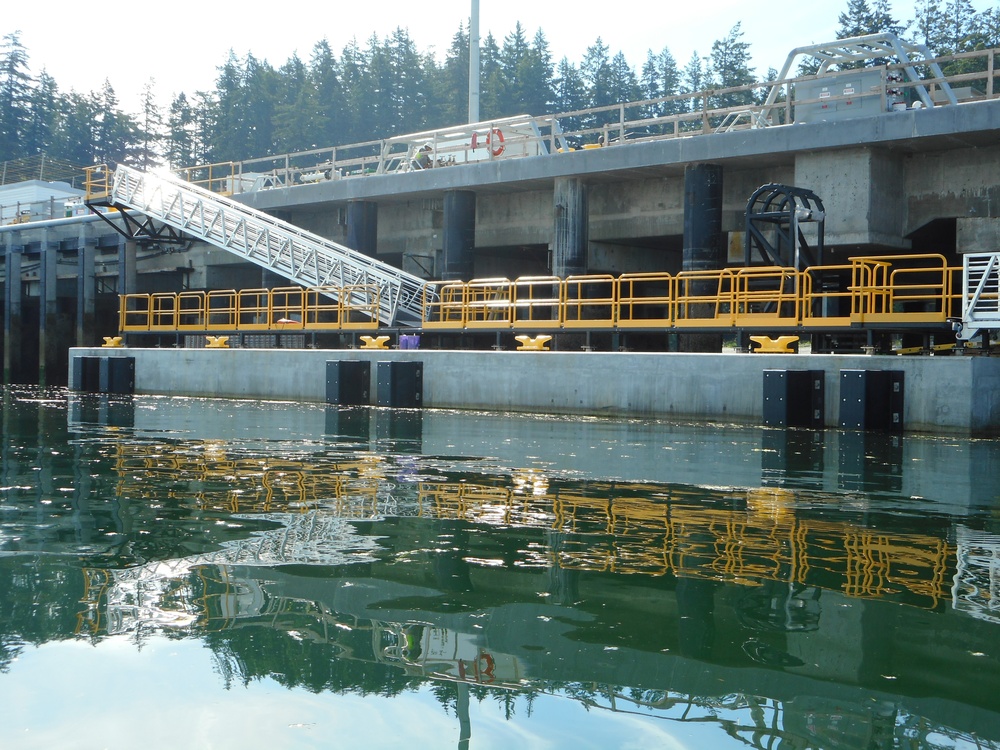
Photo of final installation of P-834 captive camel at the finished service pier......read moreread more
Photo By Sarah Lincoln | Photo of final installation of P-834 captive camel at the finished service pier extension at Naval Base Kitsap-Bangor. (Courtesy U.S. Navy photo/RELEASED) see less
| View Image Page
P-834 Service Pier Extension Strengthens Naval Base Kitsap-Bangor’s Role in Indo-Pacific Security
Project 834 (P-834) Service Pier Extension, overseen by Naval Facilities Engineering Systems Command (NAVFAC) Northwest at Naval Base Kitsap-Bangor (NBK-Bangor) in Washington state, delivers critical new berthing, homeporting, and repair capacity for SEAWOLF-class submarines and visiting submarine platforms. The $91 million military construction effort expands the existing service pier while meeting stringent requirements for durability, operational flexibility, and environmental resilience in one of the U.S. Navy’s most challenging waterfront environments.
Built as an independent structure, the pier extension measures 520 feet in length and 68 feet in width, supported by steel pipe piles. The extension is separated from the existing pier by a 24-inch seismic joint to accommodate movement during Pacific Northwest-prone seismic events. The pier superstructure combines precast, prestressed concrete deck panels with cast-in-place concrete composite topping to achieve the strength and service life requirements required by the Department of Defense’s Facilities Criteria and discipline-specific Unified Facility Criteria.
Two floating concrete camels were installed on the north face of the extension, along with precast concrete fender piles and rubber arch fenders to protect both the pier and vessel. Additional small craft floats, one new concrete foam-filled float and one reused steel float, were installed along the landside faces to provide auxiliary mooring capacity.
P-834’s primary operational driver was the relocation of two additional SEAWOLF-class submarines from Bremerton to Bangor. These vessels require berthing systems that can withstand the Pacific Northwest’s extreme tidal swings, which can reach up to 20 feet, as well as heavy seasonal winds and wave conditions. To address this, the design team incorporated a “captive” camel mooring system. Unlike traditional steel camels which are prone to corrosion and require frequent maintenance, the P-834 captive camels are constructed from lightweight marine concrete. The captive camels are foam-filled for buoyancy and designed with a sloped berthing to accommodate both current and future submarine hull forms. Rubber arch fenders absorb berthing forces, and titanium attachment hardware allows for faster and easier fender replacement over the pier’s service life.
There were several considerable engineering challenges of the floating captive camel system. First, stability had to be assured across every stage, from fabrication and dry dock launch to delivery and final installation. Second, the asymmetrical section required by the sloped berthing face increased sensitivity to weight distribution, making precise control of center gravity essential. There were also draft limitations at the dry dock, which necessitated a lightweight concrete mixture to enable launch, leaving just enough clearance to free the camels from the dock floor. It was also challenging to form and detail the tall, thin concrete walls for the hydrostatic load resistance that required extremely tight tolerances, including post-tensioning in both vertical and horizontal directions ensuring watertight joints.
Precast construction was used extensively to shorten the project schedule and improve overall quality control. At the pier level, four distinct precast panel types were fabricated to accommodate varying prestress requirements, widths, and thickness. Precast trench lids reinforced with wide flanges were designed to support heavy vehicular loads while remaining removable for maintenance. Precast vertical panels were also used to construct a roughly 64 foot wave screen, shielding small craft floats on the landside of the extension from wave action. The use of extensive precast elements allowed for a majority of the complex reinforcement and geometry to be completed under controlled plant conditions, reducing labor and improving dimensional accuracy for draft-sensitive floating structures.
The P-834 team also incorporated multiple layers of corrosion protection. Adding to watertight construction, the design used epoxy-coated rebar, low chloride permeability concrete mixes, and cathodic protection systems for embedded metals. Unsurprisingly, the Navy’s concrete requirements are among the most rigorous in the nation due to maritime conditions, including service life modeling to verify a 50-year design life.
Strategically, the P-834 Service Pier Extension enhances NBK-Bangor’s ability to support multiple submarine classes, both homeported and visiting. By increasing berthing capacity and integrating innovative mooring and fender systems, the pier extension enhances operational readiness for the Pacific Fleet in a location vital to national defense. The combination of durable construction, precise engineering, and environmental adaptability ensures the pier extension will remain a critical asset for decades, with reduced maintenance demands and increased operational versatility.
NEWS INFO
Date Taken:
12.02.2025
Date Posted:
12.02.2025 13:44
Story ID:
552752
Location:
SILVERDALE, WASHINGTON, US
Web Views:
586
Downloads:
0
PUBLIC DOMAIN
This work, P-834 Service Pier Extension Strengthens Naval Base Kitsap-Bangor’s Role in Indo-Pacific Security, by Sarah Lincoln, identified by DVIDS, must comply with the restrictions shown on https://www.dvidshub.net/about/copyright.