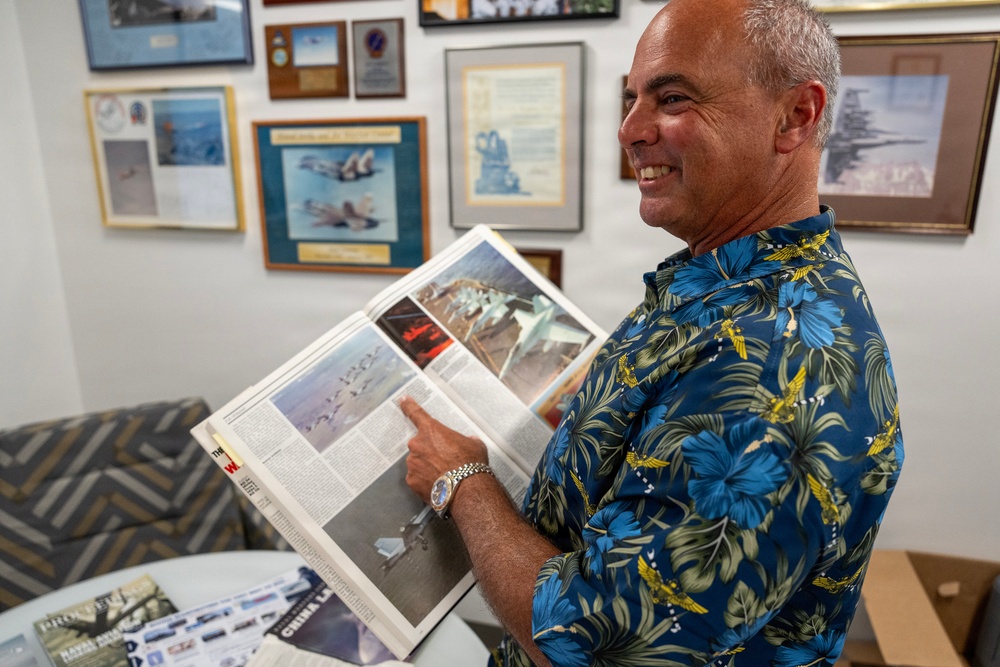
In combat over the Red Sea, an "ancient weapon" that most junior aviators had never heard of struck its targets with precision.
For Dan Carreño, who had delivered those missiles to the fleet years earlier, the strike was proof of what his 35 years at Naval Air Warfare Center Weapons Division were always about: giving warfighters what they need, when they need it.
Carreño grew up in Tampa, spending weekends hauling furniture for his grandparents’ moving company.
“It was sweaty work, and it motivated me to do something else,” he said. Among the first in his family to attend college, he turned to aerospace engineering as a way to build a future beyond the moving trucks.
Shortly after, a friend gave him a book on modern warplanes. It showed an impressive photo of nine F/A-18s from Air Test and Evaluation Squadron (VX) 5 flying over the Mojave Desert at China Lake. He still keeps a copy of that book in his office today.
Carreño thought, “China Lake. Ain’t no lake there!”
By fall 1989, defense jobs were hard to come by. Carreño encountered a hiring freeze at the Department of Defense. In his university career guide, he noticed an entry for the Naval Weapons Center in China Lake, California. It featured a photo of an F/A-18 with a weapon attached.
"Oh my gosh, that's that miserable place," he remembered thinking.
Carreño always dreamed of being a fighter pilot. But poor eyesight made him focus on a different path.
"I was in ROTC for a little bit, but the Air Force wasn't going to let me fly," he said. "Well, if I can't fly them, I'll design them."
As he read the job description, his perspective shifted. Here was an opportunity to design ramjets and rocket motor weapons, exactly the kind of cutting-edge propulsion work that had drawn him to aerospace engineering. For Carreño, it represented the next best thing to his original dream.
He sent his résumé overnight mail and made the call that would change his life.
The hiring manager told him they had 13 slots left for their junior professional program and about 100 résumés. The odds seemed long, but his aerodynamics professor had worked at China Lake years earlier and agreed to make a call.
That recommendation made the difference.
Soon Carreño was flying west, where his first supervisor, Scott Fuller, now director for energetics, picked him up from a Motel 6 in a 1968 Camaro convertible.
Today Carreño leads more than 6,000 military and civilians as executive director of NAWCWD, a role he assumed in 2021. The journey began in the desert labs. A young propulsion engineer found out that late nights and urgent deadlines were part of keeping the fleet ready.
Carreño arrived at China Lake in 1990 to find himself in the middle of nowhere. The base sat isolated, with only the thunder of F/A-18s overhead breaking the silence. That first year became one of his favorites. Long nights with his new teammates showed him something crucial about how this work directly supported warfighters.
He joined the propulsion branch on the Advanced Medium-Range Air-to-Air Missile program. The pressure was high. The team had to deliver performance data to program offices back east first thing Monday mornings, which meant running simulations through the weekends.
That's when Fuller saw what made Carreño different.
"Most engineers are risk averse and want to overanalyze everything before making a decision," Fuller said. "Dan would be saying yes even before you finished asking him the question. It didn't matter what it was. He always gave 110 percent."
Those early years were defined by pizza delivered through locked gates and code that kept them working until dawn. When transmission systems weren't available, Carreño would "sneaker-net," or hand-carry, disks and printouts across base to meet deadlines.
Fuller also saw something deeper than just enthusiasm.
"From the first day Dan started, he had complete clarity as to why we were here: to support the warfighter," Fuller said.
By the mid-1990s, Carreño had become known as an "AMRAAM guy." Colleague Steve Florian, now a propulsion, energetics and systems subject matter expert in the Weapons and Energetics Department, said he remembered Carreño running nearly a million simulations during one propulsion study. His ability to predict outcomes impressed even experienced engineers.
"He could tell you before he ran the flyout if the change was going to be better or worse than the baseline," Florian said. "His dedication to NAWCWD's mission is unwavering, back then and now."
That reputation opened doors, but not all stayed open.
In the late 1990s, Carreño led the Technical Project Office for the Joint Standoff Weapon. Tensions with his supervisor hit a breaking point. On September 11, 2001, the captain called him to the office. Carreño was pretty sure this meeting would end with his firing.
Moments before the meeting began, a deputy came in to say a plane had struck the World Trade Center. The captain turned on his television, and they saw the Twin Towers burning. As the second plane hit and the magnitude became clear, the captain told Carreño he'd get back to him in a minute.
“Take your time, I thought. I know where this is going,” Carreño said.
Carreño was right about his hunch.
"I was trying to do a good job. I was working 14-hour days," Carreño said. "I just wasn't focused on the right things."
A senior leader, who once had the experience of being fired, offered encouragement. He encouraged Carreño to seek new opportunities and move ahead.
Carreño didn't squander the opportunity to reflect. He made a list of things he could have done better and accepted a position as a science advisor at Fallon, Nevada.
“I was discouraged, but the year at Fallon put me back with squadrons and maintainers,” he said. “It grounded me in what the fleet needed right then.”
When senior leaders offered him a path back into NAWCWD, he jumped at the opportunity.
After coming back, he was assigned to the Standoff Land Attack Missile-Expanded Response, or SLAM-ER, which became one of his most significant efforts. He led a small team to develop and test the system, delivering a precision strike capability that extended the Navy’s reach inland.
The program was a success, but the missiles eventually went into storage as newer weapons entered service.
Years later, those same “ancient” SLAM-ER missiles were pulled from storage and used in combat, performing flawlessly.
Rear Adm. Keith Hash, NAWCWD’s commander, said, “when aviators off Yemen needed a capability, they turned to weapons Dan had delivered years earlier. That is the measure of his impact.”
If SLAM-ER proved old weapons could endure, Tomahawk proved they could be reborn.
In 2013, Carreño was selected to head another team. Their goal was to redesign the cruise missile to strike moving ships at sea. For 18 months, his engineers worked in a lab at China Lake, designing algorithms and integrating sensor data. Many doubted it could work, but Carreño kept pushing.
"What do we have right now? That’s what the fleet’s going to fight with," he said.
On Jan. 27, 2015, a Tomahawk launched from USS Kidd (DDG 100) received midcourse updates and struck a moving target near San Nicolas Island. It was the first time the Navy redirected a Tomahawk in flight against a maritime threat.
The test was widely described as “game-changing.” The success propelled Carreño into the Senior Executive Service the following year.
Technical wins matter, but people are Carreño’s center of gravity.
"Dan has always been one of the kindest and most sincere leaders I've had," said Lisa Barneby, now deputy director for range operations at NAWCWD. "Every time I see him, he asks how I am, asks about my family, and I know that he genuinely cares."
Carreño drives the mission forward while making sure his team is supported.
Florian noted that Carreño personally reviews every awards citation and letter that crosses his desk, correcting errors so that the recognition reflects the recipient's dedication. He signs each one by hand.
For Carreño, recognition is only part of the equation. Helping people grow is the other.
“Be bold, bring people along, and over-communicate,” he said. “Stakeholders, relationships, and accountability. Those keep you moving forward.”
His approach to mentoring reflects his own experience with setbacks. When subordinates face career challenges, he often shares wisdom from his journey with characteristic humor.
"How are you going to be executive director if you haven't been fired yet? It's not about avoiding failure. It's about what you do afterward,” Carreño said. “If everything is going perfectly, you're not growing."
The lessons in perseverance he teaches at work were learned at home.
Carreño credits his wife, Mia, who built her own career at NAWCWD, for sustaining the family through decades of long hours and travel. Together they raised three daughters.
"Living with four women kept me humble," he said.
Whether working missile propulsion in the lab or shaping NAWCWD’s strategic direction, Carreño says the mission hasn’t changed.
"We have to take care of the fleet," he said. "My job is to make sure we deliver the capabilities warfighters need as quickly and efficiently as possible."
| Date Taken: |
12.01.2025 |
| Date Posted: |
12.01.2025 16:40 |
| Story ID: |
552699 |
| Location: |
CHINA LAKE, CALIFORNIA, US |
| Web Views: |
512 |
| Downloads: |
0 |
PUBLIC DOMAIN

This work, 35 years of service: From ancient weapons to modern leadership, by Michael Smith, identified by DVIDS, must comply with the restrictions shown on https://www.dvidshub.net/about/copyright.