
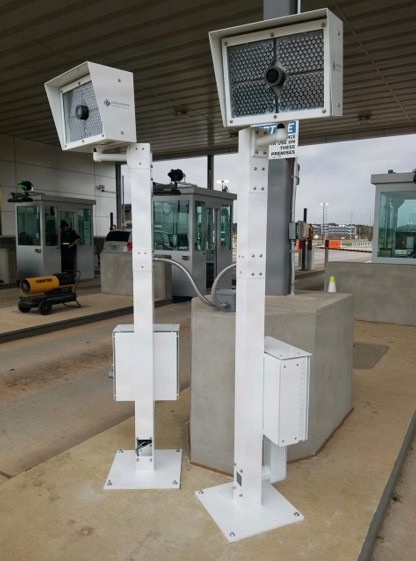
Photo By Kay Edwards | Facial recognition capabilities are a new feature being added to the Automated...... read more read more
 Subscribe
The Automated Installation Entry (AIE) system continues to revolutionize access control and security across U.S. Army installations worldwide to protect Soldiers, families, and facilities.
AIE is on track to expand to more than 200 sites over the next five years, with more than 100 additional fieldings planned globally. This cutting-edge force protection capability streamlines access control by vetting individuals, authenticating identities, and ensuring compliance with U.S. Army regulations.
Kevin Palgutt, Army Office of the Provost Marshal General Security Specialist, said AIE protects Soldiers and their families.
“In the first year of AIE, there was an approximate 20 percent drop in crime stats across most installations, a lot of which is attributed to denying people at the installation access control points who could do harm to people and property, along with impacting good order and discipline,” Palgutt said.
Recent Milestones & Key Updates
The AIE program has achieved several significant milestones in recent months, underscoring its commitment to enhancing security and efficiency:
Product Manager Force Protection Systems (PdM FPS) is the life cycle manager for the AIE program. Lt. Col. Matthew Einhorn, the PdM for FPS, said achieving each installation is a major undertaking.
“The successful installation of AIE at an installation takes the coordination and dedication of countless individuals from garrison leadership, emergency response directors, local and regional network staff, site preparation contractors, AIE installation and maintenance contractors, the PM FPS program office, and numerous others,” Einhorn said.
He added that personnel have achieved 100 AIE installations over the past 15 years.
“However, even more remarkable is that our team has accepted the challenge to double the total number of fielded AIE systems over the next five years as we turn our focus to fielding at OCONUS installations,” Einhorn said. “With this expanded footprint, AIE will continue to safeguard our Soldiers, their families, and our facilities for years to come.”
Facial Recognition Express Lanes: A New Era of Access Control Fort Bragg and Fort Riley are set to implement Facial Recognition (FR) “Express Lanes” in early 2026, following a successful pilot program at Redstone Arsenal. This innovative technology promises to improve both security and efficiency at installation access points. “Security vetting has actually gotten better because the facial recognition tool can do the identification and authentication of personnel much more efficiently than a guard looking at a photo on the screen of a laptop or handheld device,” Palgutt said.
Upcoming Efforts at Fort Bragg & Fort Riley The rollout of FR Express Lanes at these installations involves several lines of effort:
Overall Expectations The desired end state of the FR roll out is to increase vehicle and pedestrian throughput, enhance force protection, and allow security personnel to focus on proactive threat mitigation. Soldiers, civilians, and families are encouraged to stay informed through official installation channels for updates and enrollment instructions.
The AIE system and FR Express Lanes represent a significant leap forward in access control technology, ensuring the safety and efficiency of Army installations worldwide.
| Date Taken: | 12.01.2025 |
| Date Posted: | 12.01.2025 15:32 |
| Story ID: | 552673 |
| Location: | US |
| Web Views: | 247 |
| Downloads: | 0 |

This work, The Automated Installation Entry (AIE) System: Expanding Global Reach, must comply with the restrictions shown on https://www.dvidshub.net/about/copyright.


No keywords found.




