From polar bears to precision strikes: McMechan's 40-year score
Photo By Ryan Smith |
James McMechan, electronics engineer at Naval Air Warfare Center Weapons Division,......read moreread more
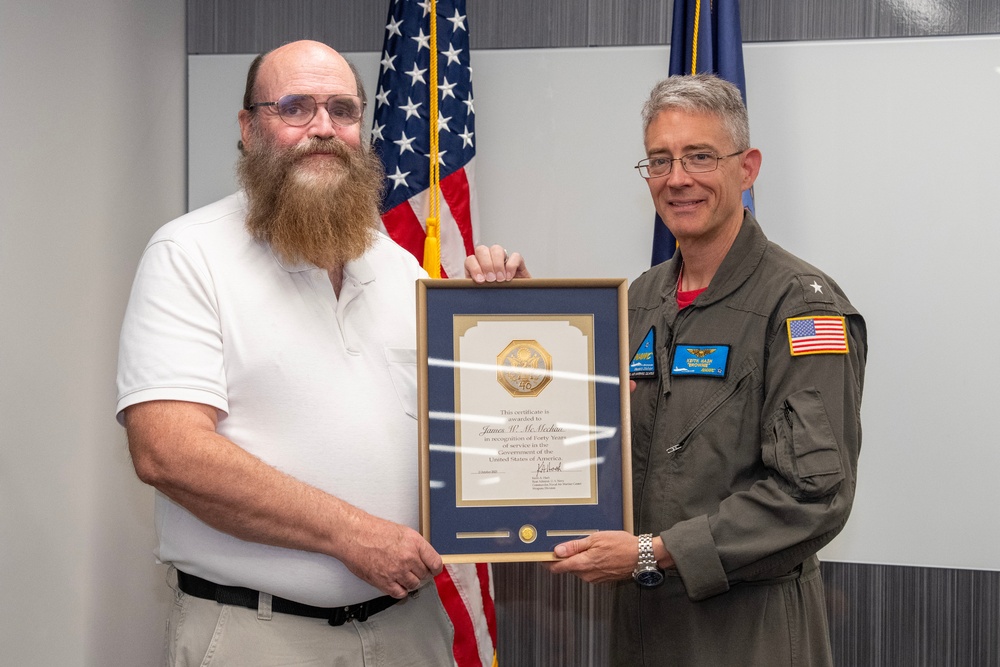
Photo By Ryan Smith | James McMechan, electronics engineer at Naval Air Warfare Center Weapons Division, receives a certificate from Rear Adm. Keith Hash, NAWCWD commander, in recognition of his 40 years of dedicated federal service during a ceremony at Naval Air Weapons Station China Lake, California, Nov. 14, 2025. McMechan's pioneering work in Live, Virtual, and Constructive (LVC) training systems has significantly advanced the Navy's ability to simulate complex combat scenarios, ensuring the safety and success of Navy pilots. (U.S. Navy photo by Ryan Smith) see less
| View Image Page
From polar bears to precision strikes: McMechan's 40-year score
James McMechan counted polar bear points before he counted missile hits
Growing up in Ames, Iowa, the future electronics engineer camped with his father through brutal Midwestern winters. Tents pitched on frozen ground. Thermometers plunging below zero. Boy Scout patches earned for enduring 100 nights of subfreezing cold. A young McMechan accumulated more than 200 polar bear points.
He kept score then, and he's been keeping score for Navy pilots in the world's largest video game, as he describes it, for nearly 40 years.
From Iowa to the Desert
In August 1985, McMechan stepped off a plane at Inyokern Airport dressed in a wool suit. The scorching desert radiated off the tarmac. A graduate of Iowa State University and the son of two professors, he had chosen weapons testing to make his own way. His father taught electrical engineering, his mother taught home economics.
If you're curious, the university arranged his course schedule so his father never taught him.
"I enjoyed taking classes at the university. I like learning," McMechan said. "When I first came here, we had the base technical library, the base reading library, the city library and I believe we had four bookstores in town. It was a very reading-inclined city."
That hunger for knowledge would prove essential.
McMechan entered the Junior Professional program, now called the Engineer and Scientist Development Program. Today, he works at the Tactical Air Range Integration Facility, where operating system support meets combat hardening. But back then, he was taking classes on the China Lake way: cut bureaucracy, build fast, deliver results.
It was the same philosophy that birthed the Sidewinder missile at dinner parties.
Before Anyone Called It Live, Virtual, Constructive
Interface boxes connecting radars to computers. That's where McMechan started. Simple work, it seemed. But he was laying foundation stones for the future.
Before anyone coined the term LVC training, McMechan helped integrate real aircraft, simulators, and computer-generated forces into seamless combat scenarios.
"We have a really big video game covering hundreds of square miles these days," McMechan said. "A hundred aircraft playing, maybe a thousand or others being tracked, planes dropping bombs, anti-aircraft missiles trying to shoot them down, anti-radar missiles trying to take out the anti-aircraft site, air-to-air missiles being shot between the aircraft."
This Is How It Happens
Blue Force F/A-18s approach target coordinates while Red Force surface-to-air missile sites activate across the desert. Enemy fighters scramble from airfields that exist only in code. Real pilots in actual cockpits dodge computer-generated missiles, drop practice bombs or bombs that exist only as bits, and practice survival against threats too dangerous to replicate live. This all happens while keeping score.
This is McMechan's world. This is how he supports the warfighter.
And you've seen his work. Those tracking systems in the background of “Top Gun”?
McMechan helped build them.
His software systems were tested with recordings of real aircraft before deployment. Sometimes that meant radar systems sitting in parking lots, with cables snaking inside to tracking computers. Whatever it took to ensure accuracy and integration.
Nearly every Navy and Marine Corps tactical jet pilot since the late 1980s has trained with systems he integrated or developed.
Multiplying the Threat
The transformation tells its own story.
In 1985, mainframe computers filling entire rooms tracked 36 aircraft — in groups of nine. Today, PC-based systems handle 100 aircraft simultaneously. McMechan's integration expanded Naval Air Station Fallon from six threat emitters to nearly 70.
Small-town training became big-league warfare simulation.
And his work has taken him to extremes, from a frying pan to a freezer.
"This job has sent me to Yuma, Arizona, in August, where I was rained on while it was 113 degrees, and to Fairbanks, Alaska, in December," McMechan said. "I believe the high that week was 17 below zero."
Technology evolved alongside his work. Xerox Star word processors with 8-inch floppies became smartphones with more power than Cray supercomputers. Team members came and went. Contractors changed. Systems were overhauled.
McMechan remained, the human constant in the algorithm.
"I've worked with a lot of people I've liked. Many have come and gone," McMechan said. "Now, it's different people, but the people make for a happy work life."
The 39 training ranges he works on stretch coast to coast. From Key West to Camp Lejeune. From Cherry Point to Gulfport. "Top Gun" at Miramar. Barry M. Goldwater Range in Yuma. McMechan's software tracks aircraft across distances so vast that even Earth's curvature affects calculations.
His code accounts for that curve.
Problems Worth Solving
"My career is lots of happy memories, some really interesting problems," McMechan said.
Problems like: scoring software that wouldn't compile with error checking enabled, arrays writing outside their boundaries, and communication systems that passed every test but crashed with real data. Each bug McMechan found was a potential training failure. Each fix prevented future catastrophes.
Forty years of solving these problems helped build something irreplaceable: a training system where pilots can fail safely before they fly for real.
A pilot can "die" 50 times in the virtual battlespace before flying a real mission. Each virtual death teaches survival. Lots of simulated failures a real flag-draped coffin.
The systems he works on save lives before wars begin.
"You know, working with people you get along with takes care of most of the problems of employment," McMechan said. "Good people make for a pleasant work environment. And the work becomes fun if you're doing it with good people."
No Jim-Shaped Hole
The last decade brought McMechan a cybersecurity focus. His team consistently exceeds 90% on security scans. Theoretically, half his time now goes to traditional interfacing. But McMechan knows the truth: He spends an equal amount of time patching security holes and preventing the personnel hole his retirement would create.
That's why, after 40 years of federal service, McMechan isn't rushing to the exits.
"I'm hoping to help train and mentor our people, so they are able to take over what I'm doing," McMechan said. "I want them to be successful. I don't want to leave them with a Jim-shaped hole because I suddenly retired."
Even though he stopped collecting polar bear points long ago, the missile scores still add up.
"For 40 years, I've worked to give Navy pilots some of the best training in the world," McMechan said. "They deserve an accurate picture of what hostile forces will throw at them when it counts."