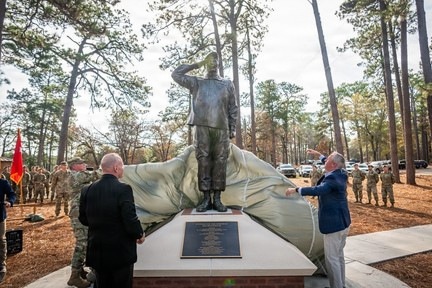
Photo By Patrick Albright | Maj. Gen. Colin Tuley, commanding general of the Maneuver Center of Excellence, retired Col. Robert Choppa, and retired Brig. Gen. Peter Jones unveil a bronze statue of Col. Ralph Puckett Jr., Nov. 25, 2025 at Victory Pond on Fort Benning, Georgia. Puckett, a U.S. Army officer and Medal of Honor recipient, led the Eighth Army Ranger Company during the Korean War and was recognized for his actions on November 25, 1950, when his company of 51 Rangers repelled an attack by several hundred enemy soldiers at the battle for Hill 205. see less
| View Image Page
Fort Benning hosts dedication ceremony for statue of Col. Ralph Puckett Jr.
FORT BENNING, Ga. — A life-size statue of the late [Col. Ralph Puckett Jr.](https://www.army.mil/medalofhonor/puckett/) was unveiled during a ceremony at Fort Benning Nov. 25, 2025. The seven-foot-tall, bronze statue on Hurley Hill, overlooking Victory Pond, depicts him in Army duty uniform rendering a salute.
This depiction was not chosen at random, and neither was the statue’s location. Retired Col. Robert Choppa, president of the National Infantry Foundation — which spearheaded the memorial’s construction — recalled Puckett wanted his likeness to be in the place where Rangers are forged and where the newest Ranger-qualified Soldiers and their families would pass under his watchful gaze and respectful salute. All current and future Rangers who pass through Fort Benning will now see a living reminder of what it truly means to embody the Ranger Creed, that “Rangers lead the way,” Choppa said.
Puckett was awarded the Distinguished Service Cross for his heroic actions Nov. 25-26, 1950, in the Korean War while serving as commander of an Army Ranger company. Puckett endangered his own life on several occasions during a battle against enemy soldiers attempting to seize a key defensive position and was severely injured. Puckett’s award was upgraded to the Medal of Honor in 2021, more than 70 years later.
The idea for the statue started with a group of Rangers launching a fundraising effort while Puckett was still alive. Puckett’s wife, Jeannie, said he found the gesture moving.
“When Ralph learned the Rangers had started this GoFundMe, he was really touched and said, ‘Why would they do that?’ I said, ‘Because, maybe they like you,’” Jeannie told a chuckling crowd at the base of the new statue.
Maj. Gen. Colin Tuley, commanding general of the Maneuver Center of Excellence, stressed that the statue is an important commemoration of an Army Ranger legend.
“We are lucky to have this statue to ensure that Rangers appreciate their benefactor,” Tuley said. “That they will know who he was, that they will know about the man whose legacy is equal to his legend.”
Puckett was commissioned in 1949 after graduating from the United States Military Academy at West Point, New York. He was selected as the commander of the newly-formed Eighth Army Ranger Company in August 1950 and was promoted to first lieutenant soon after. The company officially activated that October after less than six weeks of specialized training in Pusan, Korea.
U.S. forces were advancing deep into the northern Korean Peninsula by November. On the morning of Nov. 25, the Eighth Army Ranger Company, now under the 25th Infantry Division as part of Task Force Dolvin, was ordered to take and secure Hill 205, a critical point overlooking the Chongchon River near Unsan. This order came despite recent intelligence reports indicating there were about 25,000 Chinese troops from an expeditionary force, the People’s Volunteer Army, PVA, in the area.
Enemy forces began attacking the company with mortar, machine-gun and small arms fire less than half a mile from the hill. Puckett exposed his position to the enemy to obtain supporting fire from the accompanying 89th Tank Battalion by jumping on one of the tanks to alert its crew that they needed to engage. The Rangers then began advancing across 800 yards of frozen terrain toward the hill. One platoon became pinned down by concealed heavy machine-gun fire almost immediately, forcing Puckett to spring into action again. He ran across the open field three times to draw enemy fire, allowing his Rangers to find and destroy the hidden enemy positions. The Rangers subsequently eliminated what remained of the enemy defenses and secured Hill 205.
“Doing that one time makes you a hero,” Tuley said of Puckett’s dash to draw enemy fire. “Doing it three times makes you a superhero.”
The Rangers set up a 360-degree perimeter, dug in, and prepared for the inevitable counterattack as night fell and the temperature dropped close to zero. Around 10 p.m., Puckett heard whistles and bugles close by, a way that Chinese forces coordinated their attacks. When the sounds stopped, the PVA attacked Ranger positions on Hill 205 with a barrage of mortar and machine-gun fire. This was the first of six assault waves that Chinese forces, estimated to be around 500-strong, launched on the heavily outnumbered Rangers.
Puckett repeatedly risked his life throughout the night to push back the enemy despite having sustained a thigh injury from grenade shrapnel during the first attack. He ran from foxhole to foxhole to distribute ammunition to his Rangers, draw out enemy gunners, and observe enemy movements so he could call in artillery strikes. His bravery made it possible for the Rangers to successfully fend off the first five Chinese assault waves.
He was inspiring his troops, Tuley said. “He was motivating his Rangers and showing that as their leader he would be out there with them all the time.”
The PVA changed tactics for the sixth assault, and the Rangers were overrun with the artillery support they previously relied on now temporarily unavailable. Puckett was badly wounded when two mortar rounds landed in his foxhole, leaving him with serious injuries to his backside, feet and left arm. Puckett, now defenseless, ordered his surviving Rangers to leave him behind. Fortunately for Puckett, his Rangers decided to return for him, foreshadowing an ideal that would become part of the Ranger Creed: "I will never leave a fallen comrade to fall into the hands of the enemy.”
Two of them, Pfc. Billy G. Walls and Pfc. David L. Pollock ran up the hill and shot three Chinese soldiers approaching Puckett. The two men then scooped Puckett up and carried him down the hill to safety, where he was able to call in a final artillery strike.
Puckett was offered a medical discharge from the Army after his time in Korea, but he turned it down and remained on active duty until he retired in 1971, including serving a combat tour in Vietnam in 1967. Puckett’s service awards include two Distinguished Service Crosses — the first of which was upgraded to the Medal of Honor, two Silver Stars, two Legions of Merit, two Bronze Stars, five Purple Hearts and 10 Air Medals.
His actions during the Korean War are memorialized in the National Infantry Museum’s Korean War Memorial, which depicts Puckett as the young lieutenant he was during the war.
Puckett remained very active in the Army community until he passed away in 2024 at age 97. He was an inaugural inductee into the U.S. Army Ranger Hall of Fame in 1992 and was named the first honorary colonel of the 75th Ranger Regiment, holding the title from 1996 to 2006. In 2004, he was selected as a distinguished graduate of the U.S. Military Academy and was a recipient of the Infantry’s Doughboy Award in 2007. Puckett moved to Columbus, Georgia, after he retired and was a constant presence at Fort Benning, often attending Ranger competitions and events.
“The definition of Col. Puckett isn’t about Hill 205. Hill 205 revealed who he was,” Tuley said. “He was so much more than a brave man who found himself in the wrong place at the right time. Those of us that were privileged enough to know him will always remember that he gave everything on and off the battlefield, to inspire great Soldiers and great leaders.”
For Jeannie, the permanent physical commemoration of him on the installation is one of the most meaningful additions to his long list of honors and awards.
“This statue is an exact replica of my husband,” Jeannie said. “It is an amazing monument to the man he was and what he dedicated his life to.”
Weeks before his passing, Jeannie said Puckett brought up the possible memorials: the likeness of him planned for inclusion in the Korean War Memorial, and the crowd-sourced commemoration at Hurley Hill. Jeannie said Puckett, thinking two statues would be too many, preferred the one overlooking Victory Pond. Jeannie recalled sharing her concerns that this statue’s remote location deep within a wooded area of the installation might mean it would not be seen by as many people. In comparison, millions of people visit the National Infantry Museum each year and their memorial would even be lit at night. Puckett was undeterred for one heartfelt reason.
“He looked and me and said, ‘Jeannie, over the last 12 years I’ve been out there at 2 and 3 in the morning every six weeks at the beginning of the Ranger Course. I’ve been there with the gnats and mosquitoes when it was hot and humid; I’ve been there when it was raining and I was soaking wet. I’ve been there when it was freezing cold and my hands were numb, but that’s where I want to be. I’m not worried because the Rangers have my back.’”

 Subscribe






