
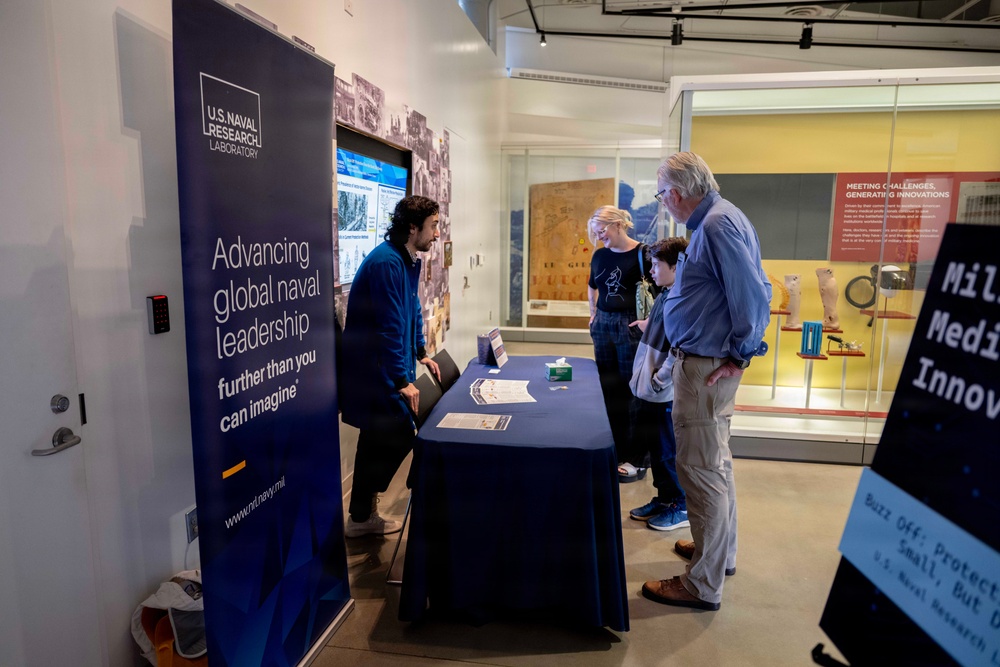
Photo By Jonathan Steffen | Javier Jimenez (Left), U.S. Naval Research Laboratory research chemist, answers...... read more read more
WASHINGTON, D.C. – The U.S. Naval Research Laboratory (NRL) demonstrated a promising new insect repellent technology at National Museum of Health and Medicine during the Military Medical Innovation Family Event program April 26.
The polymer-based material is designed for long-lasting protection against mosquito-borne illnesses. The innovation aims to reduce the logistical burden of frequent repellent reapplication for deployed warfighters operating in high-risk environments.
“One of my biggest goals was to create something that’s purely passive,” said Javier Jimenez, Ph.D., research chemist at NRL. “You just throw it on and forget about it — no sprays, no hassle. The less work our warfighters have to do to protect themselves from vector-borne diseases, the better they can focus on their mission.”
The material, which resembles the consistency of a gummy bear, can be fabricated into patches, fibers, or films — adaptable to uniforms, backpacks, tents, and other gear. With up to 60% of its weight made up of insect repellent, the material releases its active ingredients passively and consistently over time, eliminating the need for active intervention from the user.
The active ingredient is DEET (N, N-diethyl-meta-toluamide), a widely used and EPA approved insect repellent found in most off-the-shelf products.
“The gel would still need to go through EPA registration, however, the materials within the gel were specifically chosen to consist of active ingredients present in commercial insect repellent and commercially relevant polymers,” Jimenez said. “We took extra precaution to avoid additional chemicals in developing this material to facilitate rapid EPA registration and commercialization pathways.”
The material is in testing phase with an emphasis of demonstrating semi-field and in-field effectiveness which includes designing methods to affix the material onto the Warfighter or areas in which the Warfighter may reside, Jimenez added.
“This is a novel method for very extended release of mosquito repellent,” he said. “You don’t have to reapply sprays every day. You don’t even have to think about reloading for the entire season.”
The development was inspired in part by food science. “I like to cook,” Jimenez admitted with a laugh. “Jell-O holds a ton of water and still stays solid — I wanted to apply that concept. We’ve created a rubbery, solid-state material with decent mechanical properties that’s mostly made of liquid repellent.”
Initial lab demonstrations have shown strong performance, including successful repelling action in a foot-long tube filled with mosquitoes. Future work will focus on field testing and optimization.
“We’ve proven we can achieve long duration. The gel has demonstrated repellency for over half a year,” Jimenez said. “Now we’re focused on understanding the real-world performance and exploring how potent we can make it.”
The project remains in the research phase, but NRL is exploring pathways toward further testing, development, and eventual field deployment.
About the U.S. Naval Research Laboratory NRL is a scientific and engineering command dedicated to research that drives innovative advances for the U.S. Navy and Marine Corps from the seafloor to space and in the information domain. NRL, located in Washington, D.C. with major field sites in Stennis Space Center, Mississippi; Key West, Florida; Monterey, California, and employs approximately 3,000 civilian scientists, engineers and support personnel.
NRL offers several mechanisms for collaborating with the broader scientific community, within and outside of the Federal government. These include Cooperative Research and Development Agreements (CRADAs), LP-CRADAs, Educational Partnership Agreements, agreements under the authority of 10 USC 4892, licensing agreements, FAR contracts, and other applicable agreements.
For more information, contact NRL Corporate Communications at mailto:NRLPAO@us.navy.mil.
| Date Taken: | 04.26.2025 |
| Date Posted: | 12.11.2025 14:37 |
| Story ID: | 551903 |
| Location: | DISTRICT OF COLUMBIA, US |
| Web Views: | 67 |
| Downloads: | 0 |

This work, NRL Showcases Novel Long-Lasting Insect Repellent Material, by Jameson Crabtree, identified by DVIDS, must comply with the restrictions shown on https://www.dvidshub.net/about/copyright.


No keywords found.





