
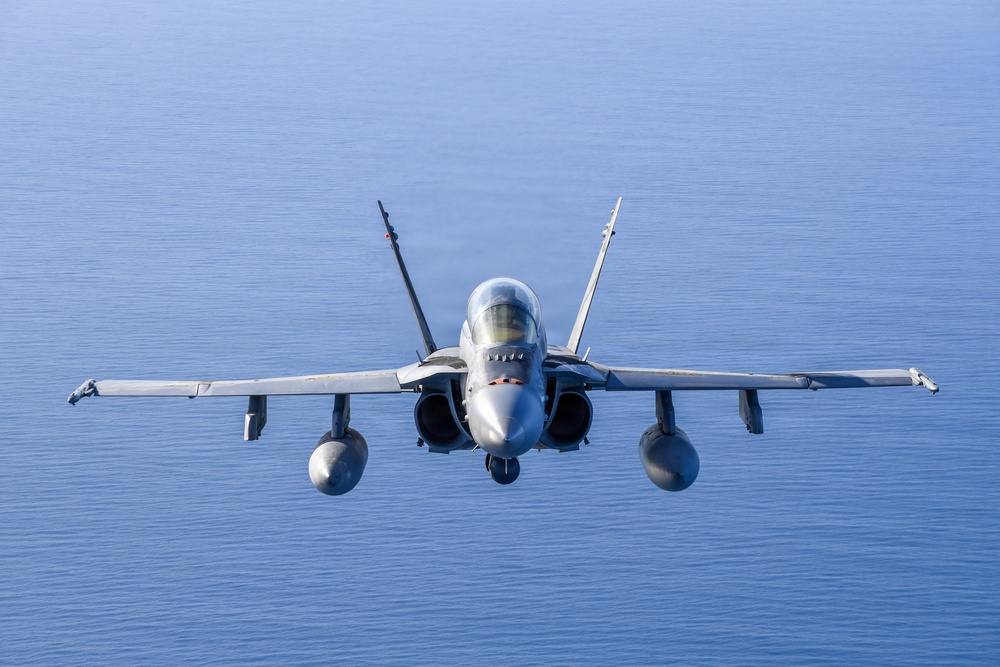
Photo By Katie Archibald | A VX-31 “Dust Devils” Hornet flies over the Point Mugu Sea Range during a photo...... read more read more
An F/A-18 Hornet raced low across the China Lake desert during a simulated terrain collision. Seconds later, the jet pulled up and climbed to safety. The recovery proved the Automatic Terrain Awareness and Warning System could take over when a pilot no longer has time to respond.
The recovery was part of a joint test program by the “Dust Devils” of Air Test and Evaluation Squadron (VX) 31 at Naval Air Warfare Center Weapons Division, in partnership with the “Salty Dogs” of VX-23 at Naval Air Station Patuxent River, Maryland.
Controlled Flight Into Terrain has long been one of tactical aviation’s most unforgiving hazards. It occurs when a fully functional aircraft is unintentionally flown into the ground.
Between 2010 and 2016, the Navy and Marine Corps lost several F/A-18 Hornets in training and operational mishaps. Each loss reinforced the need for an automatic safeguard that could save aircrew and aircraft when human limits are reached.
The Marine Corps recognized that need after seeing the Air Force’s Automatic Ground Collision Avoidance System save multiple F-16 pilots. Marine aviators and flight test teams pushed for a similar capability in the F/A-18A–D, launching development under the Navy’s program office for the aircraft, PMA-265, to protect pilots and extend the life of a platform no longer in production.
“The Marine Corps F/A-18A–D legacy Hornet community was the driving force behind ATAWS,” said Lt. Col. Timothy Burchett, commanding officer of VX-31. “Every Hornet saved means one more aircraft and aviator available for combat.”
How ATAWS works ATAWS builds upon the Hornet’s existing Terrain Awareness Warning System. It continuously predicts the aircraft’s flight path relative to the earth’s surface, using terrain data, altitude, speed and attitude to calculate when a collision is certain without pilot action.
When a crash is nearly imminent, the system issues visual and audible warnings. If the pilot fails to respond, ATAWS levels the wings automatically. It then instructs a rapid pull-up to clear the terrain. Control is returned to the pilot once the aircraft is at a safe altitude.
Since legacy Hornets use manual throttles, ATAWS intervenes through flight control inputs only. The system engages only after a pilot has missed all visual and auditory cues, providing automatic recovery when there’s no longer time for a human response.
“Any time a system is designed to intentionally take control of the aircraft away from the pilot, extreme diligence is required,” Burchett said. “We had to be absolutely certain it would not interfere with a mission or take action when it shouldn’t.”
Testing the system at China Lake From 2023 to 2025, VX-31 partnered with VX-23. They conducted a joint test campaign to ensure ATAWS operated safely and predictably in various flight conditions. The team executed three phases.
VX-23 completed 32 flights evaluating system logic responses to different dives and recoveries. VX-31 flew 16 flights focused on nuisance testing over flat desert and mountainous terrain to make sure the system would not trigger false warnings or recoveries. The final phase combined both squadrons at China Lake for 16 full-performance flights over seven consecutive weeks.
“The team executed 177 test points that challenged and stressed the system,” said David Pineda, a VX-31 flight test engineer. “Those test points validated that ATAWS met or exceeded the modeled performance.” Maj. Brian “Wedge” Walpole, VX-31 Legacy Hornet department head, said the system’s consistency between simulator and actual performance confirmed its readiness.
“Regardless of terrain or flight profiles, the system flew like the simulator, and we verified the model through flight test,” Walpole said.
Throughout those weeks, pilots did high-G maneuvers and low-angle strafing runs. Flight test engineers in the test bay watched telemetry. Meanwhile, chase plane crews provided visual backup to ensure safety and effectiveness. The team observed only minor anomalies, none requiring design changes.
Seamless collaboration The ATAWS test effort united VX-31’s mission systems experts with VX-23’s flight sciences team into one integrated test unit. Two separate approaches merged into a shared plan built on trust and communication. “This was the best test program I have ever been a part of,” said Burchett. “The teams from Patuxent River and China Lake were so well integrated that you couldn’t tell where each team member came from if you didn’t already know the people involved.”
Walpole called collaboration the foundation for success.
“We turned the challenge of two different test methods into an advantage by working face to face and keeping communication open,” he said.
Direct impact on fleet readiness Following PMA-265’s approval, ATAWS will begin fleet rollout in early calendar year 2026. The benefits to the Marine Corps are immediate: fewer lost pilots and aircraft, higher readiness and greater combat availability.
“ATAWS directly advances warfighter capability by ensuring assets are available for forward-deployed power projection,” Burchett said. “Every time an aircraft is lost to a mishap, it directly degrades the ability of the Marine Corps to forward project power.”
For test pilots and fleet squadrons alike, ATAWS represents a readiness gain that enhances safety without altering established tactics or habit patterns.
Maj. Ken “Lloyd” Endicott, VX-9 operational test director, said the system “makes protection from CFIT far more robust, but it doesn’t replace disciplined flight planning and conduct.”
Looking ahead ATAWS sets the stage for future integration of the Automatic Ground Collision Avoidance System in the F/A-18E/F Super Hornet and EA-18G Growler. VX-31 and VX-23 will apply lessons learned from the legacy Hornet to these newer platforms, incorporating system improvements based on the legacy Hornet test results and taking advantage of additional functionality that the newer platforms have available, such as potentially automating a throttle response in a way that was not possible in the older aircraft.
Burchett said the same teamwork that drove ATAWS testing will carry forward into these next efforts. “The results of the test were incredibly successful, which is an absolute testament to the whole team of designers, engineers, and test pilots who diligently worked the program for many years,” he said. “ATAWS will save lives. There’s no higher return on investment than that.”
| Date Taken: | 11.18.2025 |
| Date Posted: | 12.01.2025 15:51 |
| Story ID: | 551696 |
| Location: | CHINA LAKE, CALIFORNIA, US |
| Web Views: | 1,097 |
| Downloads: | 0 |

This work, Test squadrons prove ATAWS ready for legacy Hornet pilots, by Michael Smith, identified by DVIDS, must comply with the restrictions shown on https://www.dvidshub.net/about/copyright.

No keywords found.





