
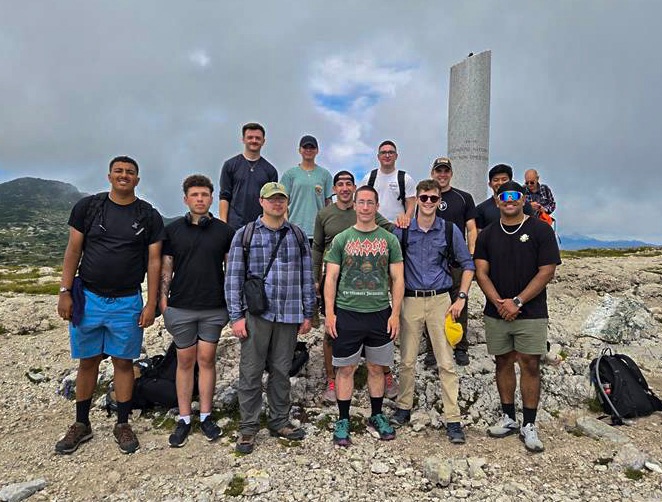
Photo By SETAF Africa | U.S. Soldiers assigned to the 517th Geospatial Planning Cell, U.S. Army Southern...... read more read more
 Subscribe
U.S. Soldiers assigned to U.S. Army Southern European Task Force, Africa’s (SETAF-AF) 517th Geospatial Planning Cell conducted a team-building offsite exercise that featured a hike up Mount Ortigara, located north of Vicenza, Italy, July 18, 2025.
Members of the 517th GPC took turns briefing at various points along the way, using historical examples from the June 1918 Battle of Ortigara. Mount Ortigara was a position on the Asiago Plateau, a significant front line during World War I that Italian and Austrian forces fought to control. Although Italian troops initially seized Mount Ortigara, they could not hold it, and Austrian forces ultimately won the battle.
The 517th’s leadership sought to build morale, provide a case study in combined arms operations and warfighting functions in combat, while also giving Soldiers an appreciation for the complexities of war and sacrifices made for others.
“A key objective of the hike was just bringing all our Soldiers together,” said U.S. Army Maj. Bryan Underwood, the 517th’s officer in charge. “Some of them are just out of advanced individual training, and others transferred here shortly before the hike, so they have never hiked these mountains before. It was a great camaraderie-oriented event for everybody to get to know each other and a chance to develop junior Soldiers by putting them in charge of briefs on warfighting functions.”
This staff ride had special relevance for the 517th GPC, whose mission focuses on creating overviews (detailed maps) of the 53 countries within SETAF-AF's area of responsibility in Africa. These products give commanders data on potential areas of operation, such as airfields, seaports, major cities and significant terrain features, among other relevant factors. If U.S. forces mobilize, those overviews provide baselines that Soldiers can quickly edit without affecting readiness.
“If you think ‘Google Maps on steroids,’ that’s essentially what we do,” Underwood said. “Whether you’re on the continent conducting training with mission partners, or you’re here at SETAF-AF [in Italy] conducting land navigation or other field training, we help you understand what’s in front of you. If it’s a terrain feature, like a river, we can get you the width of that river, or other aspects of the environment to improve knowledge.”
The 517th’s geospatial engineers and analysts became students of World War I military history during the hike, which included multiple lessons in logistics and warfighting in real-life scenarios that are still relevant.
The 10-kilometer hike began at Piazzele Lozze and led to some nearby caves both sides used to store supplies, where the 517th discussed medical logistics and operations.
“There were a couple tunnels we went into that led to observation posts looking over a valley… where soldiers were posted around the clock to observe enemy movements,” Underwood said. “Those observation posts were critical to [both sides] understanding where the enemy was, their movement, what equipment they had, as well as being able to formulate their own battle plans.”
U.S. Army Pfc. Samuel Marmol, a geospatial engineer assigned to the 517th’s plans and analysis section, said the importance of terrain was his major takeaway. He explained that having the high ground affected plans of action and significantly factored into casualty rates. Historical records indicate that Italian forces lost approximately 2800 soldiers versus the Austrian death toll of 990, and 16,000 wounded Italians compared to 6300 wounded Austrians.
“It was crazy to see how different it was on both sides, because in this battle, the Austrians had the high-ground superiority, even though the Italians had all the weaponry,” Marmol said. “It went to show that one side can have all the weaponry, but the terrain favoring the other side can have a major effect on the battle. Despite the Austrians being outgunned and outnumbered, they still lost fewer people.”
According to the 517th’s research, Italian soldiers faced challenges caused by insufficient medical supplies, poor communication and dangerous evacuation logistics while battling harsh mountain conditions. Frostbite, hypothermia and fall-related injuries were common, which contributed to approximately one-third of the battle's total deaths being medically related, not combat related.
Underwood explained that U.S. forces saw similar terrain challenges in Afghanistan, which affected combat operations in a rugged-terrain battlefield. Certain aspects of Ortigara's tunnels are similar to what observers have reported in Ukraine.
At the next stop, an observatory, Soldiers examined intelligence operations — an area wherein both sides experienced failures in 1918. A misunderstanding of Austrian troop strength and fortifications disadvantaged the Italians. The Austrians, with a focus on other fronts, had neglected the area, which led to weaker defenses on the plateau.
At the “battlements” area, briefers focused on “fires operations,” which involve the targeting, planning and the employment of weapons systems and munitions in combat, and then assessing their effectiveness. Both sides used small arms and machine guns, but Italian artillery and mortar crews struggled with steep, narrow supply routes. Austrian forces benefited from a system of valley railroads and cable cars that sustained heavier-caliber systems.
The 517th GPC’s research highlighted the crucial role of engineers on both sides, who built extensive tunnel systems that served as trenches, cave shelters and observation posts.
“It was pretty cool to see where snipers would’ve been located, how they built the trenches – which are still there – and getting an understanding of how important every factor in the battle was,” Marmol said. “For example, they had to build tunnels to protect from mortar attack. I’ve never seen anything like that back in the U.S.”
At a second observatory, the GPC’s Soldiers concentrated on communications operations. The Austrians enjoyed an advantage with better defensive positions that featured cave shelters, tunnel-based communication hubs, underground cable systems and protected observation posts that provided messaging from headquarters to field units. Italian forces struggled to lay and maintain telephone lines, while the weather made signal flags unreliable, forcing them to rely on runners who faced enemy fire and exhaustion.
The team finally stopped at a chapel near the end of the route where they discussed the chaplaincy and its role in military operations before returning to the starting point.
For units considering similar, historically focused offsite trips, Underwood said that SETAF-AF’s G7 section provides detailed staff ride handbooks that ease the research burden on training personnel.
“As geospatial engineers, understanding that terrain is critical to winning the battle is how we provide and contribute [to the force’s lethality],” Underwood said. “It’s helpful for our GPC Soldiers to go out and actually see a battle site in person. When they’re creating modern battlefield overlays, they can understand what soldiers in the past have been through, and that can help build better products.”
| Date Taken: | 07.17.2025 |
| Date Posted: | 01.16.2026 20:24 |
| Story ID: | 551679 |
| Location: | VICENZA, IT |
| Web Views: | 173 |
| Downloads: | 0 |

This work, US geospatial Soldiers study World War I lessons at Italian battle site, by SFC Shane Klestinski, identified by DVIDS, must comply with the restrictions shown on https://www.dvidshub.net/about/copyright.


No keywords found.




