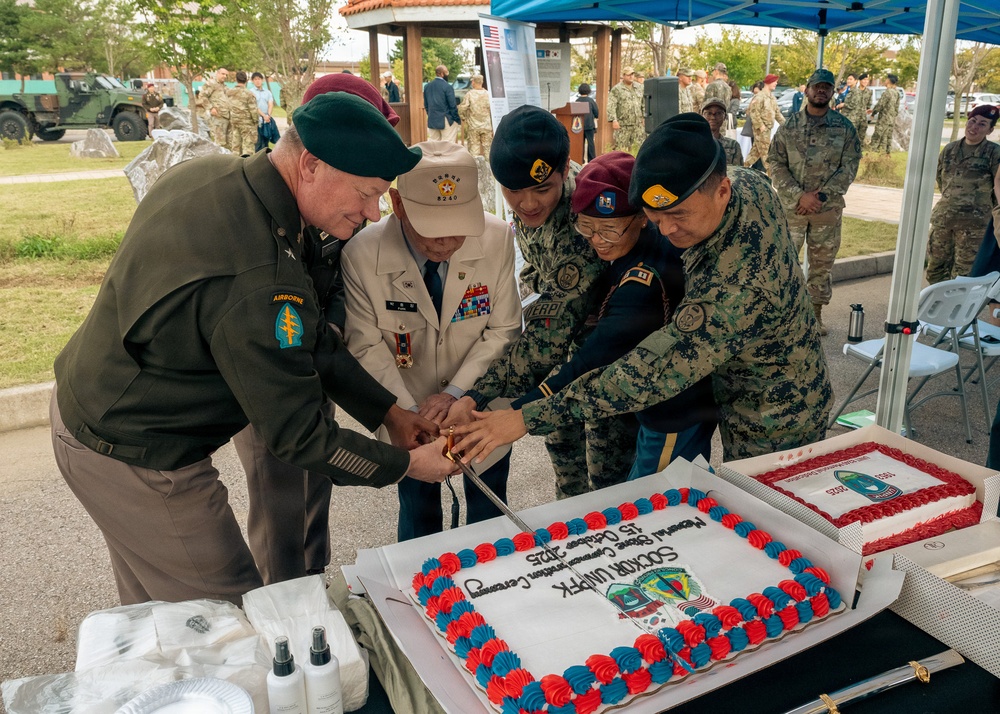
Photo By Sgt. Donghan Kim | U.S. Special Operations Command-Korea, and Republic of Korea Armed Forces personnel cut a cake during a ceremony honoring the 8240th Army Unit held at SOCKOR, Camp Humphreys, Republic of Korea, Oct. 15. 2025. The ceremony, marked by the emplacement of a memorial stone, commemorated the 8240th AU’s sacrifices, operational achievements and significant contributions to modern special operations. Also known as the White Tigers, the 8240th AU was comprised of U.S. service members and Korean partisans, with a primary mission of gathering critical intelligence, conducting guerrilla warfare and disrupting enemy operations in support of anti-Communist efforts in North Korea during the Korean War 1950-1954. see less
| View Image Page
White Tigers: SOCKOR cements honor of unconventional, unseen heroes of ‘Forgotten War’
At the center of the U.S. Special Operations Command-Korea (SOCKOR) compound, the sound
of footsteps broke the afternoon calm as Soldiers, Sailors, Airmen and Marines, as well as
Republic of Korea (ROK) military service members, veterans, families, and friends gathered on
an October sunny day in Pyeongtaek, Republic of Korea. The air was heavy with purpose.
Before them stood a newly emplaced memorial stone dedicated to the men and women of the
8240th Army Unit, known to history as the “White Tigers.”
The ceremony marked more than the unveiling of stone. It was a homecoming for a story that
began more than seven decades ago in the harsh mountains and bitter cold of the Korean War.
Established in 1951 as part of the U.S.’ guerilla warfare campaign against communist North
Korea during the Korean War, the 8240th Army Unit was composed of American advisors and
approximately 32,000 volunteer Korean partisans, all of whom fled from North Korea.
Together in small, isolated teams—fueled by an alliance built on survival, trust and shared faith
in democracy—they conducted raids, gathered intelligence and disrupted enemy movements
deep behind enemy lines in the harshest environments, all without prior training and adequate
equipment.
According to now declassified U.S. Eighth Army reports, despite limited support, the Korean
partisans reported 4,445 combat actions and 69,084 enemy casualties, and confiscated
thousands of weapons between March 1951 and the armistice in July 1953.
Tragically, many never returned from their missions. For those who did survive, following the
8240th Army Unit disbandment after the armistice, there were no parades, no headlines, and no
certainty that their feats would even be honored and much less, remembered. Instead, they
often found themselves without access to their homes and birthplaces, and nothing to show for
their revolutionary contributions to the war due to their missions being classified. Although they
endured the war, they carried the weight of unrecognition and ostracization for the rest of their
lives.
Standing before the audience, retired U.S. Army Capt. Monika Stoy, daughter of an 8240th
Army Unit Korean partisan veteran, ROK Commander Kyungjin Choi, gave a voice to these
almost forgotten heroes—speaking not as a distant observer, but as a symbolic and living
reminder of the faces and names once nearly lost to history.
“These men and women were relegated to the shadows for many decades, their deeds
unknown and unhonored,” Stoy’s words reverberated across the compound. “This monument
will help shed light on their patriotism, valor and achievements in the most challenging of
circumstances, and continue the long march to proper recognition of their heroic and honored
service.”
The groundbreaking efforts of 8240th Army Unit helped shape the principles that became the
backbone of modern special operations. Their courage and innovation bridged two nations and
two cultures in a shared fight for freedom—a bond that continues in the combined mission of
today’s SOCKOR, the only U.S. Theater Special Operations Command dedicated to a single
country, institutionally organized for combined special operations.
U.S. Army Brigadier General Derek Lipson, SOCKOR commander, justly connected the 8240th
Army Unit’s pioneering role in modern special operations, and an active force within SOCKOR’s
present-day mission.
“The White Tigers were not only a fierce unit; they were proving ground for the principles that
define Special Operations today: adaptability, precision, and the ability to operate in the most
complex and contested environments,” he said. “They expertly demonstrated that success in
modern warfare requires not just strength, but creativity, cooperation and an unyielding
commitment to the mission.”
Lipson continued, reaffirming the meaning of this significant moment, not only as a
remembrance of history, but as a renewal of purpose for the esteemed men and women who
carry the torch of special operations.
“As we unveil this stone, let us reflect on the lessons of the 8240th Army Unit—no challenge is
insurmountable, no mission too daunting, and it takes strong partnership, brothers and sisters,
to overcome adversity,” he echoed. “Let us reflect on the SOF truths built on their enduring
legacy—People are more important than hardware; Quality is more important than quantity;
Special Operations Forces cannot be mass produced; Competent Special Operations Forces
cannot be created after emergencies occur; and Most Special Operations Missions require non-
SOF assistance.”
With the help of retired ROK Armed Forces Col. Choongam Park, the last-standing veteran of
the 8240th AU Korean partisans, Lipson and Stoy gently pulled a ceremonial cloth from the
towering stone proudly bearing the U.S., ROK, United Nations, and former United Nations
Partisan Infantry Korea insignias. The afternoon light highlighted the engraved words: Honoring
more than 32,000 Korean War partisans…Their courage and sacrifice set the standard for
service and duty that continues to inspire us today. The crowd’s applause echoed throughout
the compound, emulating respect for an almost forgotten history.
“To the White Tigers and their descendants, we say thank you,” Lipson ended. “Words are
insufficient to properly honor your service. Your bravery, your vision, and your sacrifices have
shaped who we are and what we stand for. May this memorial serve as a place of pilgrimage for
those of us who wish to remember this history, and a lasting reminder that our strength lies in
unity, trust, and shared purpose. May God bless you and our glorious nations…Kapchi
Kapchida; Concilio Proveho; De Oppresso Liber.”
Their story, once buried in classified reports and fading memories, has now found its place in
stone and in the hearts of those who continue their mission. The White Tigers’ legacy of
valiance and resilience endures not only in the history of special operations, but in every
enduring act of partnership and trust that defines the U.S. and ROK’s shared vision—peace,
prosperity, and a free and open Indo-Pacific.

 Subscribe






