
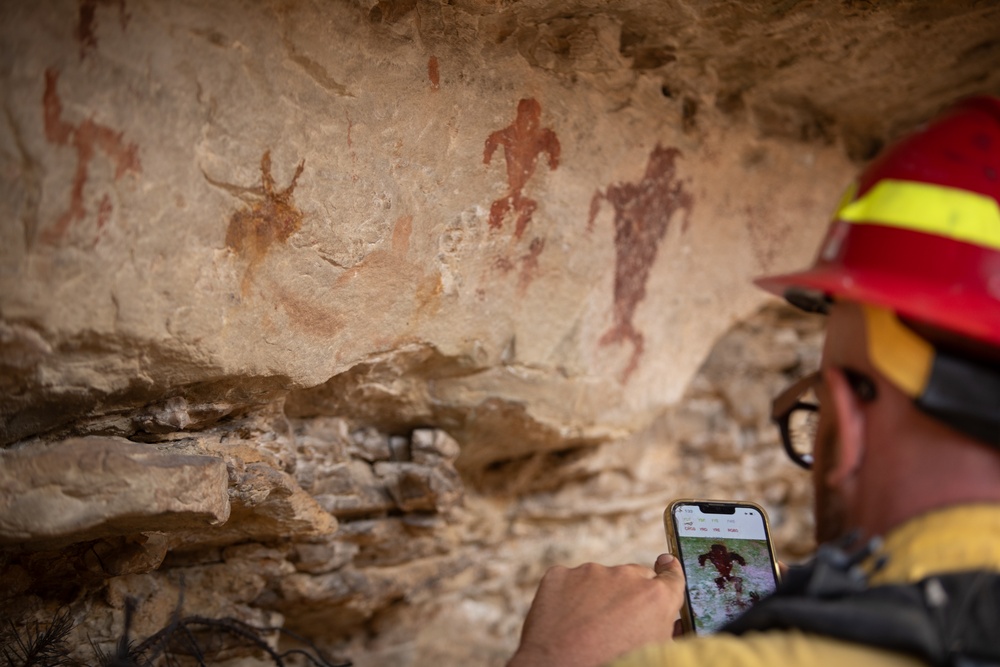
Photo By Andrew Avitt | Michael Terlep looking at Snake Gulch style rock art dating to the early...... read more read more
 Subscribe
The relationship between humans and the land is an old story. The outdoor stage still bares many of the markings, dwellings, belongings, and remains from those who lived long ago. The Forest Service, National Park Service, and other land management agencies are constantly surveying the land for these sites that serve as windows into our past, while also protecting them from natural disturbances, such as wildfire.
The Southwest has plenty of both – history and fire.
Histories of Apache, Hopi, Navajo, Pueblo, and Zuni tribes, and more the recent histories of Spanish explorers, settlers, pioneers, and cowboys can be found across Arizona and New Mexico.
“We're protecting 23,000 years of indigenous history, and hundreds of years of Euro-American history,” said Nez, who has worked to protect cultural and historical artifacts in northern Arizona for 13 years. “As an indigenous person, a member of the Navajo Tribe, saving the smallest artifact is saving a little bit of our tribal identity.”
Nez uses old survey data or, if none exists, conducts new surveys of areas to ensure that artifacts and other cultural resources are not damaged by proposed projects such as prescribed burns and infrastructure development.
This expertise also lends itself to fire suppression efforts, such as the case for this year's Kane Fire just north of the Grand Canyon on the Kaibab National Forest.
Nez is just one of many resource advisors, including three archaeologists and one biologist, assigned to the Kane Fire. Their job, as the title suggests, is to advise fire managers on how to protect any given type of resource.
“On a large fire, there might be hydrologists, biologists, fisheries specialists, botanists, and timber specialists, among others,” said Nez. “Almost every scientific discipline can provide something that's useful for fire management and suppression repair.”
“As archaeologists, we develop recommendations and monitor operational activities to minimize impacts to historical and cultural resources,” said Nez, “we're typically embedded with firefighters out on the fireline to help facilitate on-the-spot decision making to mitigate potential damage.”
Nez, who has both worked with and as a firefighter, said that members from each profession have great respect for the other.
“They know my skillset, and I know theirs, and if damage has to happen, if communities or lives are at risk, we will work together to save those values and also to minimize damage.”
Michael Terlep, a district archaeologist for the North Kaibab Ranger District of the Kaibab National Forest, is working alongside Nez and other resource advisors on the Kane Fire. He highlights some of the many risks of wildfire and suppression efforts to historical and cultural sites.
Wildfire can damage rock art, wooden cabins, and other artifacts, but it really depends on how hot a fire burns. “If it's a low intensity fire, it's probably not going to damage too much. But high intensity fire can crack masonry and may uproot trees exposing burials. So in those cases, we'll try to get out there and prep the site. We'll get in there with a sawyer crew and trim back some of that vegetation. So, when the fire does move through there, it's not going to be as hot.”
Firefighters along with archaeologists worked in canyons to reduce fuels in areas where known archaeological sites have been recorded.
“If fire gets into a canyon, it can move really fast, so getting in there trimming back that vegetation and keeping it away from the rock art was an important first step when the fire first started.”
But often wildfire itself isn’t the main concern, said Terlep. After all, these same artifacts and historical sites have survived many thousands of years of natural fire on the landscape.
“We're not as concerned with the fire itself when fire sensitive sites like wooden cabins and hogans are not present, but the tactics we often use to contain wildfire like constructing fuel breaks,” said Terlep, “The blade of a bulldozer, for example, scrapes the surface and disturbs at least the first six inches or more of topsoil, which might contain pottery, artifacts, arrowheads, tools, and prehistoric habitations. There is also the potential for ancestral burials to be disturbed.”
Resource advisors like Nez and Terlep will embed with firefighters and sometimes work out ahead of crews and bulldozers, surveying the land ahead of potential disturbances.
Archaeologists like them are called up earlier and more frequently as land management agencies have placed greater emphasis on protecting cultural sites in recent years.
“From the get-go when the Kane Fire first started as a half-acre fire caused by a lightning strike, we were called immediately because anytime firefighting activities might disturb archaeological site, we can be a asset, and advise on the best way forward,” said Terlep.
It will always be important to protect our resources, whether that’s from wildfire, mining, or development, said Nez. “When we look at federal lands, we're looking at a mirror. How we manage federal lands is how we manage ourselves. Saving and enhancing landscapes enhances our identity, it empowers us, it gives us this strength.”
| Date Taken: | 08.30.2023 |
| Date Posted: | 09.10.2025 17:49 |
| Story ID: | 547778 |
| Location: | ARIZONA, US |
| Web Views: | 67 |
| Downloads: | 0 |

This work, Suppressing Fire while Protecting History, by Andrew Avitt, identified by DVIDS, must comply with the restrictions shown on https://www.dvidshub.net/about/copyright.


No keywords found.




