
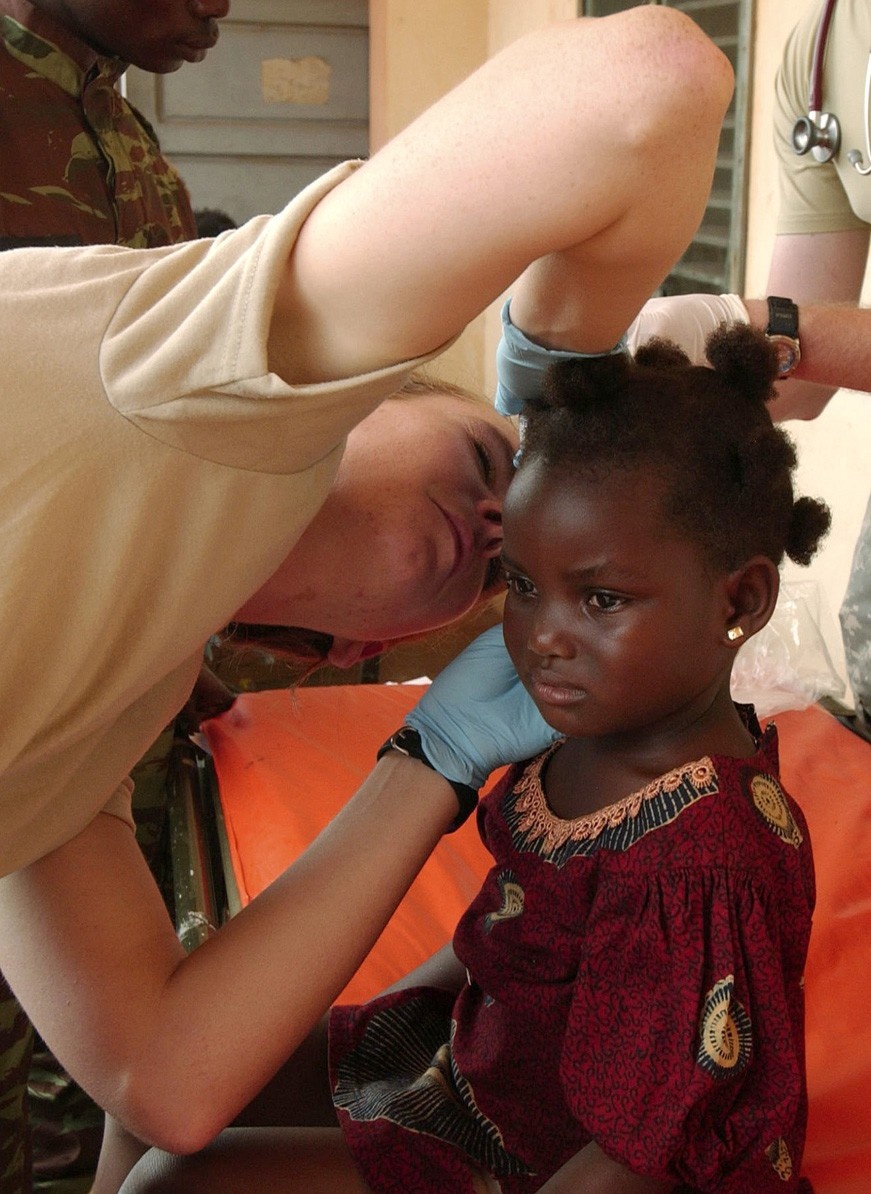
Courtesy Photo | U.S. Army 2nd Lt. Jessica Landis of the Medical Department Activity in Heidelberg,...... read more read more
Medical Task Force Benin wrapped up its final community clinic run in Africa by treating an estimated 500 patients from nearby villages during exercise Medflag ’06.
For six days, the 50-soldier team of Army active-duty and reserve-component doctors, nurses and medics from U.S. Army Europe, Europe Regional Medical Command, and stateside units treated more than 2,000 patients and 1,600 animals in the community of Ouidah.
The exercise -- supported overall by personnel from USAREUR, U.S. Air Forces in Europe, Marine Forces Europe and Naval Forces Europe -- provided medical and veterinary assistance in Benin, Nigeria, Ghana and Senegal.
Beninese army soldiers and police officers assisted with crowds outside the temporary clinic located in the hamlet of Djegbadji, ensuring that as many villagers as possible were able to see a physician and receive inoculations.
During the last day, Sept. 15, as the team treated 520 patients, embassy officials, including Gayleatha Beatrice Brown, U.S. ambassador to Benin, toured the clinic. They received a report from U.S. Army Lt. Col. Thomas Axtman, the task force’s commanding officer and Dr. (Lt. Col.) Rafioo Lawani, director of Benin’s army medical school.
“I have seen Medflag exercises before, but this is one of the best ever,” Brown said following her tour of the Djegbadji site. “This is a wonderful example of our departments of defense cooperating together and of the relationship between our two countries.”
Accordingly, Brown said she will request more Medflag and similar military-to-military exercises be held in Benin.
The ambassador praised the U.S. soldiers for their professionalism and the high quality of medical care they provided. “They worked hard and they represented us well,” she said. “I am proud of them.”
The troops saw their last patient at about 4 p.m. as the medical assistance visits ended. After a brief pause to catch their breath, soldiers began dismantling the temporary clinic and loading equipment onto Beninese army trucks for cleaning and shipment back to Europe.
“This has been a tremendous partnership between the Beninese military and our forces,” said the officer in charge of medical operations, U.S. Army Col. Albert Cooney, of 2nd Medical Brigade.
Nearly 2,800 people received treatment during the six days of clinics. Overall, more than 500 immunizations were administered, 200 patients were treated by dentists who extracted 271 teeth, and nearly 700 vision examinations were completed with optometrists issuing more than 600 pairs of eye glasses.
The most prevalent maladies included hypertension, tropical diseases, malaria, polio and orthopedic injuries.
Many of the villagers spoke only a local dialect -- called Fon -- not French, the country’s official language. The language barrier presented a temporary problem, Cooney said, but U.S. military and civilian translators worked closely with Beninese army nurses and medics to communicate with patients. “Without the Beninese military working with us and actually speaking the local dialect, we would not have been able to render 80 percent of the care,” the colonel noted.
In gratitude, several treated patients volunteered to work with the task force by filling out patients’ medical documents and serving as translators, enabling the doctors to treat twice as many patients daily.
“Medflag ’06 was a great service to the local community,” Cooney said. “More important, though, is the relationship we established with the Beninese military, particularly its medical arm. This has been extremely well received here.”
Lawani agreed. “We’ve done a huge amount of work here,” he said. “Beninese and American forces together -- we’ve done a good job. What we have done here has been remarkable.”
(Dave Melancon works for U.S. Army, Europe Public Affairs.)
Story by Dave Melancon, Special to American Forces Press Service
| Date Taken: | 09.18.2006 |
| Date Posted: | 07.04.2025 06:30 |
| Story ID: | 541386 |
| Location: | WASHINGTON, US |
| Web Views: | 15 |
| Downloads: | 0 |

This work, Medflag ’06 Clinics See 2,000 Beninese Patients, must comply with the restrictions shown on https://www.dvidshub.net/about/copyright.


No keywords found.





