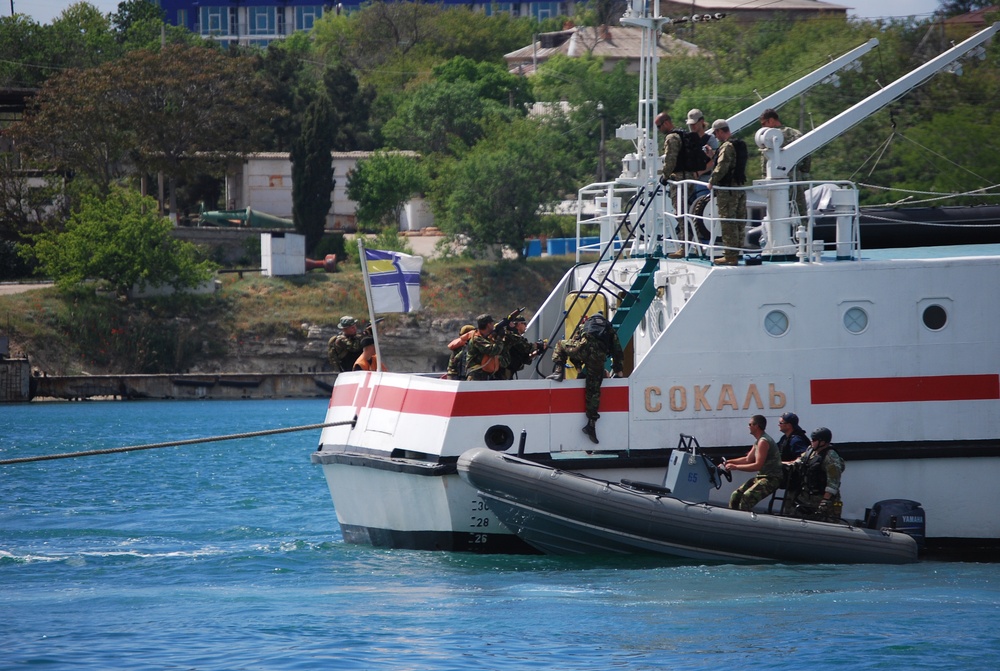
SEVASTOPOL, Ukraine – Maritime Civil Affairs and Security Training Command recently completed one of its largest military-to-military security force assistance training missions in Sevastopol, Ukraine. The U.S. Navy has been actively engaged in training with its strategic partners since the end of World War II. However, in recent years, these partnership missions have led to ports where a Sailor who served during the Cold War would never have dreamed. In Sevastopol, for example, the port was closed to all western foreigners let alone the U.S. Navy until 1995.
Seven Sailors from MCAST Command’s Security Force Assistance Detachment comprised the Mobile Training Team that conducted the Navy of the Armed Forces of the Ukraine training engagement. Over the course of two weeks the students received both classroom and hands-on instruction in Boarding Team Operations and other security related topics. Fifty-three students from three different organizations of the Navy of the Armed Forces of the Ukraine made up the class, making it the largest single class SFA DET has ever taught. Typically, SFA detachments teach classes with a maximum of twenty-five students.
Petty Officer 1st Class Ricardo Dapenavazquez, a member of the MTT who led daily practical training sessions in Defensive Tactics noted, “The large classes require great expertise and flexibility on the part of our trainers.”
“If a class size is too large, we worry about students not having enough face-to-face time with the instructors, especially when conducting practical exercises,” said Dapenavazquez. “For each case, we have to think about how we can accomplish the mission. The mission is first.”
The team overcame this challenge by modifying its normal scheme of operations and training to suit the larger class. This team consisted of seven members, whereas a normal team is composed of three or four. This allowed the trainers to break the class up into manageable and meaningful working groups.
The SFA DET-MTT also sought out a U.S. Navy Sailor who could function as a Ukrainian and Russian language translator for the training. The team found Petty Officer 1st Class Alemu Tesfaye, who is assigned to the Second Navy Expeditionary Logistics Regiment in Williamsburg, Virginia. Tesfaye was actually born in Ethiopia and served in the Ethiopian Navy, which sent him and his comrades to the former Soviet Union to receive three years of language and military training. He received language immersion training and became fluent in Russian, which is also spoken in the Ukraine.
Since enlisting in the U.S. Navy over fourteen years ago, Tesfaye has also taken the Department of Defense foreign language skills test under the Foreign Language Proficiency Program. His proficiency was high enough to qualify for pay and bonuses for Russian and Ukrainian.
Tesfaye was excited to collaborate with the trainers and utilize foreign language skills. “I was happy to help engage the Ukrainian students during this mission, and I firmly believe that the U.S. needs to maintain these types of enduring partnerships,” he said.
The SFA DET-MTT Team Leader, Lt. Charles Egli, jumped on the opportunity to bring Tesfaye onto the team. “Adding Petty Officer Tesfaye to the MTT helped to bridge the cultural and language barriers that naturally existed between the students and the instructors. The quicker instructors surmount these differences the more students will become engaged in the training and the more they’ll learn,” he noted.
Building a solid rapport with the students and their organizations is a major goal of MCAST Command. “We emphasize sustainment and stability with our Security Force Assistance training. To get to that level, you must go above and beyond just the mechanics of the courses and the tactics,” said Capt. Claudia Risner, commanding officer, MCAST Command. “We recognize there are specialized language and cultural awareness skills that must be brought to bear each time we train with a foreign partner. Without it, we can not connect and add value over the long-term.”
The students and instructors quickly discovered they shared some common ground with regard to the subject matter itself. Many of the students had received BTO training from previous exchanges with the U.S. Navy and U.S. Coast Guard. In November 2008, trainers from SFA DET and other organizations delivered instruction to students from various Black Sea nations, including Ukraine, onboard USS Mount Whitney as part of a Black Sea Partnership Cruise. Some of the students had also conducted BTO in the Black and Mediterranean Seas. This resident knowledge and experience helped to expedite the training and the understanding of complex topics.
“We came across a wide-range of abilities and experience levels,” said Dapenavazquez. “The new students initially preferred to stick to their own tactics and procedures, while older students embraced the idea that we were giving them more tools for their toolbox of existing skills. The entire group accepted the concepts by the end of the visit.”
The training also offered everyone the opportunity to refresh their skills. “It is the same for everyone; if you don’t practice these skills you’ll lose them,” said Dapenavazquez. “They are very perishable. Practice makes perfect, and only perfect practice makes perfect.”
The team also introduced some entirely new and novel concepts. For example, a topic in combat first aid aroused particular interest, especially when the discussion focused on the various pieces of equipment that team members should carry when conducting boarding operations. Based upon this reaction and the feedback of the students the instructors proposed a follow-on course dedicated solely to combat first aid. Although SFA DET works closely with U.S. Embassies and combatant and component commanders to identify courses, actual training missions with partner nation forces provide the best insight when making recommendations.
“Training and working with students gives us the opportunity to judge their knowledge and experience levels first-hand,” said Petty Officer 1st Class Paul Francois, a member of the MTT who specializes in teaching the principles of use of force and deadly force. “This is the only way we can continue to deliver quality training.”
The Ukrainian Navy does not maintain its own BTO training program. They rely on foreign militaries to provide both initial and sustainment instruction. MCAST Command hopes to work with their military to develop the scheduled training on an enduring basis.
| Date Taken: |
07.21.2010 |
| Date Posted: |
07.21.2010 11:06 |
| Story ID: |
53168 |
| Location: |
SEVASTOPOL, UA |
| Web Views: |
446 |
| Downloads: |
205 |
PUBLIC DOMAIN

This work, US Sailors Build Bonds and Strengthen Capabilities with Ukrainian Navy, must comply with the restrictions shown on https://www.dvidshub.net/about/copyright.