By Spc. Charlotte Martinez
JOLON, Calif.- When talking to a member of the 326th Quartermaster Company, New Castle, Pa., or the 542nd QM Co., Harrisburg, Pa., about their military jobs, you would almost think the Soldiers were speaking another language with all of the acronyms and large chemicals words flowered throughout their discussions. However, by the time you are done talking to them, you realize how vital the unit’s job in the military really is.
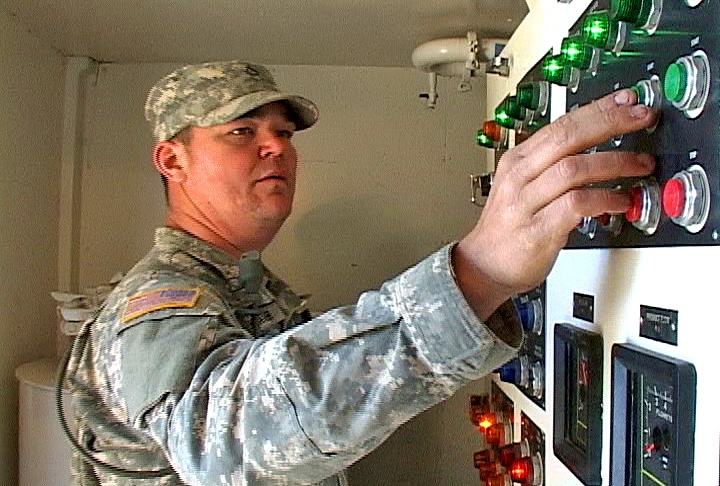
These Army Reserve units provide water for Soldiers to drink, to wash clothes and even cook food with while living in the field on a makeshift forward operating base, designed to replicate conditions in Afghanistan, at Fort Hunter Liggett during the Combat Support Training Exercise. These Soldiers are in charge of the Reverse Osmosis Water Purification Unit and supply safe water to the FOBs here. They are the water purifiers.
The ROWPU pulls water from naturally available sources and makes it safe to drink, purifying as much as 3,000 gallons of water an hour. However, the unit must first find a consistent source of water close to their location to begin the process.
“The sources could be a lake, a stream, river, any kind of water source really,” said Pfc. Keith Blow, 542nd QM Co.
“There are a lot of contaminants in the water. You don’t know if there could be dysentery, alkali, or some type of viruses in the water so we have to purify it first to make sure all those contaminants are taken out so it’s safe for cooking and/or drinking so none of the Soldiers could get sick or possibly die,” said Blow.
A strainer is used to filter the large contaminants and then other strainers within the ROWPU are used to filter out smaller contaminants, explained Blow, a native of Mechanicsburg, Pa.
“We use the reverse osmosis elements to filter out the smallest things like bacteria, viruses, and then we shock it with chlorine – That’s the final step that gets rid of everything after that process,” Blow said.
After the water has been processed through the ROWPU, it is distributed for various uses such as laundry, showers and cooking. After the water has been used, it becomes “waste water” and is collected again to be taken to a different area.
There is also a Tactical Water Distribution System that can carry water for 10 miles to a site.
“Waste water is stored in a waste bag, and afterward it’s taken to a different site so it doesn’t go back into where we pulled it from so we’re not making a bigger mess out there. It could even be sprayed on the roads to keep the dust off the roads for safety reasons like on convoys,” said Spc. Rochelle Liptrot, ROWPU operator, 326th QM Co.
While it can be overlooked, the ability to provide safe drinking water is a crucial force multiplier.
“Without water purification, the Army couldn’t function; you need it for almost everything. People tend to forget that you need water,” said Liptrot, a native of Warren, Ohio.
“Our role is important because a water purification unit can support any kind of unit,” Blow said. “You always need water to run a FOB like this and it’s always a morale booster for the Soldiers to have showers, hot meals and latrines. It’s a fun job as well.”
The 326th and 542nd QM Co. may speak their own “pure” language, but the benefits of their work are crystal clear to everyone.
Thanks to them, Soldiers in the field have exactly what they need to continue their missions, stay healthy, and remain hydrated.
The CSTX was a large scale logistics sustainment exercise held June 16-24, which recreated a deployment environment for over 2,000 Army Reserve Soldiers.
| Date Taken: |
06.24.2010 |
| Date Posted: |
06.24.2010 21:08 |
| Story ID: |
51936 |
| Location: |
FORT HUNTER LIGGETT, CALIFORNIA, US |
| Web Views: |
375 |
| Downloads: |
182 |
PUBLIC DOMAIN

This work, Training to the Last Drop, must comply with the restrictions shown on https://www.dvidshub.net/about/copyright.

 Subscribe






