By Sgt. Jason A. Merrell
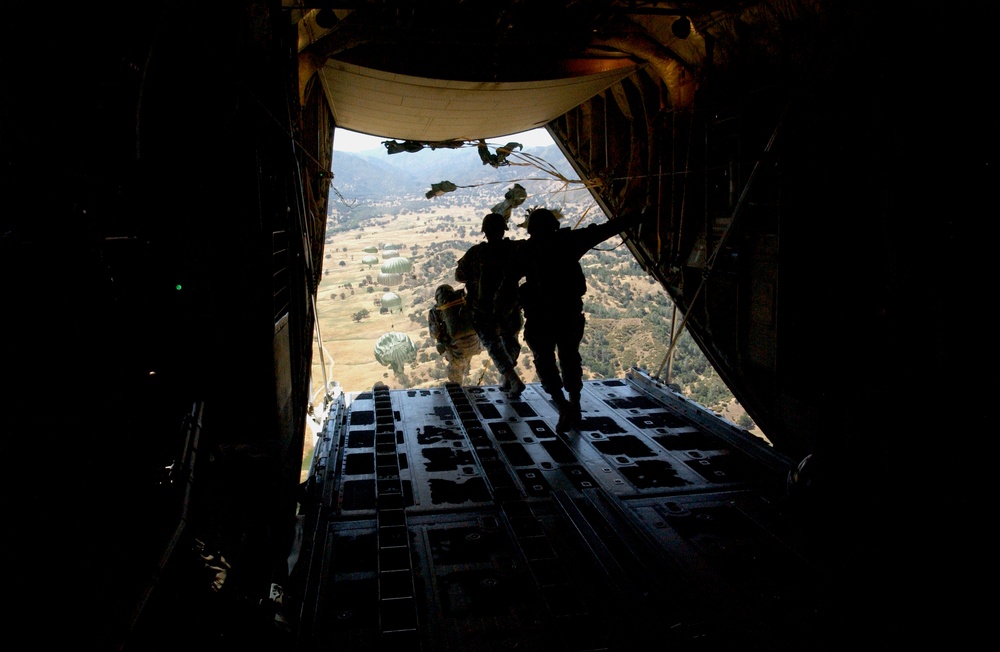
JOLON, Calif.- Foreboding clashed with excitement as 12 Soldiers rose from their seats in the back of an airborne C-130 aircraft. They hooked up to the right side, carefully positioning themselves beside a line of half-ton crates filled with supplies. The fuselage ramp suddenly opened and light exploded inside the back of the aircraft, revealing the mountainous California landscape beyond. Seconds later, the crates zipped out of the back like a roller coaster and the Soldiers quickly followed, each hollering in exhilaration as their footsteps led them to the weightlessness of open air.
This wasn’t a scene out of some military movie. This was actual training during the Combat Support Training Exercise at Fort Hunter Liggett, a large scale collective training exercise held June 16-24, which recreated a deployment environment for over 2,000 Army Reserve Soldiers.
Soldiers from the 421st Quartermaster Company, Macon, Ga., and Marines from the 3rd Marine Airwing, Miramar, Calif., joined forces June 19-21 during the CSTX, to perform a series of aerial supply drops from a C-130 aircraft over Drop Zone Patricia.
The training involved dropping several supply loads filled with Meals, Ready-to-Eat and containers filled with water to simulate fuel, followed by 12 Airborne Soldiers parachuting onto the drop zone.
“This training is very important so the Soldiers can see what it would be like in a real situation in a rigger company,” said 1st Sgt. Jimmy Bowers, jumpmaster for the 421st QM Co., and Savannah, Ga., native. “We are trying to encompass all of the aspects of re-supply as a company. This is real-world training.”
The aerial supply drop was developed during World War II and has since become the staple for delivering food, water, ammunition, fuel, mail and equipment to otherwise inaccessible troops. In Afghanistan, where the terrain closely mirrors austere conditions at Fort Hunter Liggett, supply drops are often the only viable means of delivering supplies.
The training was more than just jumping out of an airplane; it involved learning how to properly get supplies to their comrades overseas, said Pfc. Jason McDaniels, 421st QM Co., and native of Macon, Ga.
To get ready for the drop, Soldiers underwent several refresher courses on their Airborne training and received detailed instructions the morning of each drop to ensure they were prepared.
“We give them a brief every time they jump to ensure they know their duties and positions,” Bowers said. “We brief them on everything that could possibly happen during the jump. If the Soldier drifts into the wires, we tell them what to do. If they land in the trees, we tell them what to do.”
The equipment was also put through a rigorous process to minimize the chance of malfunctioning during a jump, said Staff Sgt. Wade Catlett, 421st QM Co., malfunctions Non-Commissioned Officer for the exercise. If a malfunction does occur, it would be the result of unlikely and unforeseen circumstances, not because of improper preparation.
“When you pack a parachute, it goes through a series of checks and inspections,” Catlett said. “It’s actually a very, very safe procedure. When they first jump, a lot of people are scared about their parachute not being rigged correctly. Trust me, these chutes will open.”
For some Soldiers, it was their first time jumping with the unit. In Airborne tradition, they are referred to as “cherry jumpers” and given red helmets decorated by veteran members of the unit. For Pvt. Sean Bryant, 421st QM Co., and native of Macon, Ga., his decorated helmet – fit with a red-tape fin over the top of it – came with a new nickname: “Sky Shark.” He wore it proudly when describing his feelings on the mission.
“It’s a feeling like no other, it is pure adrenaline,” Bryant said. “I just love it.”
For a jumpmaster like Bowers, who has more than 150 jumps under his belt, it’s a feeling that never fades.
“It still is an addiction. I enjoy jumping as much as the next Soldier,” Bowers said. “I’ve landed in water before, I’ve landed in trees before; I’ve done all of the good and the bad of jumping and I still want to do it. I want to do it whenever I can.”
The jump is a passion that all of the Soldiers share, many of whom skydive in their free time. According to Catlett, there’s nothing normal about jumping out of a perfectly good airplane at 1,200 feet in the air, but there’s also nothing normal about the exhilarating feeling that comes with it.
Bowers reasserted that belief as he tried to describe the sensation of jumping out of the back of a C-130.
“It’s a bit of a rush with that door opening in that aircraft and feeling the wind against your knees, chest, back and face at that rate of speed, and then feeling the peacefulness of that parachute coming down,” he said.
Aerial re-supply is becoming a more common means of delivering mission-essential supplies to Soldiers in isolated or prolonged engagements with the enemy. The success of the three-day mission reinforced the confidence of the Soldiers to successfully complete their mission downrange.
“As a company, we can supply 120 light tons per day to anywhere and everywhere that needs to be dropped,” Bowers said. “We consider the world our drop zone.”
| Date Taken: |
06.24.2010 |
| Date Posted: |
06.24.2010 20:44 |
| Story ID: |
51933 |
| Location: |
FORT HUNTER LIGGETT, CALIFORNIA, US |
| Web Views: |
445 |
| Downloads: |
218 |
PUBLIC DOMAIN

This work, CSTX Takes Air Drop Training Sky High, must comply with the restrictions shown on https://www.dvidshub.net/about/copyright.

 Subscribe






