By Sgt. Kyle Reeves
JOLAN, Calif. - Army Reserve units arrived at Fort Hunter Liggett to take part in the Combat Support Training Exercise that took place June 16 - 24. The 10-day exercise prepared combat support units for deployments like Afghanistan. Fort Hunter Liggett was selected as the ideal location for this training due to the terrain and weather conditions which present similar conditions for Soldiers possibly to deploying Southwest Asia.
Part of this simulated overseas immersion process entailed training at forward operating bases to closely replicate the field conditions Soldiers can expect when deployed.
The units involved in the CSTX were divided into two different camps, which simulated FOBs actually in Afghanistan. FOB Schoonover was a representation of Bagram and is considered the safe zone where hostilities are at a minimum. Its sister camp, FOB Milpitas, was a replica of Salerno, which is considered the hot-area that is frequently subject to attacks and improvised explosive devices. Although the camps are approximately 45 minutes driving distance from each other here, in reality they are two and a half-days travel by vehicle.
“This training was about as realistic as you can get before the bullets start flying,” said Lt. Col. Lori Bury, the Executive Officer for the 652nd Regional Support Group, from Helena, Mont., who served as the mayor of FOB Milpitas.
“The living conditions here are very realistic for Afghanistan,” said Bury, who has been deployed there.
Lt. Col. Carl David Johnson the executive officer of the 642nd Regional Support Group, based out of Decatur, Ga., who served as the mayor of FOB Schoonover, shared Bury’s enthusiasm.
“Many Soldiers, who have already deployed, have commented on how much the FOBs really look the part.”
Johnson’s prior service and deployment to Kuwait in 2003 makes him aware of the significance of this training. Fort Hunter Liggett, located north of Monterey, can reach temperatures of 105 degrees during the day and drop to temps as low as 37 degrees at night.
The Soldiers at the FOBs come from a variety of combat service and support units. Their training involved scenarios where they were expected to perform their regular duties while dealing with hostile fire. They were then evaluated by Observer Controller/Trainers. These evaluations gave the units the opportunity to monitor their strengths and correct any deficiencies before deploying.
While challenges were expected in the actual training, many other challenges have also surfaced in the planning and organization of such an expansive exercise. Prior to establishing FOBs Schoonover and Milpitas, all the units assembled at Schoonover. Many units arrived with limited manpower and some were brought in at a moment’s notice. The shortage of manpower forced units to do jobs other than what they were trained for.
“We have a fuel battalion providing defense which is not their primary mission,” said Bury, who is in the role of FOB mayor for the first time, “But training like this is realistic because down range the possibility of units being re-designated does exist.”
Soldiers of the 155th Combat Sustainment Support Battalion, from El Monte, Calif., know this. They took on more than their share to successfully complete the mission at FOB Schoonover. The 155th CSSB is a support unit that caters to eight other support units.
“Many of the units have arrived under-staffed,” said Command Sgt. Maj. Winsome Laos, the CSM for the 155th CSSB. “We have had to use some of our staff to perform responsibilities for the CSSB as well as other units.”
Despite the hurdles, Laos saw this as a positive as they gain experience in other unfamiliar roles.
“We get the experience which makes us sustainable in the event of emergencies,” said Laos. “It gives true meaning to the motto ‘Adapt and Overcome.”’
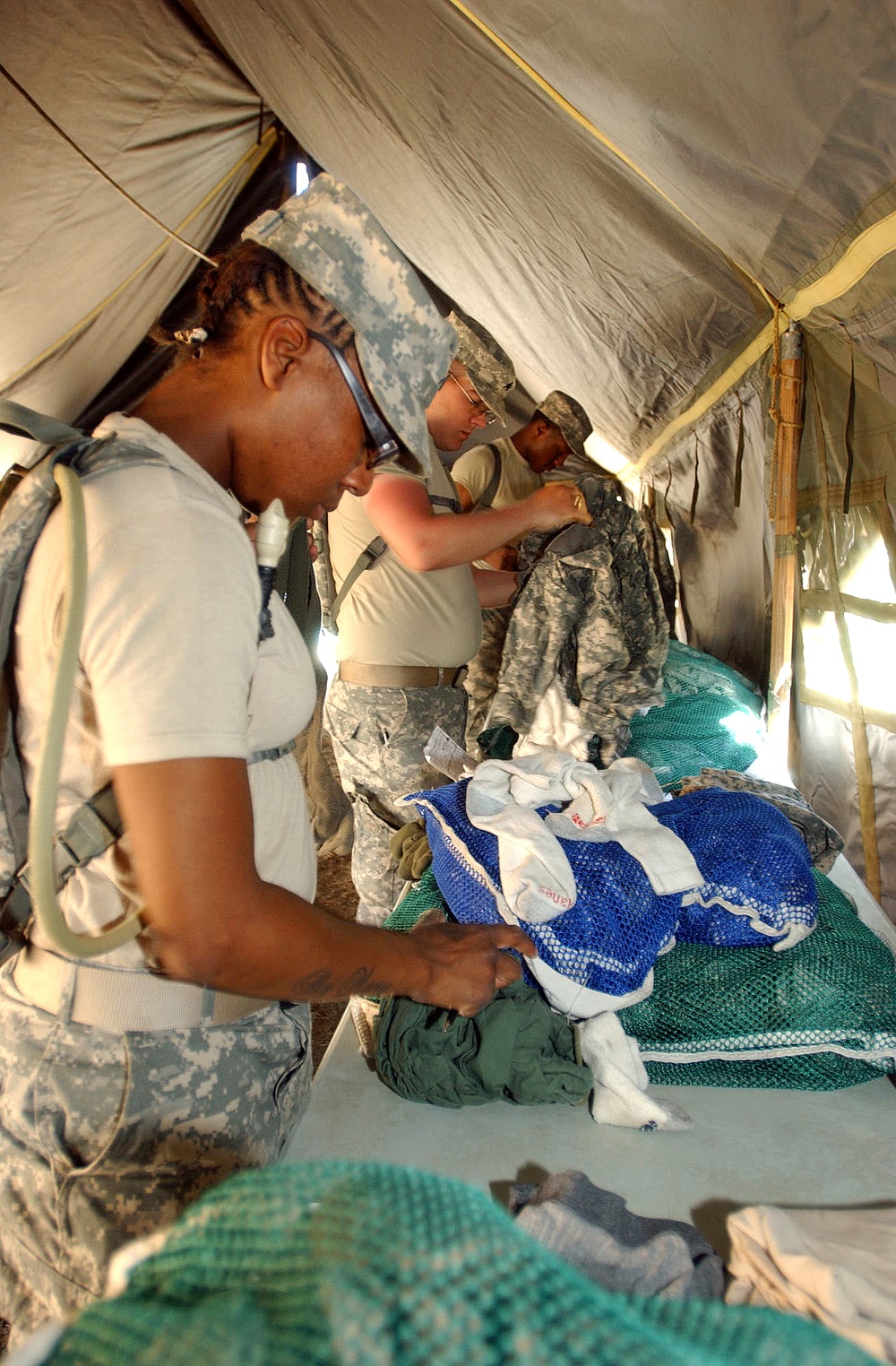
The Soldiers of the 137th Quartermaster Company, from El Monte, Calif., who ran the laundry, shower and bath facility; faced their own challenges as they arrived at FOB Schoonover with a reported cadre of only eight soldiers.
“Before FOB Milpitas was established, we were handling approximately 1,200 personnel,” said Sgt. Elda Ramirez, non-commissioned officer in charge, with the 137th QM Company. In addition to their manpower issues, they were notified of their participation two months prior to their arrival which gave them little time to prepare. However, they handled the demand with minimum staff and limited time.
Ramirez applauded the efforts of her team who have managed to service the needs of the Soldiers under extreme circumstances.
“They have really performed well. I’m extremely proud of them,” she said. She attributes the unit’s strength to the camaraderie of the staff and the training they constantly underwent which includes an annual army training exercise and two previous deployments that have already prepared them for these situations.
One the challenges that Master Sgt. Thomas Watson, NCOIC of the Mobile Kitchen Transportation Unit, with the 642nd RSG faced, was stressing the importance of cleanliness when it was time for chow and urged the Soldiers to wash their hands prior to entering the kitchen facility.
“You won’t be useful to the mission if you fall sick,” he told them.
The MKT provided sustenance to the Soldiers, and Watson takes his role very seriously when it comes to taking care of troops.
“We had approximately 790 Soldiers at FOB Schoonover,” said Watson. “If one Soldier isn’t fed then I have failed in my mission.”
While over at FOB Milpitas, the same mission was carried out, albeit with a little friendly rivalry.
“We have the highest-rated culinary cooks in the military and we are the best at what we do: feeding Soldiers,” said Staff Sgt. Terry Bateman, NCO with the 282nd QM Company, from Montgomery, Ala., a first time participant at CSTX.
“This training was good because it really boosts up the camaraderie of our troops and helps us strive to be better,” she said.
While some units deal with hurdles of the initial preparations and other units the maintaining of high standards, some units’ concerns are the challenges that may be faced during the training.
The 421st QM Company is responsible for light-air supply, dealing with aerial transport and disbursement of supplies and equipment. Loads up to 120-tons are dropped by parachute out of C-130 cargo planes. In the exercise the C-130s came from the 3rd Marine Aircraft Wing, Marine Corps Air Station, Miramar, Calif. From June 19-21, the 421st QM Company tested their skills by performing simulated training that included dropping 150-gallon tanks of simulated fuel on pallets accompanied by 15 airborne Soldiers.
For 1st Lt. Jonathan Castillo, commander of the 421st QM Company, the challenges faced are not in the preparation, but the unforeseen events possible during the exercise.
“Weather could be a mission killer,” said Castillo. “If clouds are too low, we wouldn’t be able to fly. If winds are too high, we wouldn’t be able to jump.”
Other obstacles that would hamper training exercises according to Castillo include mechanical problems on the aircraft or something in the drop zone that would make it unsafe, such as a fire.
What Castillo expected his unit to walk away with was an experience that will give them the ability to perform in a real-world environment.
“This is the first time out the door for my Soldiers,” said Castillo. “I would like to see them all get experience rigging items that would include MRE’s [Meals, Ready to Eat] and fuel.”
He also hopes to see all those who are jumping, have safe jumps.
“The preparation that we made for this training was to minimize injuries and prevent any casualties,” said Castillo.
As the start date approached, what appeared to be less challenging to overcome at the FOBs was safety awareness and hydration.
“We had no major injuries reported,” said Johnson. “We are constantly telling the Soldiers to drink water, which will be essential to the Soldiers’ well-being in theater.”
For all the Soldiers living on FOBs Schoonover and Milpitas, overcoming challenges was just another day. For them, everything was certainly real in the field.
| Date Taken: |
06.23.2010 |
| Date Posted: |
06.23.2010 18:33 |
| Story ID: |
51858 |
| Location: |
FORT HUNTER LIGGETT, CALIFORNIA, US |
| Web Views: |
498 |
| Downloads: |
152 |
PUBLIC DOMAIN

This work, Meeting the Challenges of Afghanistan in California, must comply with the restrictions shown on https://www.dvidshub.net/about/copyright.

 Subscribe






