AL ASAD AIR BASE, Iraq – Sometimes the advise-and-assist mission can be less than glamorous.
A platoon of 82nd Airborne Division paratroopers finds itself building a Russian helicopter from pieces of dilapidated wooden walls using a ball-peen hammer, two carpenter’s hammers and a fire ax for an Iraqi helicopter quick reaction force that has no helicopters.
It is June. The temperature is nearly 120 degrees. Fine desert dust powders their sweaty hands and faces in a gritty talcum that smears like wet paint when wiped.
A Soldier scavenges bent, rusty nails from a rubble pile. Others fill sandbags, and with parachute cord as wheel struts, the bags become landing gear.
The question is will it fly?
“Iraq is, for the most part, a modern and developed country, even though in many parts of the countryside, it can seem very backwards to American Soldiers,” says 1st Lt. Theron Tingstad, underscoring his platoon’s efforts as they prepare to teach air assault tactics to the Commando Battalion of 7th Iraqi Army Division, which now had their first MI-17 twin-turbine, medium transport helicopter made of two-by-fours and plywood.
In its second week of a month-long partnership with the Iraqi commandos of Camp Kassam just north of Rawah, Iraq, 2nd Platoon of Company B, 1st Battalion, 504th Parachute Infantry Regiment, will spend three days training their partners how to safely and efficiently load and unload from helicopters.
Before training the jundi, or Iraqi soldiers, Tingstad must meet with the Iraqi leader with whom he’s been working, a paratrooper himself with more than 200 jumps, Lt. Col. Hamed. Another officer informs him that Hamed has been transferred, and the Soldiers just returned from a nightlong mission and will not be available until the following day.
No leader, no jundi.
“There are some challenges with the Iraqis learning the way we work, but also us learning the way they work,” says Tingstad.
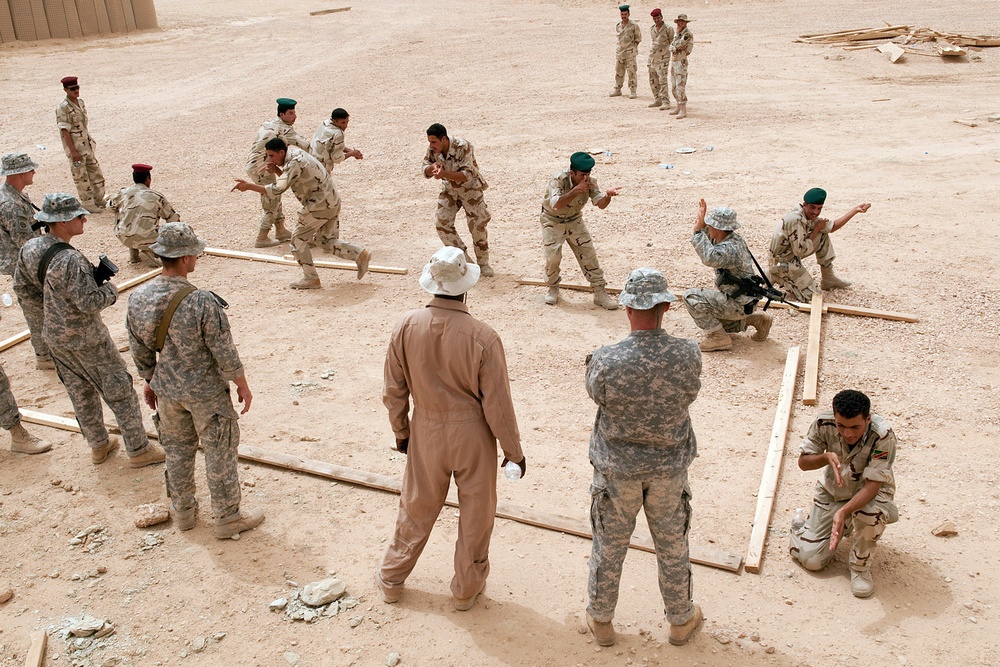
The following morning, the 30-year-old Ranger-tabbed lieutenant from Detroit is in a classroom with his interpreter, Joe, teaching several Iraqi officers – all platoon leaders – the basics of air assault operations and his non-commissioned officers are outside with two-dozen jundi clearing a “glass house” – boards placed on the ground to simulate the walls of a building – of insurgents.
“It’s really important to have a good relationship with your interpreter,” says Tingstad. “What takes you four minutes to say may take him 10 due to words and concepts that he needs to explain, and you have to be able to trust him to do that.”
For example, “chalk” is a common term for a group of Soldiers preparing to load an aircraft, but the word makes no sense in Arabic, he says. Tinstad spent four months at a university in Egypt prior to joining the Army, and his knowledge of the Arabic language and customs builds immediate rapport with the Iraqi officers.
Outside, his paratroopers are learning that the Iraqi soldiers already know a lot.
“For many of the things we tried to teach them, they already had techniques,” says Staff Sgt. Robert Burnett. “They picked up a few techniques from us, such as shooter stance and the way we handle noncombatants versus combatants, but we’re definitely going with the way they’ve been trained on room clearing because they are proficient at it right now.”
Tingstad points out that, traditionally, Iraq has had a great education system and a very strong military tradition, so there are some things they don’t need to be taught anew, or when being taught, they merely need to learn the fundamentals so they can shape them toward their own system.
During an earlier visit to the base, the training team was showing Hamed how U.S. officers make an operations order, when the veteran lieutenant colonel gently reminded the Americans that the Iraqi Army has had an order system in place for some time.
“As with cases such as their room-clearing techniques, a lot of times there’s a reason for their doing [it] the way they do it, and we just haven’t been here long enough to understand it,” said Tingstad. “There may be a reason born of experience.”
In fact, this unit of Iraqi commandos trained with Marines and Navy SEALS in 2009 near Al Asad Air Base, and prior to that, they worked the rough Ameryiat Alfallujah area near Fallujah, according to 2nd Lt. Ali Hassen Hashem, a 25-year-old platoon leader and former Baghdad University student who joined the Army two years ago.
“We really do appreciate this training though,” says Ali. “We always learn so many new tactics from the Americans.” Ali takes two steps forward, salutes, and says, “Reporting for duty!” with a toothy smile.
When violence in Rawah picked up, the commandos were moved to just north of the town, sandwiching it between them and 2nd Battalion, 28th Iraqi Brigade to the south.
“People in Rawah are good people,” says Ali. “They are getting back to their jobs and building the economy. Still, they are sometimes afraid to give information on the terrorists. The townspeople don’t always know who is working for [Al-Qaeda in Iraq]. It is complicated. I talked to a mechanic who once worked for AQI. They forced him to fix their truck. But now he doesn’t work for them anymore. You see?”
In the evening, the Iraqi officers and jundi come together at the fabricated helicopter, now with two long rows of Army cots for seating. Tingstad is opting for a light touch as a trainer, asking the Iraqi officers to teach their own men what they learned in the morning classroom session. But first, they all watch a demonstration by the U.S. Soldiers.
As the paratroopers load the helicopter, there is no trace of the casual young men who were laughing, joking and shooting hoops in a nearby barn just 30 minutes ago. Infantry is what they do.
Platoon sergeant Sgt. 1st Class Gary Wilson directs his men with simple commands, and they move swiftly from the bird to a temporary guard position around the wooden aircraft. At another command, the infantrymen fan silently into a tactical formation and move through the thistles and desert cobble toward their objective. The jundi are impressed.
It is now 2nd Lt. Tahseen Abd al Lafeef Muhi’s turn. He barks orders to two squads of jundi. They line up and load up, careful not to get near the two-by-four “rotor” of the helicopter. Perhaps not as disciplined as the American troops, nevertheless, the Iraqis unload, secure the landing zone and move in their own style of tactical formation across the same field. It’s not the wedge formation they were taught last week, but it seems to work for them. After they reload the helicopter, it is another lieutenant’s turn with another two squads. They practice many times.
“We have a term in English called ‘muscle memory,’” says Tingstad to the Iraqi officers. Joe begins translating.
The training is a success, and the following morning, the exercise is repeated. Amateurs train until they get it right; professionals train until they never get it wrong, Tingstad explains. They are here to make the Iraqis professionals at air assault.
When the training concludes, Tingstad tells the Iraqi officers that his men will be leaving shortly, but they will be back in a few days for more instruction. He also tells them they are planning to bring in two MI-17 helicopters from Baghdad in a few weeks for a culminating exercise. The young Iraqi lieutenants’ faces light up.
Ali and Tasheen thank Tingstad and Wilson once more and march off with their troops.
Wilson remarks at how much better the training goes with Iraqi officers present, as Iraqi non-commissioned officers do not have the same authority over enlisted soldiers as do American NCOs.
“Having the officers out here telling their men what to do made the trip from Al Asad worthwhile,” says Wilson.
Wilson is on his fourth deployment, the third to Iraq. Last time, he and his men spent 15 months in a difficult area of Baghdad. Back then, most of the partnered training consisted of marksmanship, room clearing and first-responder medical training, he says.
While advise-and-assist training is sometimes challenging, he says it’s important to remember the Iraqi Soldiers also have a difficult job. The day after his company exchanged gifts and said their goodbyes to their Iraqi Army training partners in Baghdad, a car bomb detonated outside the post and killed 30 of their Iraqi friends.
Says Tingstad, “I’d heard stories of it being very frustrating to work with the Iraqis at times, but in fact I found that if we were able to approach things the right way, the Iraqis were very motivated to learn. They really want to be good at their jobs, just as we do.
“The advise-and-assist brigade is a new concept. The foreign internal-defense type mission is something that used to be done by Special Operations Forces only, and now we are doing it on a grand scale across this entire country. Over the next year, two years, we are going to see if this experiment pans out.”
“Regardless, you never know what kind of partnerships we might have in the future where we’re partnering with them in actual operations, so it’s important for our own benefit to see how they work,” says Tingstad.
As the first “production model” advise-and-assist brigade assigned the mission of security-force assistance in Iraq, 2nd Platoon’s unit, 1/82 AAB, is scheduled to return to the U.S. later this summer. The unit replacing them will also be an AAB.
| Date Taken: |
06.11.2010 |
| Date Posted: |
06.11.2010 11:59 |
| Story ID: |
51251 |
| Location: |
AL ASAD AIR BASE, IQ |
| Web Views: |
696 |
| Downloads: |
604 |
PUBLIC DOMAIN

This work, Advise, assist paratroopers learn as much as Iraqis during air assault training, by SGT Mike MacLeod, identified by DVIDS, must comply with the restrictions shown on https://www.dvidshub.net/about/copyright.

 Subscribe






