CAMP VICTORY, BAGHDAD – With automated tellers and online banking, Americans often take for granted the ease with which money can be moved around in today's banking world. But in Iraq, electronic banking has only just begun to find a firm foothold in an economy that United States forces have been working to rebuild.
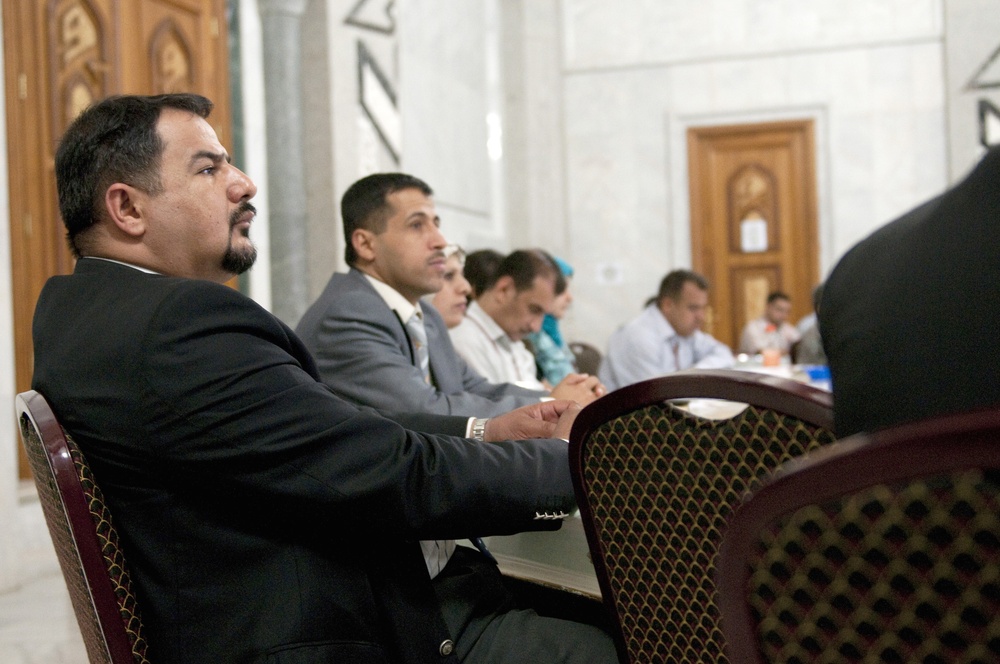
As part of the effort to secure a solid and stable economy for Iraq's future, the 15th Financial Management Company brought Iraqi bankers and business owners together June 1, to focus on the important role electronic funds transfer and modern core-banking systems play in strengthening the economy.
"One of the biggest things we're trying to do with the Iraqi banking system is to introduce more modern services, specifically electronic funds transfer and other services, like mobile banking," said Capt. Eric LaBay, from Broomfield, Colo., the banking and e-commerce officer for the 15th FMC, "The more we introduce modern banking services to Iraq, the more comfortable investors are going to be to invest money in Iraq and help grow the economy."
Hemin Qazi, from Nashville, Tenn., a project manager with the EFT Assistance Center, Task Force for Business and Stability Operations Banking and Financial Networks, says modern banking services help Iraqi businesses connect with vendors or companies from outside Iraq, who routinely use electronic means to make payments.
"It's crucial in that vendors link themselves with the international community," Qazi said. "There is more economic stability, there is more business and investment coming into Iraq and people are aware that there are banks that can do the job."
The effort to help Iraqi banks move toward modern banking systems, which has been ongoing since 2003, is making still more progress as U.S. forces reduce the amount of U.S. dollars issued in theater, in favor of the Iraqi dinar.
"One of the things that we're going to be doing is opening accounts with certain banks and cashing U.S. treasury checks for dinar, so that we can fund our finance offices," LaBay said.
He added that service members in Iraq are still able to get a limited amount of U.S. currency through their finance offices and at post or base exchanges.
According to Firas Obaid, a Baghdad native who works as an electronic funds transfer specialist with the EFT Assistance Center, a policy of using dinar instead of American dollars for electronic funds transfers directly to vendors' accounts also provides stability.
"It promotes confidence in the dinar" said Qazi, "This is Iraq. Iraqis should use their own currency. It was solid before; it's getting a lot better.
"Confidence is key in terms of helping grow the economy," LaBay said.
"Traditionally Iraqis have not trusted the banks," he said. "When they don't trust the banks they don't put their money in because they think they're going to lose it and not get it back."
According to Obaid, the secure transmission of funds makes people more willing to open accounts with banks. As accounts are opened, he said cash comes off the street and the money can then be used by banks to promote and establish businesses, which will help provide jobs.
LaBay says he is inspired by the willingness of the Iraqis to change and improve their systems.
"Every single one of the bankers that I work with today came through some very challenging situations to be here," he said. "That tells me they're very interested in growing their banks, which in turn will help the Iraqi economy.
"Regardless of what your idea of banking is, it's really the lifeblood of an economy," LaBay said. "And if we help create a strong economy, people will have jobs; People will be in a little bit better place than they are right now."
"With the enhancements in private and state banking, it's accelerating," Qazi said. "It's not going to happen overnight, but it is happening."
| Date Taken: |
06.01.2010 |
| Date Posted: |
06.06.2010 08:19 |
| Story ID: |
50934 |
| Location: |
CAMP VICTORY, IQ |
| Web Views: |
220 |
| Downloads: |
146 |
PUBLIC DOMAIN

This work, Modern banking key to Iraq's economic future, by SFC Roger Dey, identified by DVIDS, must comply with the restrictions shown on https://www.dvidshub.net/about/copyright.