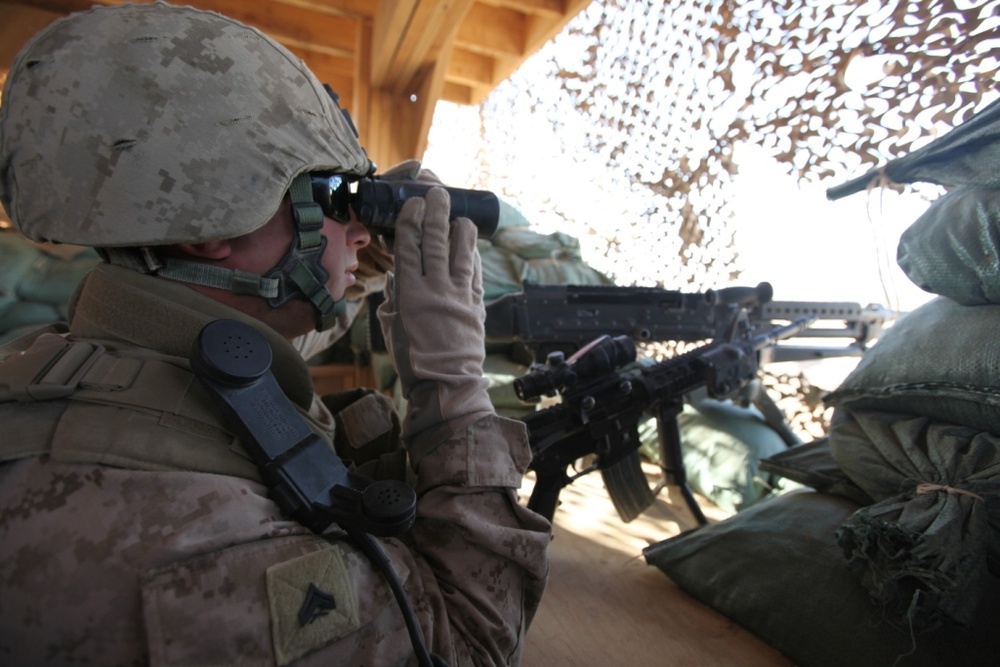
CAMP DELARAM II, Afghanistan — While the sun rises and sets over Camp Delaram II, Marines, sailors and civilians rest assured that the facility is under the watchful eye of a Marine on post.
Capt. Geoffrey Englund, Camp Delaram II Security Forces commanding officer, has continued to increase security conditions with a wide spectrum of interior, exterior and quick reaction forces on hand.
Second Low Altitude Air Defense Battalion has comprised the majority of this security unit, but many Marines from surrounding units such as Regimental Combat Team 2 and 1st Tanks have lent a hand when able.
According to Englund, his primary job is to organize the security force; setting up entry control points, multiple posts staggered around the perimeter, mobile patrolling units throughout the exterior and to maintain constant liaison with the reaction forces patiently standing by.
While preparing for this deployment, 2nd LAAD's original mission detailed multiple security units to be positioned amongst the numerous bases in RCT-2's area of operation. After changes were made, the mission focused solely on the security of newly-developed Camp Delaram II.
"The over-all mission remained the same," said Englund. "A number of my Marines have done multiple security force missions in Iraq, but this is our first security mission in Afghanistan."
The security of this base is comprised of many different components. While interior security includes tower security, as well as entry-control points, exterior security includes roving security patrols outside the perimeter, patrols through neighboring areas and a quick-reaction force.
Unlike most of the security positions, QRF has a variety of expectations set before them.
According to Sgt. Jarred Bluecoat, the non-commissioned officer in charge of the QRF, his group responds to any disturbance or call within a set parameter of the base.
"If the ECP needs man-power, if someone is spotted in on the perimeter, we respond," said Bluecoat.
Rotating on a 12-hour shift, QRF is always on stand-by awaiting any needs of the security unit, or base.
"As QRF, you need to know everything," said Bluecoat.
In the past, QRF has assisted in a variety of situations. Though needs may vary from detainee transportation, providing security for Marines in the battle space, or transporting local nationals who are in dire need of medical assistance to the base Regimental Aide Station, QRF is ready to respond.
According to Bluecoat, the best part of QRF is simply being a part of it.
"It wasn't what I trained for initially, but I am able to help," said Bluecoat. "I feel like I am contributing."
With an excess of previous experience in this department, 2nd LAAD has brought in Marines from supporting units and trained them in security tactics.
"As soon as we received augments, we did initial training," said Englund. "Every Marine is a rifleman, so the basics were there. We just had to get them thinking a little different."
According to Englund, his augments picked up fast on the mission requirements, but leadership was a key factor.
"It really came down to NCO leadership," said Englund. "Their leadership is really what makes or breaks a mission."
With a steady increase in base personnel, and an expanding perimeter, security continues to enhance as time goes on. Englund and his men have accepted the task of securing the base and look forward to months to come.

 Subscribe






