by Micheal E. Bigelow, INSCOM Command Historian
12 SEPTEMBER 1918
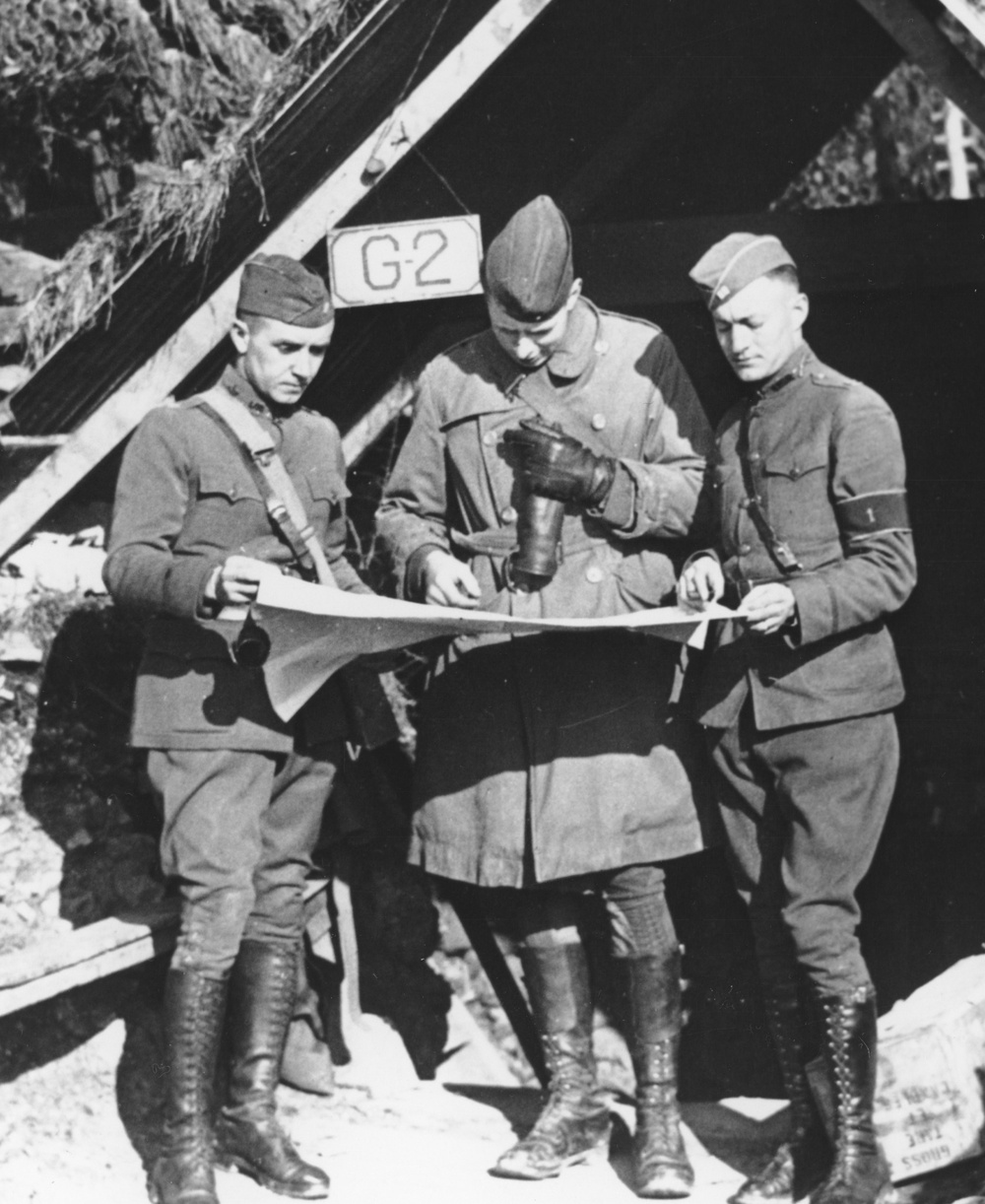
On 12 September 1918, the four infantry regiments of Maj. Gen. Charles Summerall’s 1st Division advanced against the German positions east of the French town of St. Mihiel. To assist its advance, Lt. Col. Thomas R. Gowenlock, the divisional G-2, had built a meaningful picture of the enemy and terrain facing the division and actively directed its intelligence system.
In early September, when he learned of his division’s mission and sector, Gowenlock—a 31-year-old Kansan—immediately set about gathering information on the German forces and the terrain they defended. He queried the French army headquarters that had occupied the sector for three years. For more up-to-date information, he visited his corps headquarters and, later, the American 89th Division, which was then occupying the sector. From the gathered information, he and his G-2 section prepared an extensive analysis of the enemy situation, including locations of artillery and machine gun positions. He concluded the Germans would not attack and would probably withdraw in case of attack. He also gave a general description of the topography supplemented with maps showing the significant terrain features.
Gowenlock, however, decided he needed more data on the Rupt de Mad, a large stream that ran diagonally across the sector. Without more information of the stream’s depth, width, and fording areas, its crossing could hold up the advancing riflemen’s first-day advance. So, he organized patrols across the stream’s frontage. Each patrol, consisting of experienced scouts, covered the ground assigned to its parent regiment. The scouts would then be able to lead the assault wave of the operation. On the night of 3 September, the G-2 himself accompanied one of the patrols to get a first-hand view of the important terrain feature. Over the next few days, more patrols probed other points of the Rupt de Mad. In the end, Summerall’s men knew where they could and could not cross.
As the regiments trained and rehearsed for the attack, Gowenlock coordinated his division’s intelligence assets. He directed the regimental and battalion S-2s to quickly move enemy prisoners to the division “POW cage” where they could be properly questioned. He also worked with the division’s signal battalion to emplace wire communications between the intelligence officers at the various command posts. As a backup, he provided runners to carry messages between command posts. Finally, the G-2 distributed maps showing enemy trench lines, machine gun nests, and artillery positions to every officer in the division.
On the day before the operation, Gowenlock arrived at the division command post in the ruined town of Beaumont. Early the next morning, he watched American and French artillery pound the German positions. He noted “it was fascinating…to see the fruits of our labors thus dramatically acted upon.” At 0500, the American soldiers began their attack behind the scouts Gowenlock had kept at the front after their patrols of the Rupt de Mad.
The scouts, now thoroughly familiar with the enemy terrain, led their regiments around remaining machine guns nests. Armed with information on fording sites, the division moved quickly over the Rupt de Mad. By mid-morning, hundreds of German prisoners were coming back to the divisional holding area. There, Gowenlock spent time listening to the interrogations. Useful tactical information he sent immediately to General Summerall and the regimental S-2s; he sent other information to his corps headquarters by special courier.
Within two days, the division reached its objectives and the battle was over. The intelligence Gowenlock provided played a role in the victory. With available information, he created an accurate template of the enemy situation that American artillery could use to target and neutralize. His patrols gathered invaluable data on the crossing sites over the Rupt de Mad, preventing undue delays. The decision to keep the scouts on the front also proved tactically astute. Finally, during the battle, he kept information moving through the intelligence chains to both higher and subordinate headquarters.
----
"This Week in MI History" publishes new issues each week. To report story errors, ask questions, or be added to our distribution list, please contact: TR-ICoE-Command-Historian@army.mil.
| Date Taken: |
09.11.2023 |
| Date Posted: |
09.11.2023 18:36 |
| Story ID: |
453200 |
| Location: |
US |
| Web Views: |
107 |
| Downloads: |
0 |
PUBLIC DOMAIN

This work, 1st Division G-2 Prepares For Offensive (12 SEP 1918), must comply with the restrictions shown on https://www.dvidshub.net/about/copyright.

 Subscribe





