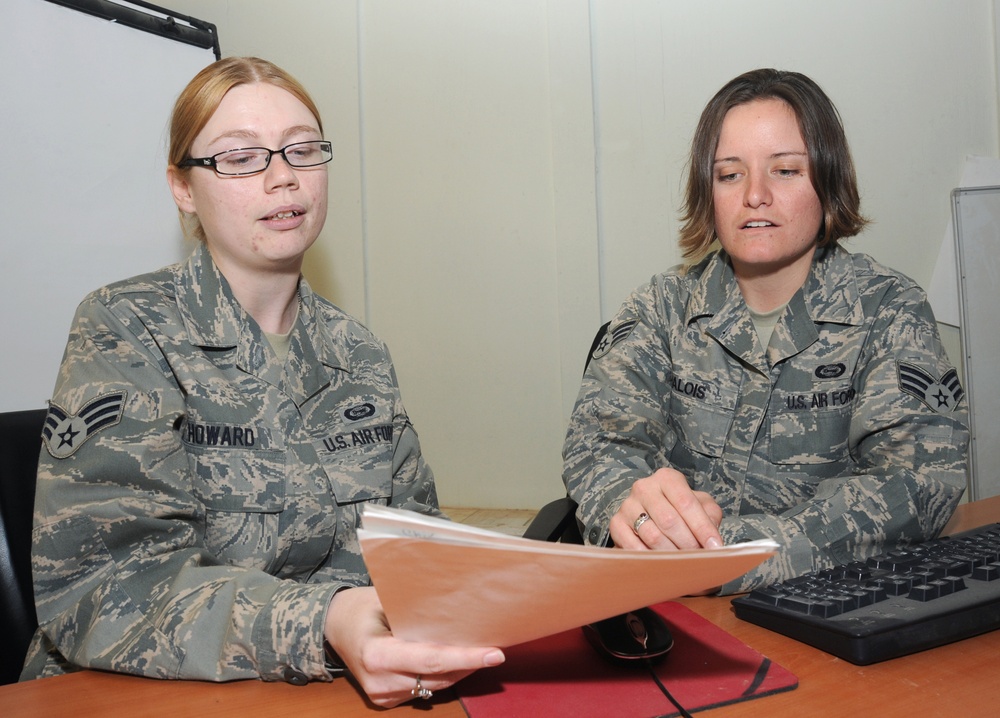
CAMP SLAYER, Iraq — Two U.S. Airmen deployed to Iraq work with several agencies to compile information that will ultimately help counter terrorism efforts.
Senior Airman Shai Howard, Defense Intelligence Agency analyst, and Senior Airman Sandra Valois, 732nd Expeditionary Intelligence Squadron terrorism analyst, work together daily to ensure countermeasure reports are factual before the information is forwarded to military leadership.
Valois may see 30 reports cross her desk every day, while Howard's section views close to 100 a day.
"Operations are based off of intelligence; everyone uses our information," said Valois, a native of Cambria, Calif. "We basically take information from other sources and figure out which terrorists are planning what and how to stop them. We gather all sources we can, figure out what they're doing and stop it the best we can."
Meanwhile, Howard's section has a slightly different purpose.
"We basically track and evaluate human reporting on a day to day basis," said Howard, who is deployed from Offutt Air Force Base, Neb. "We take it, look at it and coordinate through Senior Airman Valois' team and figure out whether or not it's reliable — we see who is telling us the truth. It's direct intelligence collection."
Both Airmen feel that human intelligence analysis is vital.
"They can give indicators," said Howard, who hails from South Warren, Mich. "That's the purpose -- to find out what the enemy is doing to counter it. The sources could be talking about weapons movement or leadership travel or changes. We can pull our sources and see what we can get. It's definitely a central source for targeting."
Valois, who is deployed from Fort Meade, Md., agrees.
"If you look at how Saddam was found, it was because someone came and told us, and that's basically what Airman Howard does," she said. "The human factor is essential in the whole intelligence game, it's a key part. We get information from human reporting that we may not get otherwise and we get opinions of our sources. That gives us a good idea of what's going on in the minds of the Iraqis we're talking to."
The Airmen understand how crucial their job is within the area of responsibility.
"I think it has an impact," Valois said. "Intelligence in this point in the game is our greatest weapon. We don't need boots on the ground or fire fights — we need to try to figure out what they're planning and figure out how to stop it. And, on top of that, building the Iraqi's intelligence capabilities so they can take over when we leave."
Although there aren't Iraqi airmen currently training within their offices, both Airmen say they are very confident in the Iraqi's capabilities based off their previous successes. Also, they are proud of their own accomplishments.
"At this point I'm emotionally invested," Valois said. "I think our work is making a difference -- and it's the key to getting us out of here and this country standing on its own and remaining a good bilateral partner after we leave."