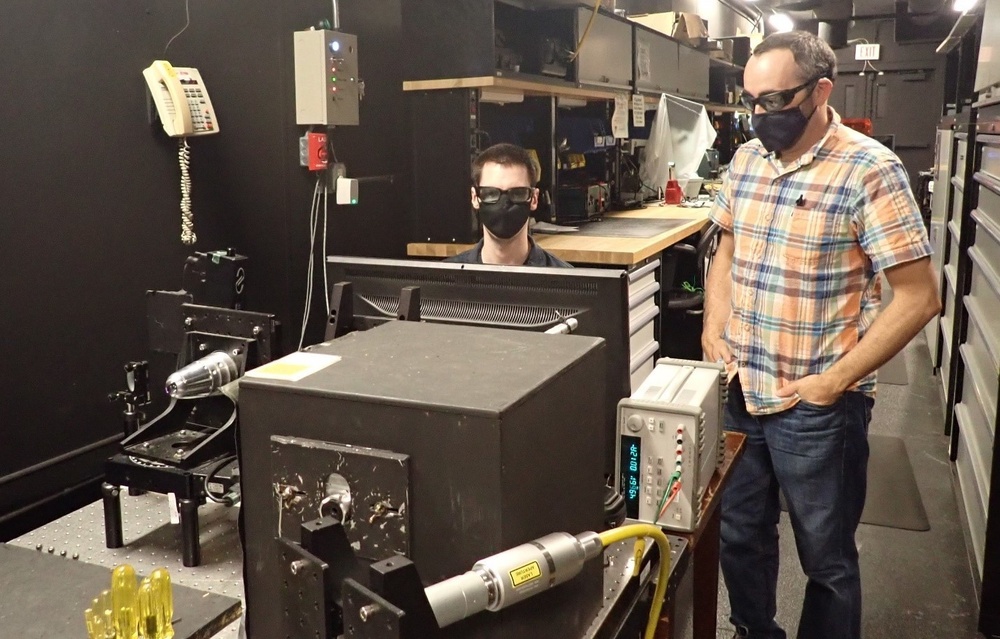
Engineers at NSWC Dahlgren Division have developed a new, lower-in-cost, semi-active laser (SAL) seeker.
SAL seekers are a key enabling technology for guided munitions that allow warfighters to target stationary and moving targets in areas where GPS is unavailable.
SAL seekers function in tandem with an operator that directs a pulsing, infrared laser at targets. The seeker, typically in the nose of laser-guided munitions, detects the laser energy reflecting off the target and guides the munition to the operator’s mark with high precision. This partnership assures that the correct target is engaged.
The seeker developed by engineers at Dahlgren Division is smaller, three-to-five times cheaper than comparable laser seekers, and is based on modern electronics designs not only to ensure relevance, but also to improve performance and implement the next generation of signal processing and countermeasures. As precision weapons requirements continue to expand, the design is ready to support integration with imager systems. The upgraded terminal seekers will be instrumental in the development of future guided munition systems.
“In response to the shift in force design, warfighting function and the trends going forward, we’re technologically pivoting to stay ahead of the game,” said program manager for the Enhanced Expeditionary Engagement Capability program Luke Steelman.
Traditional SAL seeker systems use a gimbaled detector element to track the laser spot as it moves relative to the weapon. Engineers at Dahlgren were able to develop a new combination of fixed optics and software algorithms to replicate the capability without the need for those expensive and sensitive moving parts. This has not only led to a smaller and more cost-effective product, but also one that is instrumental in ensuring compatibility with the next generation of system currently under development.
What’s more, the new seeker design also includes an integrated height-of-burst sensor that is able to measure proximity to the ground and signal the weapon’s fuze to create a very precise airburst function without the need of an additional sensor on the guided munition, further saving space and reducing cost.
Dahlgren has produced more than 50 prototypes, 30 of which have been live-fire tested on multiple weapon systems—including the 81-mm Advanced Capability Extended Range Mortar (ACERM)—and successfully guided systems to stationary and moving targets.
Michael St. Vincent, project lead engineer, said that direct feedback from warfighters was critical to the successful development process.
“We would get feedback from warfighters—what kind of targets they are targeting, what they are like, and also what requirements they need to meet,” said St. Vincent. “If they needed more range or more field of view . . . we would do simulations and make some changes and new iterations that moved closer to what they want.”
Dahlgren has long had a hand in terminal seeker technology, but in recent years the focus of the warfighting function has moved to exceedingly longer-range engagements. These long-range engagements keep warfighters and targeting assets far away from adversaries, but often preclude the use of laser-guided munitions.
Despite increasing engagement distances, Steelman says that laser-guided munitions that use the SAL seeker will always be a mainstay in warfighters’ toolboxes for one reason: target assurance.
“If the operator is putting a dot on a target, he is telling me ‘this is your target, not the one to the left, not the one to the right, that one,’” St. Vincent noted. “Laser guidance will always provide that 99.99-percent assurance that a specific truck or boat is your target.”
| Date Taken: |
04.06.2022 |
| Date Posted: |
04.19.2022 20:08 |
| Story ID: |
418796 |
| Location: |
DAHLGREN, VIRGINIA, US |
| Web Views: |
68 |
| Downloads: |
0 |
PUBLIC DOMAIN

This work, NSWC Dahlgren Division Engineers Develop Modernized Low-Cost SAL Seeker, must comply with the restrictions shown on https://www.dvidshub.net/about/copyright.

 Subscribe





