FORT CAMPBELL, Ky. — The mission was simple in nature, as Soldiers were sent out to conduct a "tactical call out" procedure, which offers insurgents forces the opportunity to surrender without any shots ever being fired.
They were briefed there was a chance of a low-intensity fight, with minimal chance of enemy resistance. However, they were also told that sometimes the insurgent they were looking for often visits with one of the unit's high-value targets. If this were the case, they would know right away and the intensity of the fight would escalate. They knew there would be a trigger to the upscale in violence.
And that's exactly what happened. While moving toward their objective, Soldiers from 4th Platoon, Company D, 2nd Battalion, 502nd Infantry Regiment, were engaged by a rocket-propelled grenade team. Immediately they eliminated the threat.
"Once we noticed that activity, we knew were dealing with an HVT," said 2nd Lt. Kyle Snook, platoon leader, 4th Platoon, Co. D.
Their mission now changed; they were now dealing with a time-sensitive target and knew quickness and efficiency would be key to capturing this wanted individual.
"Once you hit that point you are more in a high-intensity fight situation so you change your tactics and procedures," said Snook. "So we decided to dismount our vehicles and move into a mounted/dismounted fight."
While the vehicles cleared the roadways, the dismounted elements cleared the wooded area around the roads, because they knew the enemy combatants would want to eliminate their best asset — their vehicles.
So they needed to clear the area of insurgent forces first while on foot. They were able to accurately use support by fire positions and assaulting positions and ultimately assault a village and set up a counter attack.
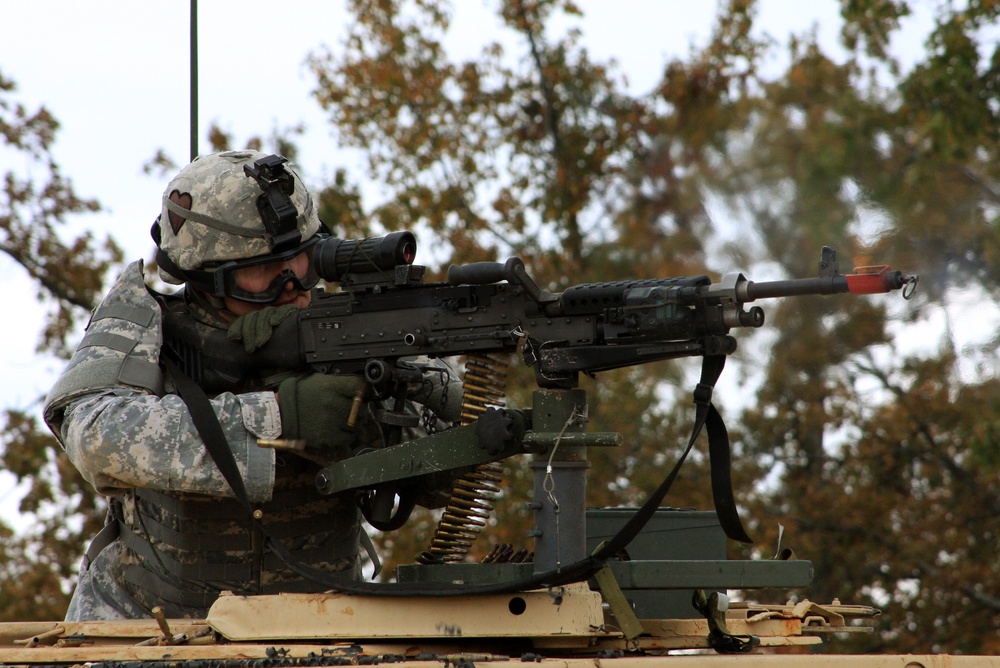
This scenario described above was one Soldier's from Company D acted out on a numerous of occasions during Eagle Flight II live-fire training exercises Oct. 23-26.
According to the company commander, Capt. Mike Miller, the training provides leadership confidence in their abilities to employ dismounted and mounted elements in combat.
Controlling the movement of the vehicles gives leaders the confidence to effectively maintain constant communication with the elements on the ground and control the rates of fire of their gunners in the turret, said Miller. Simultaneously it allows the ground forces to properly control their men, and lift and shift fires while moving toward their objective.
For the Soldiers, "it shows the platoon their leadership is confident and well-trained in being able to implement all that and bring them home safely."
Being able to effectively control mounted and dismounted forces is becoming ever more crucial in modern warfare, because, "you want to be able to get each element into the fight effectively," said Miller. "Your mounted element is nearly like your dismounted element because you have to be able to control it and move it precisely."
Snook believes this training was very crucial as they were given the opportunity to move, shoot and communicate with live-rounds.
"It allows me to work on controlling multiple assets with the mounted and dismounted elements," said Snook. "For the squad leader, it allows them to control their assets at the same level either mounted or dismounted and it allows them real-time feedback with live-fire ammunition while moving and the different stresses that puts on you.
With all combat operations, there are difficulties and dangers that come with the job; however, through this training they are learning to quell those indifferences and create a platoon capable of fighting any battle.
"It becomes a dangerous situation. People sometimes are easy to control in the sense that you can see them and they can only move so fast," said Snook. "But when you are dealing with vehicles these are large pieces of equipment that can move really fast and the weapons mounted to them are that much more powerful. It's a lot harder to communicate person to vehicle. [It has] to be that much more accurate and that much more known."
All have to be done safely and accurately while simultaneously destroying the enemy.
Being a heavy-weapons company, their traditional role in combat is eliminating anti-armor threats on the ground and conducting screening operations, so being able to properly employ dismounted forces offers them a great deal of balance while in combat.
"It shows we're not a solely mounted force," Miller said. "We can dismount, we can do the same techniques, we just may not have the same amount of dismounts on the ground."
There's a lot Snook learned about his platoon during this training exercise. Though many are new to operations such as this, the knowledge and proficiency his men gained is ultimately critical in decisively engaging and eliminating enemy forces.
"While it's difficult for a platoon of our size to fight a situation made for a regular infantry-size platoon, our guys seem to still muster the motivation and the ability to do so," said Snook.
In the end, all one could hope for was a better, well-trained platoon capable of fighting any type of battle their country asks them to do whether mounted or dismounted in an urban or rural environment, said Snook.
| Date Taken: |
11.04.2009 |
| Date Posted: |
11.04.2009 16:12 |
| Story ID: |
41096 |
| Location: |
FORT CAMPBELL, US |
| Web Views: |
286 |
| Downloads: |
249 |
PUBLIC DOMAIN

This work, Strike platoon's become efficient during live-fire exercises, by SSG James Hunter, identified by DVIDS, must comply with the restrictions shown on https://www.dvidshub.net/about/copyright.

 Subscribe






