JOINT BASE BALAD, Iraq -- The Air Force Theater Hospital here is one of a kind, and the staff can treat a wide variety of conditions.
But when patients need care beyond what the AFTH provides, the contingency aeromedical staging facility steps in and ships them out -- fast -- usually to Landstuhl Regional Medical Center in Germany.
"Our main mission is to bring patients in [from locations throughout Iraq and Afghanistan] and ensure they are stabilized, their medication is correct for flight, and their pain is under control so we can get them on planes and out to their next location," said Maj. Julianna Olson, 332nd Expeditionary Aeromedical Squadron clinical nurse at the CASF. "It can be as quick as 'tail to tail' for some of our critically wounded -- where a plane comes in from a [forward operating base], we unload them into an ambulance and move them to another plane on the runway to take off to Germany.
"The average time is 48 hours or less for our more stable patients."
Patients, both military and civilian, are brought to JBB from FOBs by one of two methods: They may come via an Air Force aircraft, if the patient can be transported to a location with a usable runway, or by Army helicopter, which can pick up patients directly at the point of injury.
"We get contacted by nine-line [medical evacuation request] and are told where to go and pick up our guy," said Chief Warrant Officer Scott Anderson, Charlie Company, 7th Battalion, 158th Aviation pilot in command. "Depending on their immediate needs, we may take them to the nearest hospital for care. If they are stable enough for the flight, we bring them back [to the AFTH]."
Depending on the urgency of treatment, hospital staff ushers the patients to either the CASF or the AFTH emergency room.
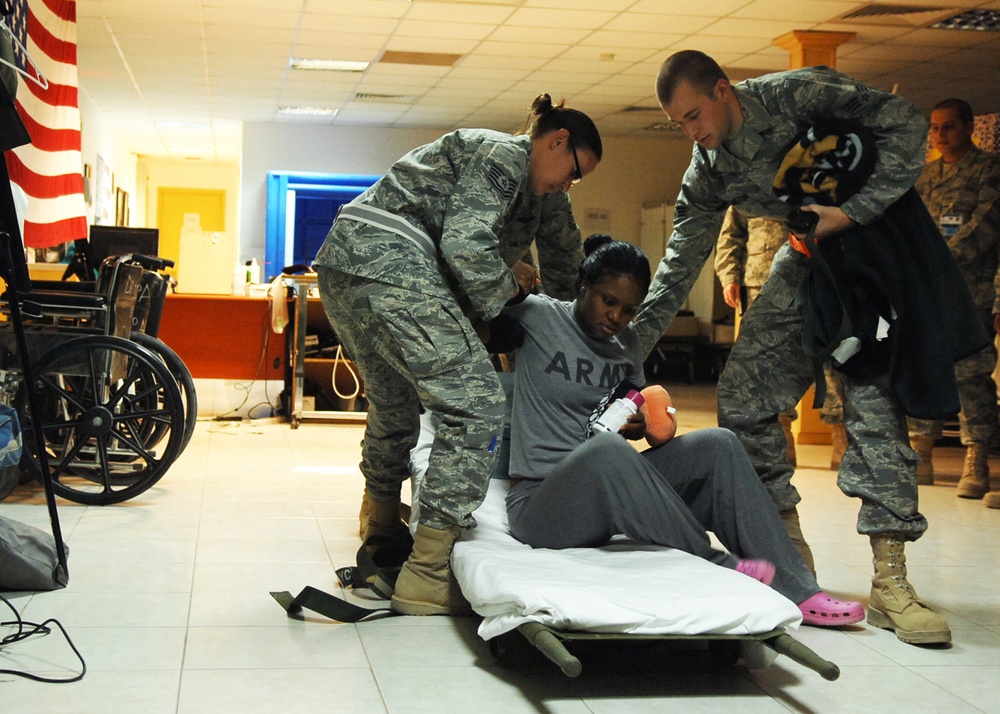
At the CASF, medical professionals assess and stabilize the patients, then make them comfortable and prepared for the transfer to their next echelon of treatment. Part of the preparation includes deciding whether patients are able to withstand the altitude of flying based on their injuries.
After being cleared to fly, the CASF ensures any patient discomfort, both physical and emotional, is eased for the upcoming flight.
"An area of concern for us is patient comfort," said Olson, whose home station is St. Paul Air Reserve Station in Minneapolis, Minn. "Pain can increase two to threefold on ascent and descent, so it's very important that we address pain management while we have our patients here. We also talk to the patient about this so there are no surprises when they're in the air. We explain to them the stressors to expect during the flight as well as what to expect when they get to Germany or wherever they are going."
She added that the medical equipment used must also be prepared for flight as well, since the change in pressure plays a role in the effectiveness.
When they're ready to go, CASF staff loads the patients and their gear onto their next transport vehicle. That's when they turn patient care over to the aircraft's aeromedical evacuation crew.
"We have some pretty rock star teams [here at the CASF]," said Olson. "It's like watching kind of a chaotic ballet. But, everyone knows exactly where to be, when and what to do in order to keep the patient safe, keep them comfortable and get them loaded and unloaded."
| Date Taken: |
09.18.2009 |
| Date Posted: |
09.18.2009 08:23 |
| Story ID: |
38956 |
| Location: |
BALAD, IQ |
| Web Views: |
416 |
| Downloads: |
249 |
PUBLIC DOMAIN

This work, CASF role crucial for injured patient transport, by Andria Allmond, identified by DVIDS, must comply with the restrictions shown on https://www.dvidshub.net/about/copyright.

 Subscribe






