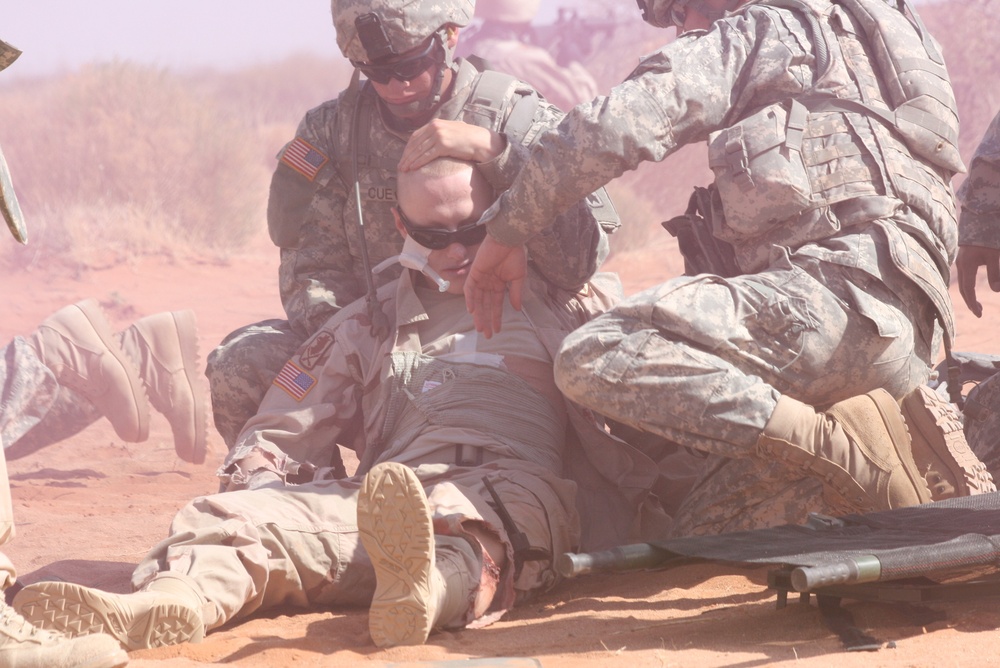
MCGREGOR RANGE, N.M. — Despite the heavy smoke and loud blasts from simulated artillery rounds, Soldiers from C Troop, 1st Squadron, 105th Cavalry Regiment, 32nd Infantry Brigade Combat Team, administered fluids into the veins of simulated casualties, controlled their bleeding, and treated their wounds and fractures during a casualty-recovery exercise April 22.
"I think [the exercise] is very important because you have different people who learn different ways," said Sgt. Jesse Wanta, assigned to C Troop, 1-105th Cav. "The majority [of combat lifesaver training] is classroom, which everybody can get a handle on it, but there are those people who need a hands-on experience to really get a full effect of what they're doing."
The Guardsmen received 40 hours of classroom instruction before engaging in the capstone exercise where they evaluated themselves as to how they applied their skills, said Sgt. 1st Class Robert Williams, a medical instructor with 5th Armored Brigade. The event simulated battlefield conditions in the theater of operations with the use of artillery simulators and smoke grenades.
"We can't recreate Iraq here on Fort Bliss," said Williams. "All we can do is hopefully add some stress to it and hope that [Soldiers] take from that stress and have felt that before when they actually get into a real situation and need to apply the combat lifesaver skills that they've learned here."
Soldiers learned various intervention techniques including managing an airway, repairing a tension pneumothorax through chest decompression and controlling bleeding.
"No Soldier should ever die from a bleeding extremity — not with the use of tourniquets and all the new wiz-bang gizmos the Army's given us," said Williams.
Williams said the intervention methods taught in the CLS course have proven effective and have helped save lives down range. He said the decrease in the number of deaths in Iraq and Afghanistan is attributable to the CLS course. Evidence-based medicine is part of the CLS program of instruction. The number of casualties versus the interventions applied to them is used to determine the success rate of survivability, said Williams. If a particular intervention helped save lives, then it is added to the CLS class, he said.
"Rapid intervention, controlling of bleeding at the point of injury, controlling of airways at the point of injury — there's a very limited number of medics to go around, so we need combat lifesavers there right at the point of injury when a Soldier's injured, so they can stop [the] bleeding and save that life on the spot," said Williams.
Pfc. Nathan Block from C Troop, 1-105th Cav., said the CLS training was significantly more intense than the one he underwent during his first deployment a few years ago. Block said the simulated combat exercise here addressed the learning styles of those who prefer instruction outside a traditional classroom environment.
"I'm more of a hands-on person, so like reading and listening to instructors talk doesn't really get to me," said Block. "Out here is where I get it."
| Date Taken: |
05.11.2009 |
| Date Posted: |
05.11.2009 14:17 |
| Story ID: |
33471 |
| Location: |
MCGREGOR RANGE, US |
| Web Views: |
280 |
| Downloads: |
247 |
PUBLIC DOMAIN

This work, Soldiers use combat lifesaving skills during casualty-recovery exercise, by LTC Deanna Bague, identified by DVIDS, must comply with the restrictions shown on https://www.dvidshub.net/about/copyright.

 Subscribe






